The Builders of Nan Madol: Lost People
The stone city of Nan Madol rises from the Pacific’s waters like a forgotten dream. Its builders, the Saudeleur dynasty, vanished without explanation around 1628 CE, leaving behind ninety-two artificial islands connected by basalt corridors. They’d ruled Pohnpei for five centuries, yet no one knows where they went. Local legends whisper of sorcery and divine retribution, but the truth remains submerged beneath centuries of silence.
Introduction
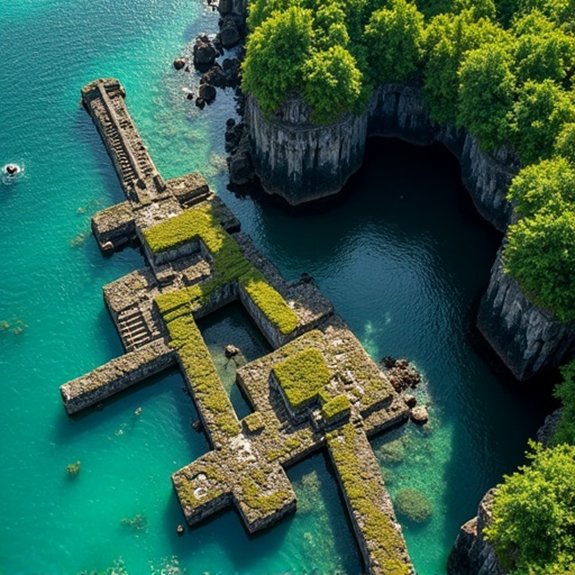
Mystery shrouds the ancient stone city that rises from the Pacific Ocean near Pohnpei, Micronesia. Nan Madol’s massive basalt columns and artificial islands have puzzled archaeologists for centuries. Who built this engineering marvel, and why did they abandon it?
The site spans 92 artificial islands connected by canals, earning its nickname “Venice of the Pacific.” Construction began around 1200 CE, though local legends suggest earlier origins. The Saudeleur dynasty ruled from these stone halls until their mysterious disappearance around 1628.
Today’s Pohnpeians call themselves descendants of the builders, but oral histories conflict. Some stories speak of foreign architects who arrived with advanced knowledge. Others claim divine intervention. The truth remains buried beneath centuries of coral growth and tropical storms that’ve weathered the megalithic structures.
Ancient Saudeleur Dynasty Emergence
While legends trace the Saudeleur dynasty‘s origins to twin sorcerers who descended from the clouds, archaeological evidence points to a gradual consolidation of power around 1100 CE. The Saudeleurs emerged from competing Pohnpeian clans, establishing themselves as divine rulers who controlled the island’s resources and trade networks. They’d unified the previously fragmented chiefdoms through strategic alliances and religious authority.
Their rise coincided with increased construction at Nan Madol, transforming the site from scattered ceremonial platforms into an elaborate administrative center. The dynasty’s founders instituted a tributary system that demanded regular offerings from outlying districts. This centralized control enabled them to mobilize the massive labor force needed for Nan Madol’s construction. By 1200 CE, the Saudeleurs had created Micronesia’s first organized state, ruling from their artificial island capital.
Notable Cases or Sightings

The Saudeleur dynasty’s mysterious disappearance around 1628 CE has sparked centuries of speculation, with early European explorers documenting strange phenomena at the abandoned site. Captain James O’Connell reported seeing unexplained lights moving between the basalt columns during his 1828 visit. German ethnographer Paul Hambruch recorded local accounts of ghostly figures wearing ancient ceremonial dress appearing at dawn near the main temple complex.
In 1907, archaeologist F.W. Christian described hearing rhythmic drumming from empty chambers, though he couldn’t locate the source. Modern visitors’ve reported similar experiences, including Japanese researcher Masao Hadley who photographed unexplained shadows in 1985 that didn’t match surrounding structures. Local Pohnpeians still avoid certain areas after dark, claiming they’ve witnessed processions of silent figures walking the ancient causeways, disappearing when approached.
Common Theories or Explanations
Although mainstream archaeologists attribute Nan Madol’s construction to the Saudeleur dynasty using traditional Micronesian engineering methods, alternative researchers’ve proposed several competing theories about the site’s origins. Some claim the megalithic complex was built by survivors of Lemuria or Mu, citing local legends about giants who levitated the massive basalt columns into place. Others suggest extraterrestrial involvement, pointing to the site’s precise astronomical alignments and the difficulty of transporting 750,000 metric tons of stone.
Acoustic levitation theory’s gained traction among fringe historians who believe ancient peoples possessed lost sound-based technologies. They argue the builders used specific frequencies to move the enormous blocks. Another hypothesis connects Nan Madol to pre-Columbian trans-Pacific voyagers, proposing advanced maritime civilizations constructed similar sites across Oceania before vanishing mysteriously.
Frequently Asked Questions
What Tools and Construction Techniques Did the Builders Use to Transport the Basalt Columns?
The builders likely used wooden rollers, rafts, and ropes to transport massive basalt columns from quarries. They’d have leveraged tides, created log pathways, and employed coordinated human labor to move these multi-ton stones.
How Many People Lived at Nan Madol During Its Peak Occupation Period?
Archaeologists estimate that 500 to 1,000 people lived at Nan Madol during its peak between 1200-1600 CE. The elite ruling class and priests occupied the stone structures while commoners likely lived in wooden buildings nearby.
What Specific Religious or Ceremonial Practices Took Place Within the Stone Structures?
Priests conducted ritual ceremonies honoring ancestral spirits and sea deities within Nan Madol’s stone structures. They performed sacred eel feeding rituals, made offerings at altars, and carried out burial rites for the Saudeleur dynasty’s rulers.
Are There Similar Megalithic Sites Elsewhere in Micronesia or the Pacific Region?
Yes, Micronesia’s Lelu on Kosrae features similar basalt construction. Polynesia’s Easter Island moai and Tonga’s Ha’amonga trilithon represent comparable megalithic achievements. These Pacific sites share mysterious construction techniques that still puzzle today’s archaeologists.
What Preservation Efforts Are Currently Underway to Protect the Ruins From Erosion?
UNESCO’s monitoring Nan Madol’s structural integrity while local authorities implement vegetation control programs. International teams’re conducting digital mapping projects, and Japan’s funding seawall repairs. They’ve established restricted access zones to minimize visitor damage to vulnerable sections.

The Subterranean Temples of China

The Mystery of the Phaistos Disc

Forgotten Explorers Who Changed History
About The Author
