The Prehistoric City Beneath the Amazon
Scientists have uncovered a massive prehistoric metropolis beneath Bolivia’s Amazon rainforest, where the Casarabe culture thrived over two thousand years ago. They’ve mapped extensive networks of canals, earthen pyramids, and sophisticated urban infrastructure using Lidar technology. The discovery’s most intriguing element isn’t just the city’s size—it’s the engineered soil that made such large-scale settlements possible in what many considered an impossible environment.
Introduction
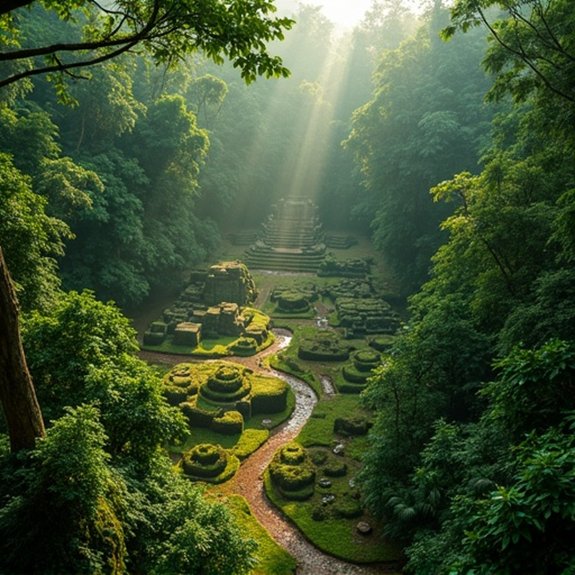
How did an ancient metropolis remain hidden beneath the world’s largest rainforest for over two millennia? Deep within Bolivia’s Llanos de Mojos region, archaeologists’ve uncovered a sprawling prehistoric settlement that’s rewriting history. The dense Amazon canopy concealed massive earthworks, canals, and pyramids built by the Casarabe culture between 500 and 1400 CE.
Lidar technology pierced through the jungle’s thick vegetation, revealing what ground surveys couldn’t detect. Scientists discovered 26 interconnected sites spanning 4,500 square kilometers. The urban network features sophisticated water management systems, raised agricultural fields, and monumental architecture rivaling any ancient civilization.
This discovery challenges the notion that the Amazon couldn’t support large populations. The Casarabe people engineered their landscape, creating a sustainable metropolis that thrived for nearly a thousand years before mysteriously vanishing.
Ancient Soil Engineering Discoveries
When researchers analyzed the soil composition around the Casarabe settlements, they discovered terra preta—an engineered “super soil” that’s retained its fertility for centuries. This dark, carbon-rich earth wasn’t naturally occurring. The ancient inhabitants had deliberately mixed charcoal, bone fragments, pottery shards, and organic waste into the typically nutrient-poor Amazonian soil.
Scientists found these modified soils extending several feet deep across vast agricultural zones. The terra preta’s unique composition allows it to regenerate nutrients and retain moisture far better than surrounding soils. Carbon dating revealed the oldest deposits date back over 2,000 years. This discovery proves the Casarabe people weren’t just skilled builders—they’d mastered sustainable agriculture through advanced soil chemistry. Their techniques supported dense populations in what’s now considered unsuitable farmland.
Notable Cases or Sightings
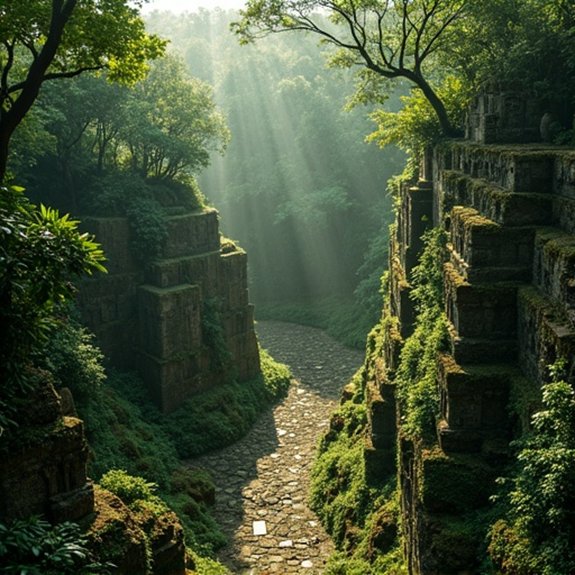
The terra preta discoveries weren’t the only remarkable finds that emerged from the Casarabe excavations. Archaeologists uncovered massive earthen pyramids reaching 70 feet in height, connected by raised causeways stretching for miles through the forest. LiDAR technology revealed over 26 unique settlement sites, each featuring complex water management systems with reservoirs and canals.
The team’s most striking discovery came when they identified U-shaped structures surrounding central plazas, suggesting ceremonial or administrative purposes. These platforms, some measuring 500 feet in length, challenged previous assumptions about Amazonian societies’ architectural capabilities. Carbon dating placed the settlements between 500 and 1400 CE, with population estimates reaching 10,000 inhabitants per site. The findings proved that pre-Columbian Amazonians didn’t just adapt to their environment—they transformed it completely.
Common Theories or Explanations
Researchers have proposed several compelling theories to explain how ancient Amazonians built such sophisticated cities in what’s now dense rainforest. They suggest these civilizations mastered terra preta, an engineered super-soil that transformed poor jungle earth into fertile farmland. This innovation could’ve supported populations reaching 50,000 people per settlement.
Archaeologists believe extensive canal systems connected cities, enabling trade networks spanning thousands of miles. They’ve found evidence of advanced water management, including reservoirs and irrigation channels that survived centuries of abandonment.
Climate data indicates the Amazon was drier during these cities’ peak, making large-scale construction more feasible. Some experts argue that indigenous peoples deliberately shaped the forest itself, cultivating useful trees and creating “forest islands” that served as managed agricultural zones around urban centers.
Frequently Asked Questions
Can Tourists Visit the Prehistoric City Site Today?
Tourists can’t visit the prehistoric city sites beneath the Amazon today. They’re located in dense, protected rainforest areas that aren’t accessible to the public. Researchers continue studying these ancient settlements using remote sensing technology instead.
What Modern Technology Is Used to Study the Underground Structures?
Scientists use LiDAR technology to map underground structures, sending laser pulses through the forest canopy. They’ve combined ground-penetrating radar with satellite imaging and magnetometry to detect buried walls, roads, and earthworks without excavation.
How Much Would a Full Excavation of the Site Cost?
Archaeologists haven’t estimated the full excavation cost for the prehistoric Amazonian sites. They’d likely need hundreds of millions of dollars given the vast area, dense jungle conditions, and years of careful work required for proper documentation.
Are There Any Ongoing Archaeological Digs Accepting Volunteers?
Several archaeological projects in the Amazon region accept volunteers through organizations like Earthwatch and local universities. They’d need to check specific programs’ current status, as availability changes seasonally and depends on funding and permits.
Which Museums Display Artifacts From the Prehistoric Amazon City?
No museums currently display artifacts from a prehistoric Amazon city because archaeologists haven’t discovered such a site. They’ve found ancient earthworks and settlements, but nothing matching the description of a prehistoric city beneath the Amazon.



About The Author
