The Nazca Lines: Power Grid or Message?
The massive geometric patterns etched across Peru’s desert plateau shouldn’t exist. Yet there they are—hundreds of lines and shapes the Nazca people created two thousand years ago, visible only from heights they couldn’t reach. Some researchers claim they’ve found evidence of an ancient energy network. Others insist they’re sacred messages to the gods. The truth behind these mysterious formations might challenge everything archaeologists think they know about pre-Columbian technology.
Introduction
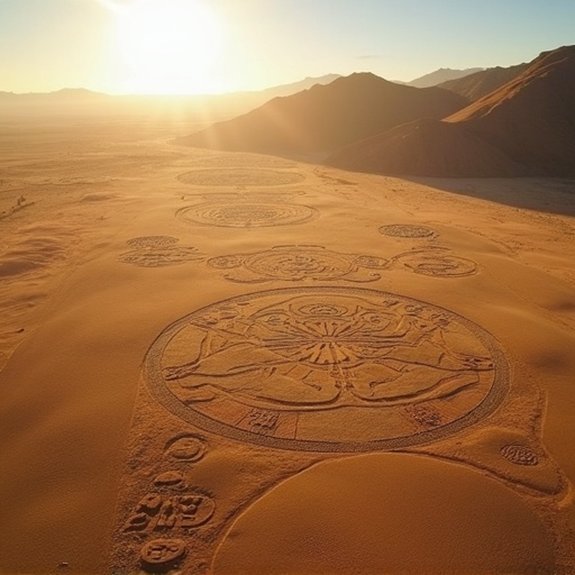
When travelers fly over Peru’s arid Nazca Desert, they’re confronted with one of archaeology’s most perplexing mysteries: hundreds of enormous geometric patterns and animal figures etched into the earth’s surface over 2,000 years ago. The Nazca Lines span nearly 200 square miles, featuring designs of spiders, hummingbirds, monkeys, and perfectly straight lines stretching for miles. Created by the Nazca civilization between 200 BCE and 600 CE, these geoglyphs have sparked intense debate among researchers. Some theorists propose they’re remnants of an ancient power grid system that channeled Earth’s electromagnetic energy. Others argue they’re astronomical calendars or messages to sky gods. The lines’ scale and precision challenge conventional understanding of ancient capabilities, as many designs can’t be fully appreciated without aerial observation.
Ancient Nazca Civilization’s Creation
The Nazca people developed their remarkable line-making technique through surprisingly simple yet effective methods. They’d remove the reddish-brown iron oxide-coated pebbles covering the desert surface, revealing the light-colored earth underneath. Workers used wooden stakes, ropes, and basic surveying tools to maintain straight lines across vast distances. They didn’t need complex technology—just careful planning and coordinated effort.
Archaeological evidence shows they created these geoglyphs between 500 BCE and 500 CE. The civilization’s artists scaled up small designs using grid systems, transferring patterns from textiles and pottery onto the desert floor. They’ve preserved remarkably well due to the region’s minimal rainfall, lack of wind, and stable climate. The Nazca’s engineering precision remains impressive, with some lines deviating less than two meters over several kilometers.
Notable Cases or Sightings
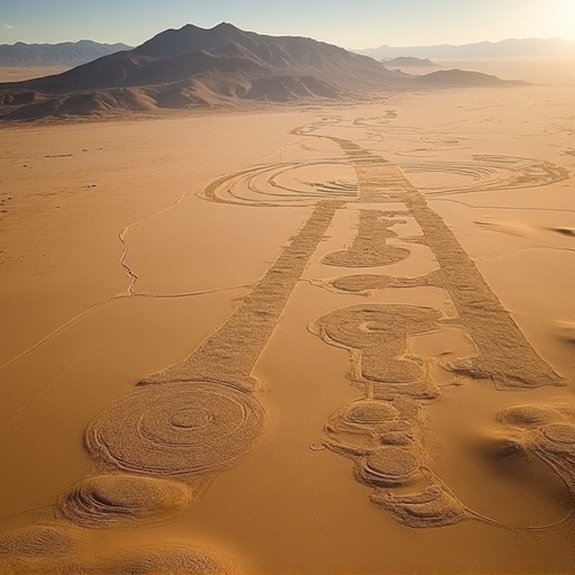
Maria Reiche, a German mathematician who dedicated her life to studying the lines, documented over 1,000 individual geoglyphs during her five decades of research. She’s identified numerous animal figures, including a 93-meter monkey, a 135-meter condor, and a spider spanning 46 meters. In 1994, researchers discovered previously unknown figures using satellite technology, revealing faint lines invisible from ground level.
Pilots have reported seeing new geoglyphs after sandstorms clear surface debris. In 2019, Japanese researchers using AI analysis found 143 new designs, including humanoid figures and two-headed snakes. Local guides’ve witnessed tourists accidentally uncovering partial lines while hiking off designated paths. Archaeological teams continue finding smaller geometric patterns between the major figures, suggesting the site’s more extensive than originally thought.
Common Theories or Explanations
Although mainstream archaeologists attribute the Nazca Lines to pre-Columbian civilizations performing religious rituals, alternative researchers’ve proposed they’re remnants of an ancient power distribution network. They suggest the geometric patterns and straight lines functioned as energy conductors, channeling electromagnetic forces across Peru’s desert plateau. Some theorists believe extraterrestrials created these designs as landing strips or navigation markers for spacecraft. Others argue they’re star maps encoding astronomical knowledge far beyond the Nazca culture’s supposed capabilities.
Another theory posits the lines served as communication beacons, transmitting messages through vibrational frequencies to distant civilizations. Proponents cite the lines’ precise mathematical alignments and their visibility only from extreme heights as evidence of advanced technology. They claim conventional archaeology can’t explain why ancient peoples invested enormous resources creating images invisible from ground level.
Frequently Asked Questions
Can Tourists Visit the Nazca Lines Today?
Yes, tourists can visit the Nazca Lines today. They’ll typically take small aircraft tours from nearby airports for aerial views, since the massive geoglyphs are best seen from above. Ground observation towers also exist.
How Much Does It Cost to See the Nazca Lines?
Flights over the Nazca Lines typically cost $80-150 per person for 30-minute tours. Visitors can also climb the observation tower for about $3, though it doesn’t provide views of all the geoglyphs like aerial tours do.
What Is the Best Time of Year to View Them?
The best time to view the Nazca Lines is during Peru’s dry season from May to October. Visitors’ll find clearer skies and better visibility during these months, especially in morning hours when winds are calmer.
Are There Any Restrictions on Flying Over the Lines?
Yes, Peru’s government restricts flights over the Nazca Lines. Pilots must follow designated flight paths, maintain specific altitudes, and can’t fly before sunrise or after sunset. Tour companies need special permits to operate these flights.
How Are the Nazca Lines Being Preserved From Damage?
Peru’s government restricts tourist access to designated viewing platforms and walking paths. They’ve installed surveillance systems, employ guards, and prohibit vehicles from entering protected zones. UNESCO monitoring and regular maintenance help prevent erosion damage.

The Hidden Tunnels of Teotihuacan

Is There Proof of Ancient High Technology?

The Flood Myth: Variations Worldwide
About The Author
