The Lost Kingdom Beneath the Sea
The ocean’s depths conceal stories that’ve haunted civilizations for millennia. Ancient texts describe magnificent kingdoms swallowed whole by vengeful seas, their advanced societies vanishing in catastrophic moments. Modern sonar equipment occasionally detects anomalous structures on the seafloor, fueling speculation about what lies beneath. Scientists and explorers continue searching for evidence of these legendary territories, but the ocean guards its secrets well. Something waits down there in the darkness.
Introduction
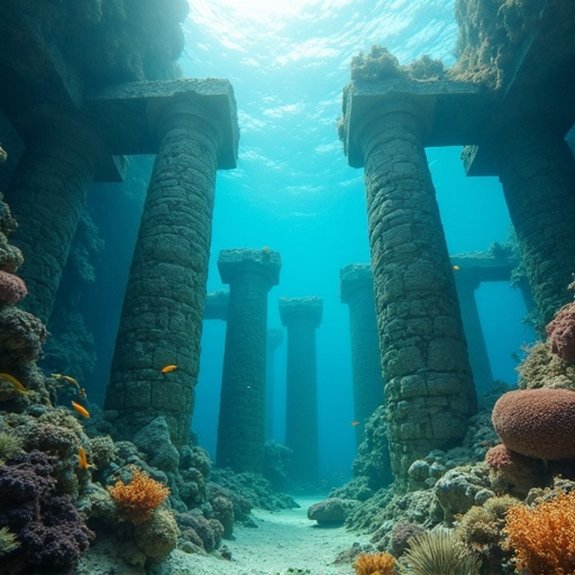
Three thousand years of human history have unfolded since the Mediterranean’s waters allegedly swallowed an entire civilization in a single day and night. The legend of Atlantis has captivated scholars, explorers, and dreamers who’ve searched relentlessly for evidence of this lost kingdom. Plato’s ancient dialogues first described the island nation’s advanced technology, circular canals, and eventual destruction by the gods.
Modern archaeology hasn’t confirmed Atlantis’s existence, yet underwater discoveries continue to fuel speculation. Submerged cities off Egypt’s coast, sunken settlements near Greece, and prehistoric ruins in the Black Sea demonstrate that rising sea levels have indeed claimed ancient civilizations. These findings suggest that while Plato’s specific account remains unverified, the concept of lost underwater kingdoms isn’t pure fantasy but reflects real historical catastrophes.
Ancient Greek Maritime Myths
Beyond Atlantis, the ancient Greeks populated their seas with countless tales of vanished islands, divine retributions, and maritime catastrophes that shaped their understanding of the ocean’s dangers. They spoke of Scheria, the Phaeacians’ mystical island that vanished after helping Odysseus reach Ithaca. Poseidon’s wrath supposedly sank entire cities when mortals defied him. The island of Atalante disappeared beneath the waves after an earthquake, while Chryse and Argyre, the legendary gold and silver islands, remained forever lost to sailors who’d claimed to have seen them.
These myths weren’t mere entertainment. They served as cautionary tales for mariners traversing treacherous waters and explained the Mediterranean’s unpredictable nature. Each story reinforced the sea’s dual identity as both life-giving trade route and deadly domain where gods punished hubris.
Notable Cases or Sightings
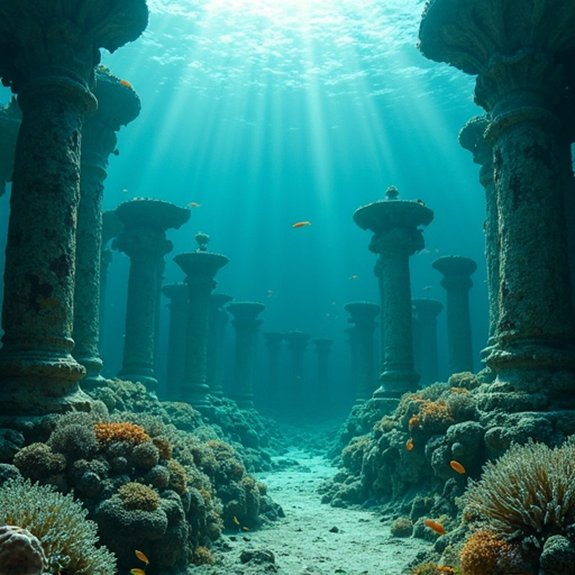
While ancient civilizations relied on mythology to explain mysterious disappearances at sea, modern history has documented equally puzzling accounts of underwater discoveries and vanishing landmasses. In 1968, pilots spotted the Bimini Road‘s limestone formations off the Bahamas, sparking debates about Atlantis’s location. Japan’s Yonaguni Monument, discovered in 1987, features terraced structures that divers can’t definitively classify as natural or man-made.
Sandy Island appeared on maps for over a century until Australian scientists proved it didn’t exist in 2012. Similarly, Thompson Island vanished after its 1825 discovery near South Africa. Sonar readings have detected anomalies beneath Antarctica’s ice sheets, while satellite imagery revealed submerged structures off Cuba’s coast in 2001. These findings haven’t confirmed any lost kingdom’s existence, but they’ve intensified scientific investigations into Earth’s changing coastlines.
Common Theories or Explanations
Although scientists can’t prove lost kingdoms existed beneath the waves, they’ve developed several compelling theories to explain the persistent legends. Geologists point to catastrophic events like earthquakes and tsunamis that’ve submerged coastal civilizations throughout history. The Mediterranean’s ancient port cities now lie underwater, providing tangible evidence for such disasters.
Anthropologists suggest collective memory plays a vital role. Stories of great floods appear across cultures, possibly stemming from rising sea levels after the last ice age. These oral traditions transformed over millennia into tales of magnificent underwater domains.
Some researchers propose psychological explanations. The ocean’s vastness triggers human imagination, while its unexplored depths represent the unknown. Maritime folklore naturally evolved to explain mysterious disappearances and strange phenomena at sea.
Frequently Asked Questions
What Modern Technology Is Being Used to Search for Underwater Kingdoms?
Scientists employ advanced sonar mapping, autonomous underwater vehicles, and satellite imagery to explore ocean floors. They’ve discovered submerged cities using magnetometers, side-scan sonar, and remotely operated vehicles that capture high-resolution footage of ancient structures.
How Deep Underwater Would These Lost Kingdoms Theoretically Be Located?
Archaeologists estimate lost underwater kingdoms would’ve existed at depths ranging from 10 to 400 feet below current sea levels. They’re focusing on ancient coastlines that flooded when ice sheets melted 12,000 years ago.
Are There Any Ongoing Expeditions Currently Searching for Lost Underwater Civilizations?
Yes, several expeditions are actively searching. Robert Ballard’s team explores the Mediterranean, while marine archaeologists investigate India’s Gulf of Khambhat. Japan’s searching near Yonaguni, and researchers’re examining Cuba’s underwater formations for possible ancient structures.
What Would Be the Estimated Economic Value of Discovering Such a Kingdom?
Experts estimate a major underwater kingdom discovery’s value could reach billions through tourism, archaeological artifacts, and historical significance. They’d expect immediate economic benefits from documentary rights, research grants, and museum exhibitions worldwide generating substantial revenue.
Which Specific Ocean Regions Are Considered Most Likely to Contain Lost Kingdoms?
Researchers consider the Mediterranean Sea, particularly near Santorini and Crete, most promising for lost kingdoms. They’ve also identified the Black Sea, India’s Gulf of Khambhat, and Japan’s Yonaguni waters as regions with compelling underwater structures.

The Mystery of Göbekli Tepe’s Builders

Myths of the Undersea Kingdoms

The Mayan Codices: Lost Knowledge of the Stars
About The Author
