The Legend of Cantre’r Gwaelod (Wales’ Atlantis)
The ancient Welsh tell of a prosperous kingdom that vanished beneath Cardigan Bay’s dark waters. Cantre’r Gwaelod‘s flooding wasn’t gradual—it happened in a single catastrophic night when a drunken gatekeeper failed his duty. Medieval manuscripts preserve fragments of this tale, while fishermen still report hearing phantom church bells during storms. What’s most unsettling isn’t the legend itself, but the mounting geological evidence that suggests something significant really did disappear beneath those waves.
Introduction
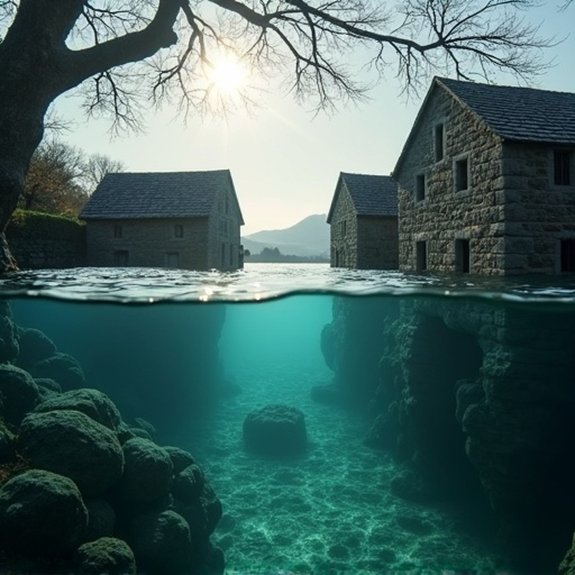
Sixteen bells ring out beneath the waters of Cardigan Bay, according to Welsh folklore, marking where an ancient kingdom once thrived before the sea swallowed it whole. Cantre’r Gwaelod, meaning “The Lowland Hundred,” was supposedly a fertile territory protected by massive seawalls and sluice gates. The kingdom stretched across what’s now submerged land between Bardsey Island and Cardigan.
Medieval texts describe it as Wales’ most prosperous region, supporting sixteen magnificent cities. The land’s catastrophic flooding transformed it into Wales’ own Atlantis myth. Historians debate whether the legend stems from actual flooding events during the post-glacial period when sea levels rose dramatically. Today, low tides occasionally reveal ancient tree stumps and peat deposits off the Welsh coast, fueling speculation that Cantre’r Gwaelod wasn’t entirely mythical.
Medieval Welsh Manuscript Mentions
The earliest written accounts of Cantre’r Gwaelod appear in the Black Book of Carmarthen, Wales’ oldest surviving manuscript of poetry, dating to around 1250. This medieval text contains verses describing a submerged kingdom beneath Cardigan Bay, ruled by King Gwyddno Garanhir. The manuscript’s poems reference sixteen fortified cities that once thrived before catastrophic flooding destroyed them.
Later medieval sources expanded the legend’s details. The Book of Taliesin includes cryptic verses about drowned lands, while genealogical texts from the fourteenth century name Seithenyn as the drunken keeper who neglected the kingdom’s flood defenses. These manuscripts don’t agree on every detail—some blame a maiden named Mererid for the disaster—but they’ve consistently preserved the story’s core elements through centuries of Welsh literary tradition.
Notable Cases or Sightings

Throughout history, fishermen and sailors have reported strange encounters in Cardigan Bay that they’ve linked to the sunken kingdom. In 1770, Welsh antiquarian William Owen Pughe documented locals’ claims of hearing church bells ringing beneath the waves during calm weather. Victorian-era fishermen frequently reported snagging their nets on what they believed were ancient stone structures.
The most intriguing discovery occurred in 1977 when marine archaeologists identified a series of linear stone ridges extending into the bay near Borth. These formations, dubbed “Sarn Badrig,” stretch for miles underwater. Scientists debate whether they’re natural glacial deposits or remnants of ancient sea walls. Local divers have photographed what appear to be worked stones and timber fragments embedded in the seafloor, though experts haven’t confirmed their artificial origin.
Common Theories or Explanations
While skeptics dismiss the legend as pure mythology, several theories attempt to explain Cantre’r Gwaelod‘s origins through historical and geological evidence. Geologists point to Cardigan Bay’s submerged forest, visible at low tide, as proof of ancient land loss. Tree stumps dating back 4,500 years suggest gradual sea level rise swallowed coastal settlements after the last Ice Age.
Historians propose the legend preserves collective memory of catastrophic flooding events. Medieval warming periods and storm surges could’ve destroyed Welsh coastal communities, inspiring tales of sunken kingdoms. Some researchers link Cantre’r Gwaelod to Bronze Age settlements that’re now underwater.
The most compelling theory combines both approaches: real flooding disasters merged with Celtic mythology, creating a cautionary tale about human negligence that’s endured for centuries.
Frequently Asked Questions
Can Tourists Visit Any Physical Sites Related to Cantre’r Gwaelod Today?
Tourists can’t visit physical remains since Cantre’r Gwaelod lies submerged beneath Cardigan Bay. They can explore nearby beaches where ancient tree stumps occasionally appear at low tide, which locals claim are remnants of the sunken kingdom.
How Does This Legend Compare to Other Global Flood Myths?
Cantre’r Gwaelod shares themes with Atlantis, Noah’s flood, and Hindu puranas – divine punishment through submersion. Unlike purely mythical tales, it’s possibly grounded in actual post-glacial flooding of Cardigan Bay, giving it unique archaeological credibility.
What Modern Scientific Equipment Has Been Used to Search for Remains?
Scientists’ve deployed multibeam sonar systems, side-scan sonar, and remotely operated vehicles to map Cardigan Bay’s seabed. They’ve also used ground-penetrating radar and magnetometry to investigate submerged forests and potential stone structures beneath the waters.
Are There Any Annual Festivals or Cultural Events Celebrating This Legend?
While there aren’t major festivals specifically for Cantre’r Gwaelod, Welsh cultural events often feature the legend through storytelling, music, and poetry. Cardigan Bay communities incorporate the tale into local heritage celebrations and educational programs.
Which Welsh Poems or Songs Reference Cantre’r Gwaelod?
Several Welsh works reference Cantre’r Gwaelod, including the medieval Black Book of Carmarthen’s verses, J.J. Williams’s poem “Clychau Cantre’r Gwaelod” (The Bells of Cantre’r Gwaelod), and modern folk songs that’ve adapted the ancient drowning story.

What’s Lurking in the Pine Barrens of New Jersey?

The Lost Pools of Atlantis

Did Egyptians Visit the Grand Canyon?
About The Author
