The Disappearance of the Indus Script
The ancient Harappan civilization left behind thousands of artifacts bearing mysterious symbols that scholars can’t decipher. Around 1900 BCE, this sophisticated writing system vanished along with the civilization itself, creating one of archaeology’s most frustrating puzzles. Despite finding over 4,000 inscribed objects, researchers haven’t cracked the code. What these symbols meant—and why they disappeared so completely—remains unknown, leaving an essential chapter of human history unreadable.
Introduction
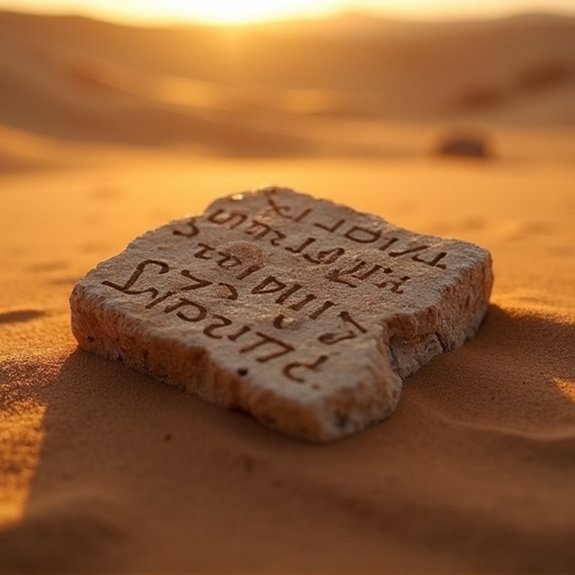
When archaeologists first uncovered the ancient cities of Harappa and Mohenjo-daro in the 1920s, they discovered thousands of small objects bearing mysterious symbols that would become known as the Indus script. These markings appeared on seals, pottery, tablets, and tools throughout the Indus Valley Civilization, which thrived from 3300 to 1300 BCE across present-day Pakistan and northwest India. The script’s approximately 400 distinct signs have defied decipherment for a century, making it one of archaeology’s most enduring puzzles. Around 1900 BCE, the script vanished from the archaeological record as the civilization declined. No bilingual texts exist to aid translation, and the brief inscriptions average just five symbols. Today’s scholars can’t even agree whether these marks represent true writing or served as non-linguistic symbols for trade and administration.
Harappan Civilization’s Mysterious Symbols
The enigmatic symbols of the Harappan civilization appear on over 4,000 artifacts discovered across dozens of archaeological sites. These inscriptions, dating from 2600 to 1900 BCE, consist of roughly 400 distinct signs. They’re found on seals, pottery, tablets, and copper tools throughout the Indus Valley region.
Most inscriptions contain just five symbols arranged in short sequences. The longest discovered text spans only 26 characters. This brevity’s puzzled researchers who can’t determine if the script represents a true writing system or merely symbolic notation.
The symbols display remarkable consistency across vast distances. Identical signs appear at sites separated by hundreds of miles, suggesting standardized communication. Yet despite decades of analysis, scholars haven’t cracked the code. Without bilingual texts or longer inscriptions, the Harappan script remains one of archaeology’s most tantalizing mysteries.
Notable Cases or Sightings

How did archaeologists first encounter these mysterious symbols? In 1872, Alexander Cunningham discovered the first Harappan seal near Harappa, Pakistan, featuring an unknown script alongside animal imagery. He couldn’t decipher the markings and mistakenly dated them to medieval times.
The script’s true significance emerged during the 1920s excavations at Harappa and Mohenjo-daro. Archaeologists John Marshall and Ernest Mackay uncovered thousands of inscribed objects—seals, tablets, pottery, and tools. The most famous find remains the “Pashupati seal,” showing a seated figure surrounded by animals with text above.
Since then, over 4,000 inscribed objects have surfaced across 60 excavation sites. Notable discoveries include the Dholavira signboard, displaying ten large symbols that might’ve marked the city’s entrance, and numerous copper tablets from Mohenjo-daro containing longer inscriptions.
Common Theories or Explanations
Although scholars have studied the Indus script for nearly a century, they’ve proposed wildly different theories about its nature and meaning. Some researchers argue it’s not writing at all but merely symbolic decoration or property markers. Others insist it represents a logo-syllabic system similar to Sumerian cuneiform.
The Dravidian hypothesis remains popular, suggesting the script encodes an ancient Dravidian language. Finnish scholar Asko Parpola has championed this view, identifying potential astronomical and religious meanings. Conversely, farmer and researcher Steve Farmer controversially claims the Indus symbols don’t constitute true writing since they lack the complexity of other ancient scripts.
Another theory proposes the script recorded multiple languages across the vast Indus civilization. Without bilingual texts or longer inscriptions, each explanation remains speculative.
Frequently Asked Questions
Can Modern Technology Like AI Help Decode the Indus Script?
AI technology’s helping researchers analyze Indus script patterns through machine learning algorithms. Scientists’ve developed computational models that identify symbol frequencies and relationships, though they haven’t achieved full decipherment yet due to the script’s brevity and isolation.
How Much Would Deciphering the Script Be Worth Financially?
Deciphering the Indus script would likely generate millions in research grants, book deals, and documentary rights. Museums would pay substantial fees for exhibitions, while universities and governments would fund extensive archaeological projects exploring newly understood texts.
Are There Any Living Languages Related to the Indus Script?
No living languages have proven connections to the Indus script since scholars haven’t deciphered it yet. Some researchers propose links to Dravidian languages like Tamil, but they can’t confirm any relationship without understanding the script’s meaning.
What Materials and Tools Were Used to Create the Inscriptions?
The Indus people carved inscriptions primarily on steatite seals using bronze or copper tools. They’ve also inscribed symbols on pottery, bronze implements, and terracotta tablets using sharp metal points and stone-cutting tools for engraving.
How Many Scholars Worldwide Are Actively Researching the Script Today?
Approximately 100-200 scholars worldwide actively research the Indus script today. They’re concentrated in India, Pakistan, Finland, the United States, and Japan. This small community includes archaeologists, linguists, computer scientists, and epigraphers who’ve dedicated careers to decipherment attempts.

The Underworld Passage of the Incas
The Lost Cities of the Silk Road

Is There a Secret Society Guarding Ancient Artifacts in the Rockies?
About The Author
