The Hidden Tunnels of Teotihuacan
Beneath Teotihuacan’s Temple of the Feathered Serpent lies a network of tunnels that’s rewriting archaeological textbooks. Sealed for 1,800 years, these passages weren’t discovered until 2003. They’re packed with jade statues, jaguar bones, and mysteries that challenge everything experts thought they knew about the ancient city. The 340-foot tunnel system hints at engineering capabilities and religious practices far more complex than anyone imagined. What the builders intended remains unclear.
Introduction
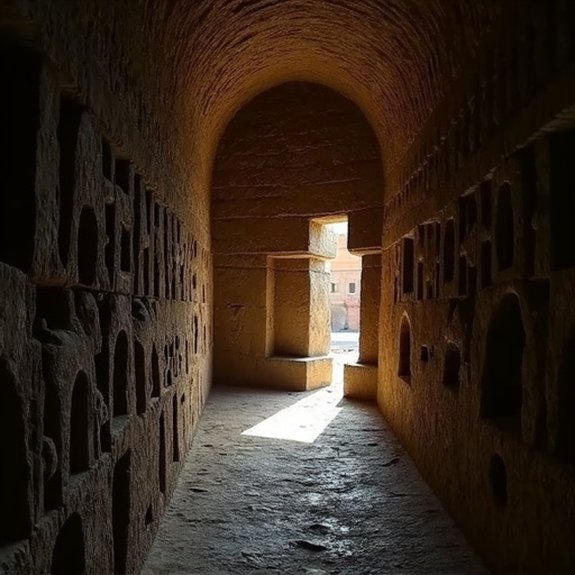
When archaeologists discovered a hidden tunnel system beneath Teotihuacan’s ancient pyramids in 2003, they’d stumbled upon one of Mexico’s most significant archaeological finds in decades. The tunnel network stretches beneath the Temple of the Feathered Serpent, one of Teotihuacan’s three main pyramids. Sealed for nearly 1,800 years, these underground passages have revealed thousands of artifacts and provided unprecedented insights into the mysterious civilization that built America’s first major city.
Teotihuacan flourished between 100 BCE and 550 CE, housing over 125,000 residents at its peak. Despite its massive influence on Mesoamerican culture, the city’s original name, rulers, and language remain unknown. The tunnel system’s exploration has transformed researchers’ understanding of Teotihuacan’s religious practices, political structure, and daily life.
Ancient Mesoamerican Construction Methods
Stone hammers, copper chisels, and obsidian blades—these basic tools helped Teotihuacan’s builders create architectural marvels that have endured for two millennia. Workers quarried volcanic rock from nearby deposits, then shaped massive blocks using percussion and abrasion techniques. They’d transport materials on wooden rollers and human-powered sleds across carefully prepared causeways.
The city’s engineers developed sophisticated lime plaster that’s proven remarkably durable. They mixed crushed limestone with water and volcanic ash, creating a concrete-like substance for waterproofing and structural support. Builders used plumb bobs and measuring cords to ascertain precise alignments with astronomical phenomena. They constructed drainage systems with graded channels that still function today. Without metal tools or wheeled vehicles, these ancient craftsmen relied on ingenious planning, communal labor, and refined techniques passed down through generations.
Notable Cases or Sightings
How did archaeologists first discover Teotihuacan’s extensive tunnel network? In 2003, heavy rainfall opened a sinkhole near the Temple of the Feathered Serpent, revealing a shaft that led archaeologist Sergio Gómez to investigate. He’d stumbled upon a sealed tunnel that hadn’t been entered for nearly 2,000 years.
Gómez’s team spent years excavating the 340-foot tunnel, finding it filled with offerings including jade statues, jaguar bones, and thousands of metallic spheres. Robot exploration in 2013 uncovered three chambers at the tunnel’s end, containing seeds, pottery, and rubber balls.
Earlier discoveries include archaeologist Jorge Acosta’s 1970s findings of tunnels beneath the Pyramid of the Sun. These passages, likely used for ritual purposes, contained pottery shards and obsidian blades that’ve helped researchers understand Teotihuacan’s religious practices.
Common Theories or Explanations
These remarkable discoveries have led researchers to develop several theories about why Teotihuacan’s inhabitants built such an elaborate underground system. Many archaeologists believe the tunnels served religious purposes, functioning as symbolic pathways to the underworld where priests conducted sacred rituals. The presence of mercury, jade, and pyrite suggests they’re recreating an underground cosmos.
Some experts propose the tunnels housed royal tombs, though no ruler’s remains have been found yet. Others argue they’re sophisticated drainage systems that managed the city’s water supply during rainy seasons. A growing theory suggests multiple functions—the tunnels weren’t just ceremonial spaces but also stored valuable goods and connected important buildings secretly. The magnetite and mercury deposits might’ve created special visual effects during rituals, enhancing the spiritual experience for ancient participants.
Frequently Asked Questions
Can Tourists Visit the Tunnels During Regular Operating Hours?
No, tourists can’t visit the hidden tunnels during regular operating hours. Archaeologists restrict access to these underground passages for preservation and safety reasons. They’re conducting ongoing research and excavations that prevent public entry to the tunnels.
What Safety Equipment Is Required for Tunnel Exploration?
Explorers must wear hard hats, closed-toe shoes, and carry flashlights in Teotihuacan’s tunnels. They’ll need dust masks for air quality, and guides provide safety harnesses for certain sections. Visitors can’t bring large bags or tripods inside.
How Much Do Guided Tunnel Tours Typically Cost?
Guided tunnel tours at Teotihuacan typically cost between $50-100 per person. Tour operators charge varying rates depending on group size, duration, and whether they’ve included transportation from Mexico City. Private tours often exceed $150.
Are Photography and Filming Allowed Inside the Tunnels?
Photography’s generally restricted in Teotihuacan’s tunnels due to preservation concerns and narrow spaces. Visitors can’t use flash photography, and some areas prohibit cameras entirely. Tour guides’ll specify photo rules, but most tunnels maintain strict limitations.
What Is the Best Time of Year to Visit the Tunnels?
Visitors’ll find November through April ideal for exploring the tunnels, when Mexico’s dry season brings cooler temperatures and minimal rainfall. The site’s less crowded during weekdays, and morning tours offer the most comfortable underground conditions.

The Disappearance of the Harappan Civilization

Could the Ark of the Covenant Still Exist?
The Ghost City of Ki by Mongolian Lore
About The Author
