The Cosmic Serpent Myth Across Civilizations
The cosmic serpent myth appears in nearly every ancient civilization, yet scholars can’t fully explain why. From Mesopotamia’s chaos dragon to Australia’s Rainbow Serpent, these beings share striking similarities despite emerging from isolated cultures. They’re not just mythological creatures—they represent something fundamental about how humans understand creation itself. What’s particularly puzzling is how these serpentine deities consistently embody the same paradox: they’re both destroyers and creators, chaos and order intertwined.
Introduction
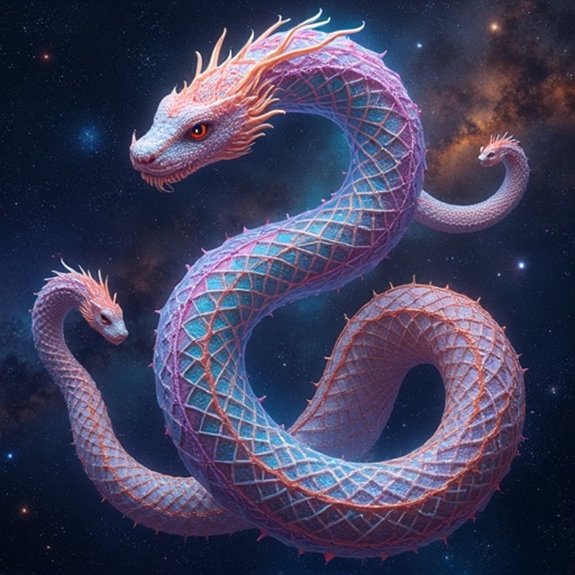
Serpents have slithered through humanity’s collective imagination since ancient times, manifesting as cosmic beings that shape reality itself. These mythological creatures appear in creation stories from Australia to Mesoamerica, often representing primordial chaos, wisdom, or regeneration. They’ve embodied the Milky Way, encircled the world, and supported the earth in various cultural narratives.
The cosmic serpent’s universality suggests deep psychological or observational roots. Some scholars link these myths to shamanic visions, astronomical phenomena, or DNA’s double helix structure glimpsed through altered consciousness. Others see them as metaphors for natural cycles and transformation.
This widespread motif transcends geographical boundaries and historical periods. From Quetzalcoatl to the Rainbow Serpent, from Jörmungandr to Shesha, these beings reveal humanity’s attempt to understand cosmic forces through familiar yet mysterious creatures.
Ancient Mesopotamian Creation Tablets
Among the earliest recorded serpent myths, the Babylonian Enuma Elish presents Tiamat as a primordial dragon-goddess of salt water who existed before creation itself. She’s depicted as both creator and destroyer, embodying chaos that predated order. When younger gods disturbed her peace, Tiamat transformed into a monstrous serpent-dragon, spawning an army of demons to wage war against them.
The god Marduk ultimately slew Tiamat, splitting her serpentine body to form heaven and earth. This cosmic battle established fundamental Mesopotamian beliefs about creation through conflict. The tablets also reference Apsu, Tiamat’s freshwater consort, and their offspring Lahmu and Lahamu—serpent deities who bridged primordial chaos and divine order. These narratives influenced subsequent Near Eastern cosmologies, establishing the serpent as both creative force and chaotic threat.
Notable Cases or Sightings
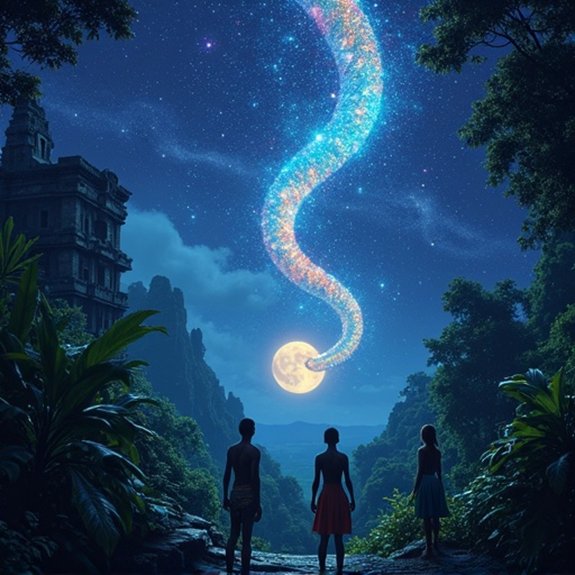
Historical records and indigenous testimonies document numerous encounters with cosmic serpent phenomena across cultures. The Dogon people of Mali‘ve reported celestial serpent sightings during their Sigui ceremonies since the 13th century. In 1561, residents of Nuremberg witnessed what they described as “serpentine tubes” battling in the sky, recorded in Hans Glaser’s famous woodcut.
Australian Aboriginal elders claim direct contact with the Rainbow Serpent during dreamtime visions, particularly at Uluru’s sacred sites. Peru’s ayahuasceros consistently report encountering luminous anaconda-like beings during ceremonies. The 1897 Aurora, Texas incident included witness accounts of “writhing aerial serpents” before the famous crash. Modern researchers’ve catalogued over 400 similar reports from remote villages in the Amazon, Himalayas, and sub-Saharan Africa, where serpent-shaped lights allegedly appear during solstices.
Common Theories or Explanations
While skeptics attribute cosmic serpent sightings to natural phenomena, researchers’ve proposed several compelling explanations for these widespread accounts. Carl Jung’s collective unconscious theory suggests serpentine imagery represents universal psychological archetypes embedded in humanity’s shared psyche. Neurobiologists’ve identified phosphenes—geometric patterns produced by the optic nerve—that resemble serpentine forms during altered consciousness states.
Some anthropologists argue these myths reflect ancient observations of auroras, comets, or the Milky Way’s sinuous path across night skies. David Lewis-Williams’s neuropsychological model links serpent visions to shamanic trance experiences common across cultures. Meanwhile, diffusionist theorists propose these stories spread through prehistoric trade routes from a single origin point. Graham Hancock’s controversial hypothesis connects serpent mythology to forgotten astronomical knowledge encoded by advanced civilizations. Each explanation attempts to decode why serpentine beings consistently appear in humanity’s oldest stories.
Frequently Asked Questions
How Do Indigenous Shamans Interpret the Cosmic Serpent in Their Spiritual Practices?
Indigenous shamans interpret the cosmic serpent as a bridge between earthly and spiritual domains. They’ve traditionally viewed it as embodying life force, transformation, and wisdom that connects humans to universal consciousness during healing ceremonies.
What Astronomical Phenomena Might Have Inspired Ancient Cosmic Serpent Myths?
Ancient peoples likely drew inspiration from the Milky Way’s serpentine shape across night skies, meteor streams’ snaking paths, and auroras’ undulating forms. They’d also observed eclipses where celestial bodies appeared “devoured” by invisible serpents.
Are There Modern Religious Movements That Incorporate Cosmic Serpent Symbolism?
Yes, several modern movements incorporate cosmic serpent symbolism. Neo-pagan groups honor Ouroboros, while ayahuasca churches visualize serpentine entities. New Age practitioners embrace Kundalini’s snake energy, and some UFO religions interpret ancient serpents as extraterrestrial beings.
How Do Cosmic Serpent Myths Relate to DNA Discoveries in Molecular Biology?
Some researchers’ve noted visual similarities between DNA’s double helix structure and intertwined serpent imagery in ancient myths. They suggest shamanic visions might’ve intuitively perceived molecular patterns, though mainstream science doesn’t support these speculative connections.
Which Contemporary Artists Have Depicted the Cosmic Serpent in Their Work?
Contemporary artists like Alex Grey incorporate cosmic serpents in psychedelic paintings, while Android Jones creates digital serpent imagery. Martina Hoffmann’s visionary art features DNA-like serpents, and Pablo Amaringo’s ayahuasca paintings depict intertwining cosmic snakes.



About The Author
