The Hero’s Journey in Mythic Structures
Joseph Campbell’s 1949 publication revealed a pattern that’s shaped storytelling for decades. He’d discovered something profound in myths worldwide—a recurring narrative structure that transcends cultural boundaries. From ancient epics to modern blockbusters, the same archetypal journey emerges again and again. But Campbell’s monomyth theory isn’t without controversy. Critics argue it oversimplifies diverse traditions and ignores narratives that don’t fit the pattern. What Campbell missed might prove more revealing than what he found.
Introduction

When scholars examine the fundamental patterns underlying humanity’s most enduring stories, they’ll discover a remarkable consistency that transcends cultural boundaries and historical periods. The hero’s journey represents one of storytelling’s most powerful frameworks, appearing in myths from ancient Greece to modern Hollywood blockbusters. Joseph Campbell first identified this narrative pattern in 1949, revealing how diverse cultures independently developed similar story structures. The journey typically follows a protagonist who leaves their ordinary world, faces trials, achieves victory, and returns transformed. This archetypal template doesn’t just entertain; it reflects universal human experiences of growth, challenge, and transformation. Understanding the hero’s journey helps readers decode the deeper meanings in literature, film, and even personal narratives, making it an essential tool for analyzing mythic structures.
Campbell’s 1949 Monomyth Publication
Joseph Campbell’s groundbreaking book “The Hero with a Thousand Faces” revolutionized how scholars understand mythology when it appeared in 1949. Campbell identified a universal pattern he called the “monomyth” that appears across cultures and time periods. He’d studied thousands of myths, folktales, and religious stories from around the world, discovering they share fundamental structural elements.
The book outlines seventeen stages of the hero’s journey, though Campbell emphasized that not every story includes all stages. His work synthesized insights from psychology, particularly Carl Jung’s theories about archetypes and the collective unconscious. Campbell demonstrated that whether examining Greek odysseys, Native American legends, or Buddhist texts, the same narrative arc emerges: a hero ventures from the ordinary world into supernatural domains, faces trials, and returns transformed with wisdom to benefit their community.
Notable Cases or Sightings
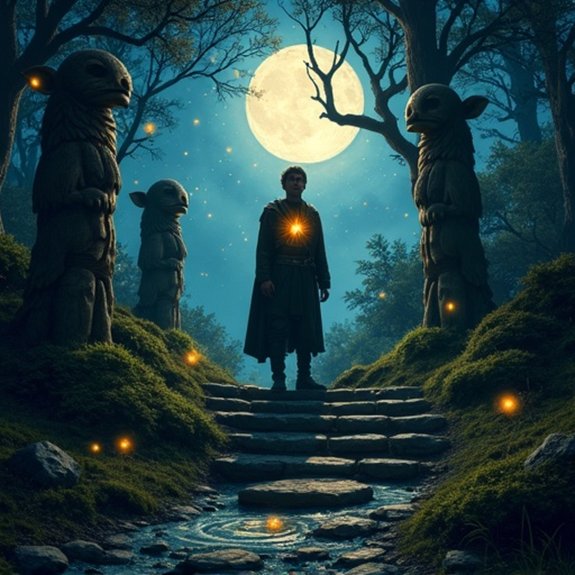
While Campbell’s framework provides the theoretical foundation, countless stories across media demonstrate the monomyth’s enduring power. George Lucas famously crafted Star Wars using Campbell’s structure, creating Luke Skywalker’s journey from farm boy to Jedi Knight. The trilogy’s success sparked Hollywood’s widespread adoption of the hero’s journey template.
Literature showcases Tolkien’s The Hobbit, where Bilbo Baggins reluctantly leaves the Shire, faces dragons, and returns transformed. Harry Potter’s arc from cupboard-dwelling orphan to wizarding savior follows Campbell’s stages precisely. Modern films like The Matrix present Neo’s path from office worker to humanity’s chosen one.
Video games embrace this structure too. The Legend of Zelda series repeatedly sends Link through trials to save Hyrule. These examples prove the monomyth’s versatility across cultures and mediums.
Common Theories or Explanations
These widespread applications have sparked debate about why the hero’s journey resonates so deeply across human cultures. Joseph Campbell argued it reflects universal psychological patterns embedded in humanity’s collective unconscious. Carl Jung’s archetypal theory supports this, suggesting the journey mirrors fundamental mental structures shared by all humans.
Evolutionary psychologists propose it’s hardwired into our brains through natural selection. Stories of overcoming challenges and returning transformed helped early humans survive by teaching vital lessons. Christopher Vogler refined Campbell’s work, demonstrating how the pattern fulfills basic storytelling needs that engage audiences emotionally.
Critics like María Tatar contend it’s not universal but reflects Western, male-centered perspectives. They argue other narrative structures exist in non-Western traditions that don’t follow Campbell’s model, challenging its supposed universality.
Frequently Asked Questions
How Can Writers Practically Apply the Hero’s Journey to Their Own Storytelling?
Writers can map their protagonist’s arc through Campbell’s stages, adapting the structure to fit their genre. They’ll identify key turning points, create meaningful mentor characters, and guarantee the hero’s transformation resonates with their story’s themes.
What Are the Main Criticisms of Campbell’s Hero’s Journey Framework?
Critics argue Campbell’s framework’s too male-centric, ignoring female experiences and non-Western narratives. They’ve noted it oversimplifies diverse storytelling traditions, forces stories into rigid patterns, and doesn’t reflect many cultures’ circular rather than linear mythologies.
How Does the Hero’s Journey Differ Across Various Cultural Mythologies?
Cultural mythologies shape the hero’s journey differently through varying emphasis on community versus individuality, cyclical versus linear progression, and distinct mentor figures. Eastern myths often stress harmony and collective benefit, while Western versions typically celebrate personal triumph.
Can the Hero’s Journey Structure Work for Non-Fiction or Documentary Narratives?
Yes, filmmakers and writers successfully apply the hero’s journey to non-fiction narratives. They’ll frame real people’s transformations through familiar stages—depicting subjects who face challenges, find mentors, overcome obstacles, and return changed, creating compelling documentary arcs.
What Modern Films Best Exemplify Each Stage of the Hero’s Journey?
Modern films that exemplify the hero’s journey include “Star Wars” for the call to adventure, “The Matrix” for crossing the threshold, “The Lord of the Rings” for trials and transformation, and “Black Panther” for the return with wisdom.



About The Author
