The Morrigan: Death Goddess of Celtic Lore
The Morrigan’s presence haunts Ireland’s ancient battlefields, where warriors once glimpsed her washing bloodied armor in streams before their deaths. She’s appeared throughout Celtic manuscripts as both prophet and harbinger, shifting between raven and woman while determining who’d survive the coming slaughter. Modern scholars can’t agree whether she represents one deity or three sisters bound by fate. What they’ve discovered in medieval texts challenges everything previously understood about Celtic death goddesses.
Introduction
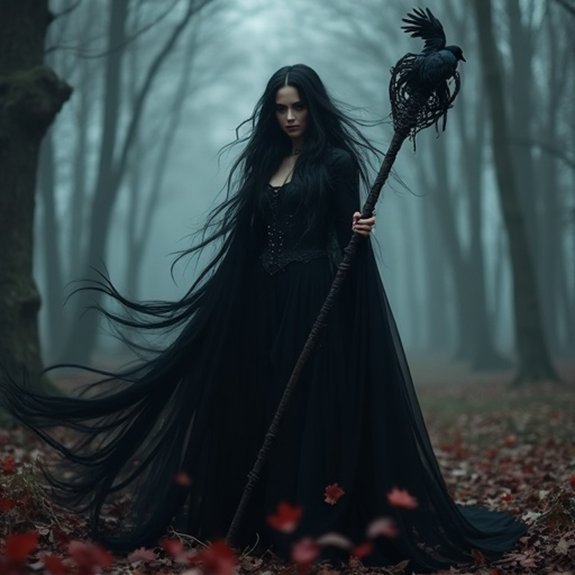
When ancient Celtic warriors prepared for battle, they’d scan the skies for ravens and crows—signs that the Morrigan watched from the shadows. This shape-shifting goddess of war, death, and fate commanded fear and reverence throughout Iron Age Ireland. She appeared as both a single deity and a triple goddess, manifesting as three sisters: Badb, Macha, and Nemain. The Morrigan didn’t simply observe warfare—she actively influenced its outcome through prophecy, psychological warfare, and direct intervention. Medieval Irish texts like the Ulster Cycle and the Táin Bó Cúailnge preserve her mythology, depicting her as a complex figure who embodied sovereignty, sexuality, and destruction. Her influence extended beyond battlefields into matters of kingship, where she’d determine rulers’ legitimacy and foretell their doom.
Ancient Irish Manuscript References
Although the Morrigan’s origins stretch back to pre-Christian Ireland, medieval scribes preserved her mythology in several key manuscripts written between the 11th and 15th centuries. The Book of Leinster contains the earliest detailed accounts of her shapeshifting abilities and prophetic powers. She appears prominently in the Ulster Cycle’s Táin Bó Cúailnge, where she confronts the hero Cú Chulainn three times, offering him her love and later cursing him when rejected.
The Yellow Book of Lecan and the Book of Fermoy expand on her triple nature, depicting her as Badb, Macha, and Nemain. These texts describe her washing bloodied armor at river fords before battles, an omen of impending death. Medieval scribes often portrayed her as both a single deity and a trinity, creating complex theological interpretations that’ve puzzled scholars for centuries.
Notable Cases or Sightings

Several documented encounters with the Morrigan have emerged from Irish folklore and historical accounts spanning centuries. Medieval chronicles describe warriors reporting crow-women appearing before major battles, particularly at Clontarf in 1014. Local testimonies from County Meath claim she’s been spotted washing bloodied armor at riverside fords, foretelling imminent deaths.
The 16th-century Annals of Connacht record a noble’s encounter with three hooded women who prophesied his clan’s downfall—witnesses believed they’d seen the goddess’s triple aspect. Rural communities throughout Ulster have preserved stories of the Morrigan appearing as an elderly woman seeking hospitality, cursing those who refused her.
Modern sightings persist near ancient battlefields. In 1919, soldiers stationed at the Curragh reported seeing a woman in black accompanied by ravens before several men died unexpectedly.
Common Theories or Explanations
These persistent accounts of Morrigan encounters have prompted scholars and folklorists to propose various explanations for the phenomenon. Psychological theories suggest she’s a manifestation of collective trauma, particularly in regions affected by centuries of warfare and colonization. Jung’s concept of archetypes positions her as a shadow figure representing humanity’s suppressed relationship with death.
Some researchers argue she’s a cultural memory preserved through oral tradition, with sightings triggered by environmental factors like electromagnetic fields near ancient sites. Others propose sleep paralysis and hypnagogic hallucinations explain nighttime encounters.
Modern pagans contend she’s an active deity responding to ecological destruction and social upheaval. Meanwhile, skeptics attribute sightings to misidentified birds, particularly corvids, combined with confirmation bias among those familiar with Celtic mythology.
Frequently Asked Questions
How Do Modern Pagans Worship or Honor the Morrigan Today?
Modern pagans honor the Morrigan through ritual offerings of red wine, crow feathers, and poetry. They’ll meditate on battlefield sites, practice divination, and invoke her during Samhain celebrations for protection, prophecy, and transformative magic.
What Offerings Are Traditionally Appropriate for the Morrigan?
Traditional offerings for the Morrigan include red wine, whiskey, blood (often menstrual), crow feathers, bones, dark bread, and raw meat. She’s also honored with weapons, poetry, and storm water collected during battles or conflicts.
Are There Specific Symbols or Sigils Associated With the Morrigan?
Ravens, crows, and wolves represent the Morrigan’s presence. She’s associated with the triple spiral, triskele, and battle spears. Modern practitioners often use crow feathers, dark crystals, and triangular symbols to honor her warrior-death aspects.
What’s the Difference Between the Morrigan and Other Celtic Death Deities?
The Morrigan differs from deities like Donn by embodying war’s chaos and prophetic power rather than peaceful afterlife domains. She’s actively involved in battles’ outcomes while others simply receive souls after death’s occurred naturally.
Can the Morrigan Appear in Dreams or Visions to People?
Yes, the Morrigan’s known to appear in people’s dreams and visions, often as a warning of death or battle. She’ll manifest as a crow, warrior woman, or crone, delivering prophecies or omens to dreamers.

About The Author
