Mythical Twins: Castor & Pollux Variants
The twin brothers Castor and Pollux have sparked countless interpretations across ancient civilizations, each culture reshaping their story to reflect local beliefs. They’ve appeared as divine horsemen in Spartan battles and as protective deities in Roman military camps. Their worship practices ranged from blood sacrifices to elaborate festivals. But what drove ancient warriors to claim they’d witnessed these mythical twins during vital battles? The evidence points to something far more complex than mere legend.
Introduction
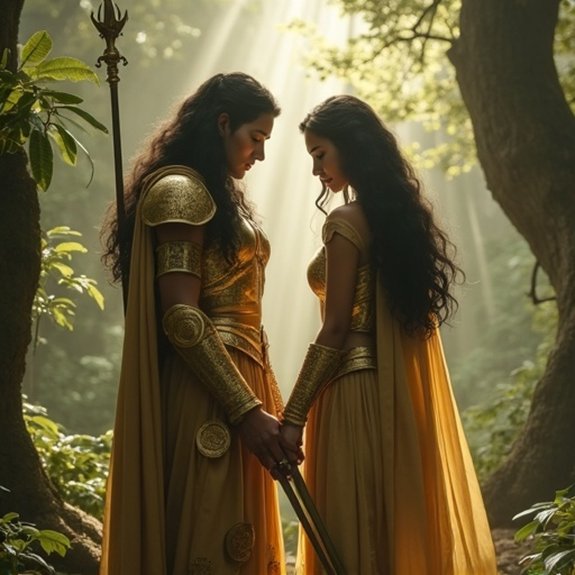
While ancient mythologies often feature divine siblings, few pairs have captured humanity’s imagination quite like Castor and Pollux, the twin brothers whose story has spawned countless variations across cultures and centuries. Known collectively as the Dioscuri in Greek tradition, these twins embody the complex relationship between mortality and divinity. Their tale’s endured because it explores universal themes: brotherhood, sacrifice, and the boundaries between human and divine spheres.
Different cultures’ve adapted their story to reflect local values and beliefs. Romans emphasized their military prowess, while sailors across the Mediterranean viewed them as protectors during storms. Each retelling adds layers to their mythology, creating a rich tapestry of narratives that’s influenced art, literature, and astronomy for over two millennia.
Ancient Spartan Worship Practices
The Spartans held Castor and Pollux in particularly high regard, considering them divine patrons of their warrior society and claiming direct descent from the twins through their royal houses. They’d invoke the Dioscuri before battles, believing the twins rode alongside their cavalry units. Spartan soldiers swore oaths by the brothers’ names, and their dual kingship system reflected the twins’ shared divinity.
At the twins’ primary sanctuary near Therapne, Spartans performed ritual dances and athletic competitions. They’d sacrifice white horses—animals sacred to the Dioscuri—and offer dedications of weapons after military victories. During the Dioscuria festival, young warriors underwent initiation rites that mimicked the twins’ legendary exploits. The dokana, twin wooden beams connected by crosspieces, served as the brothers’ sacred symbol throughout Spartan territories.
Notable Cases or Sightings

Battle-hardened sailors throughout antiquity reported seeing the twins’ distinctive St. Elmo’s fire phenomenon during storms, interpreting the electrical discharge as divine intervention. The Roman historian Pliny documented multiple naval encounters where twin flames appeared on ship masts before victories. During the Battle of Lake Regillus in 496 BCE, two mysterious horsemen allegedly led Roman forces to triumph, later identified as Castor and Pollux themselves.
Greek merchants recorded the twins’ appearance at Delphi’s oracle, where they’d supposedly warned of impending disasters. The phenomenon wasn’t limited to maritime settings—Roman soldiers claimed they’d witnessed the brothers at critical battles, particularly when defending territories sacred to their cult. These sightings typically featured identical warriors on white horses, wearing starred helmets, and vanishing after ensuring victory or delivering prophetic messages.
Common Theories or Explanations
Although ancient witnesses genuinely believed they’d encountered divine twins, modern scholars propose several explanations for these widespread sightings. Psychological phenomena offer the most compelling theories. Mass hysteria during battles could’ve triggered shared hallucinations of protective deities. Soldiers facing death often experienced altered states that produced visions of legendary figures.
Natural occurrences provide alternative explanations. St. Elmo’s fire—electrical discharges appearing as twin flames on ships’ masts—likely inspired maritime Castor and Pollux sightings. This phenomenon’s dual lights perfectly matched descriptions of the twins’ manifestations.
Some historians suggest political propaganda. Leaders deliberately spread twin-sighting stories to boost morale or justify military campaigns. The Romans particularly exploited these myths, claiming divine endorsement through fabricated encounters. These calculated deceptions reinforced cultural beliefs while serving practical purposes.
Frequently Asked Questions
How Do Castor and Pollux Variants Differ From Other Twin Deity Archetypes?
Castor and Pollux variants uniquely feature mortal-immortal duality, where one twin’s divine and the other’s human. They’re characterized by self-sacrificial brotherhood, shared immortality arrangements, and specialized complementary skills rather than identical powers or antagonistic relationships.
What Astronomical Phenomena Are Associated With the Gemini Constellation’s Mythological Significance?
The Gemini constellation’s brightest stars represent the twins’ heads, while their heliacal rising marked sailing season in ancient Greece. They’re associated with St. Elmo’s fire, which sailors believed showed the twins’ protective presence during storms.
Are There Modern Religious or Spiritual Practices That Honor These Twin Figures?
Yes, modern astrologers invoke Castor and Pollux’s duality in Gemini readings. Some neo-pagan practitioners honor them during summer solstice rituals. Maritime spiritual communities still petition these twins for protection, maintaining ancient Greek sailing traditions.
Which Artistic Depictions Best Capture the Duality of Mortal and Immortal Twins?
Peter Paul Rubens’ “The Rape of the Daughters of Leucippus” brilliantly captures their duality through contrasting light and shadow. The painting shows one twin earthbound while the other’s positioned celestially, embodying their mortal-immortal divide.
What Role Did These Twins Play in Ancient Maritime Navigation Beliefs?
Ancient sailors believed Castor and Pollux protected ships during storms. They’d identify the twins with St. Elmo’s fire – electrical phenomena appearing on masts. Romans called them “savior gods,” invoking their protection before dangerous voyages.
The Beast Within: Dual Nature Myths

The Forest Spirits: Kodama, Dryads
The Legend of the Phoenix Across Cultures
About The Author
