The Sea-Goat: Capricornal Creature Myths
The sea-goat‘s emerged from ancient star maps as more than just celestial decoration. This half-goat, half-fish creature’s influenced religious texts, maritime folklore, and astronomical traditions across three millennia. While scholars’ve traced its origins to Babylonian mythology, unexplained sightings along Mediterranean coastlines suggest there’s more to uncover. The creature’s dual nature raises questions about why ancient civilizations consistently depicted this specific hybrid—and what they knew that modern researchers don’t.
Introduction
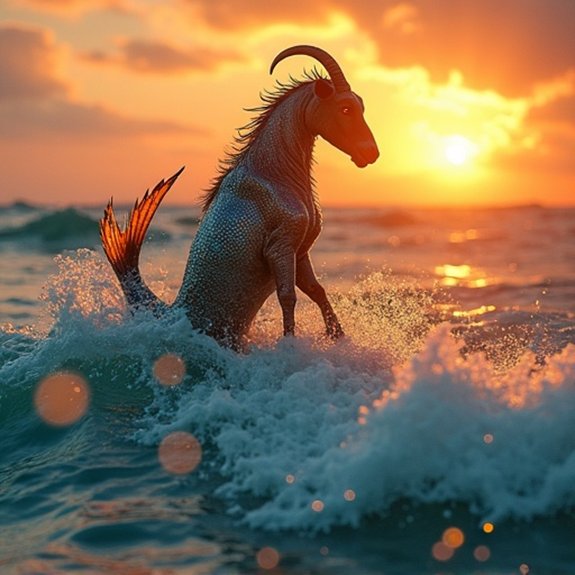
When ancient civilizations gazed at the winter sky, they saw in Capricorn’s stars a creature that defied nature itself—a goat with a fish’s tail. This bizarre hybrid, known as the sea-goat, has captivated humanity’s imagination for millennia. The constellation’s mythological origins stretch back to Babylonian astronomy, where it represented Ea, the god of water and wisdom.
Greeks later adopted this celestial figure, weaving it into their pantheon through the tale of Pan’s transformation. The sea-goat’s dual nature—terrestrial above, aquatic below—symbolized the bridge between earthly ambitions and emotional depths. Various cultures’ve interpreted this cosmic chimera differently, yet they’ve consistently recognized its paradoxical form. Today’s astrologers still invoke these ancient stories when describing Capricorn’s characteristics, proving that mythology’s influence endures in modern consciousness.
Ancient Babylonian Astronomical Texts
The earliest written records of Capricorn emerge from Mesopotamian clay tablets dating to the second millennium BCE. Babylonian astronomers called this constellation MULSUḪUR.MAŠ, meaning “goat-fish,” and they’d already recognized its hybrid form. They associated it with Ea, their god of wisdom and water, who ruled the Abzu—the cosmic freshwater ocean beneath Earth’s surface.
The MUL.APIN texts, compiled around 1000 BCE, precisely documented Capricorn’s position among eighteen zodiacal constellations. These astronomical compendiums tracked the goat-fish‘s heliacal rising and its relationship to agricultural cycles. Babylonians observed that when Capricorn appeared before dawn, winter’s depths approached.
Their star catalogues influenced later Greek and Roman astronomy. The Babylonians’ meticulous observations established Capricorn’s celestial coordinates that astronomers still reference today, proving these ancient texts weren’t merely mythological but sophisticated scientific documents.
Notable Cases or Sightings
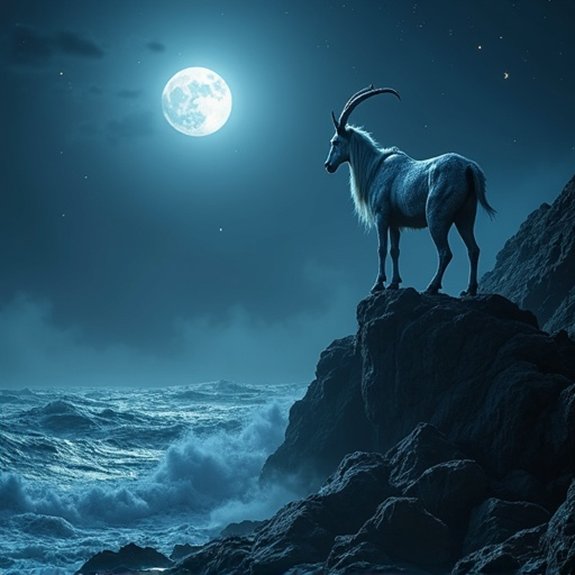
Although Capricorn remains a constellation rather than a cryptid, several historical accounts describe encounters with goat-fish creatures that mirror its form. Medieval sailors from Cyprus reported seeing “bearded sea-goats” near rocky shores in 1203, claiming the creatures possessed front hooves and scaled tails. Venice’s maritime records from 1547 detail a merchant vessel’s crew witnessing a horned aquatic animal that “walked upon the waves” before diving beneath their ship.
In 1891, Japanese fishermen near Shikoku Island described catching a creature with a goat’s head and fish body in their nets, though it escaped before reaching port. While these accounts can’t be verified, they’ve influenced regional folklore. Modern cryptozoologists note similarities between these reports and Capricorn’s mythological depiction, suggesting ancient astronomical knowledge may have shaped eyewitness interpretations of unusual marine life.
Common Theories or Explanations
Since ancient astronomers first mapped Capricorn’s stars, scholars have proposed various explanations for the goat-fish hybrid‘s enduring presence across cultures. Some anthropologists suggest the creature represents humanity’s dual nature—earthbound ambitions paired with emotional depths. The goat climbs mountains while the fish navigates oceans, symbolizing mastery over land and sea.
Jungian psychologists interpret the sea-goat as an archetype bridging conscious and unconscious domains. They’ve noted its appearance in dreams often coincides with major life changes. Maritime historians propose a practical origin: ancient sailors mistook swimming goats escaping floods for mythical hybrids. Meanwhile, comparative mythologists trace the symbol to Mesopotamian water deities, particularly Enki’s sacred animal. Modern theorists even suggest the constellation’s shape naturally evokes a chimeric form, leading independent cultures to similar interpretations.
Frequently Asked Questions
What Role Does the Sea-Goat Play in Modern Astrology and Horoscope Interpretations?
The sea-goat represents Capricorn in modern astrology, where it’s interpreted as embodying ambition, discipline, and practicality. Astrologers believe it symbolizes the balance between earthly goals and emotional depths, influencing Capricorns’ determined yet sensitive nature.
How Do Different Cultures Depict the Sea-Goat in Their Traditional Art Forms?
Different cultures depict the sea-goat through varied artistic traditions. Mesopotamians carved it on cylinder seals, Greeks painted it on pottery, while medieval Europeans illustrated it in illuminated manuscripts. Asian cultures rarely feature this creature.
Are There Any Festivals or Celebrations Dedicated to the Sea-Goat Creature?
While there aren’t major festivals specifically honoring the sea-goat creature, some modern Capricorn-themed celebrations and ancient Babylonian New Year rituals referenced Ea’s goat-fish form. Contemporary astrology events sometimes feature sea-goat symbolism during Capricorn season.
What Is the Symbolic Meaning of the Sea-Goat in Dream Interpretation?
Dream interpreters believe the sea-goat symbolizes one’s ability to navigate between emotional depths and ambitious heights. It represents balancing practical goals with intuitive wisdom, suggesting the dreamer’s bridging conscious achievements with unconscious spiritual yearnings.
How Has the Sea-Goat Influenced Contemporary Fantasy Literature and Gaming?
The sea-goat’s influenced modern fantasy through hybrid creatures in RPGs like Dungeons & Dragons, where amphibious monsters blend terrestrial and aquatic traits. Writers’ve incorporated Capricorn’s duality into shape-shifting characters who navigate both land and water domains.



About The Author
