The Myth of the Sun Chariot
The sun chariot‘s ancient myth spans continents and millennia, revealing humanity’s deepest questions about cosmic order. These stories aren’t mere folklore—they’re sophisticated explanations for natural phenomena that shaped entire civilizations. From Nordic fjords to Indian temples, cultures independently developed remarkably similar narratives of divine charioteers pulling the sun across heaven’s vault. What drove these parallel beliefs, and why did they persist for thousands of years across unconnected societies?
Introduction
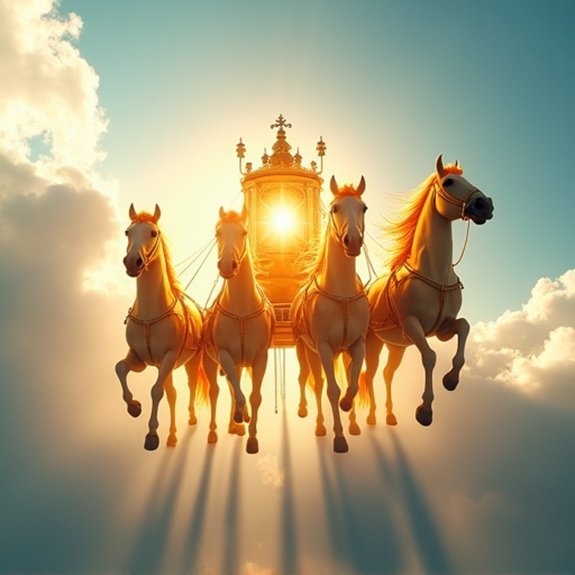
While ancient civilizations gazed at the sun’s daily journey across the sky, they couldn’t explain this celestial phenomenon through science, so they created elaborate myths featuring divine chariots pulled by magnificent horses or other sacred creatures. These stories weren’t mere entertainment; they served as essential explanations for natural events that shaped daily life. From Greece’s Helios to India’s Surya, cultures worldwide developed remarkably similar narratives about solar deities commanding radiant vehicles across the heavens. The sun chariot myth transcended geographical boundaries, appearing in Norse, Egyptian, and Celtic traditions with distinct cultural variations. Each civilization’s version reflected its values, fears, and understanding of cosmic order. These myths provided structure to chaos, offering ancient peoples a framework to comprehend the sun’s crucial role in sustaining life on Earth.
Ancient Indo-European Solar Mythology
As Proto-Indo-European peoples migrated across Eurasia between 4000 and 2500 BCE, they carried shared beliefs about a divine solar chariot that would evolve into distinct mythological traditions. Archaeological evidence from Bronze Age petroglyphs in Scandinavia and Central Asia depicts wheeled vehicles carrying solar discs, suggesting this myth’s ancient origins.
The sun chariot concept appears across Indo-European cultures with remarkable consistency. Greek mythology describes Helios driving his golden chariot from east to west. Norse tradition tells of Sol racing across the sky while wolves pursue her. Vedic texts detail Surya’s seven-horse chariot traversing heaven. Celtic artifacts show solar wheels and chariots, while Slavic folklore preserves tales of the sun-god Dazhbog’s daily journey. These parallels aren’t coincidental—they’re linguistic and mythological fossils from a shared ancestral belief system.
Notable Cases or Sightings
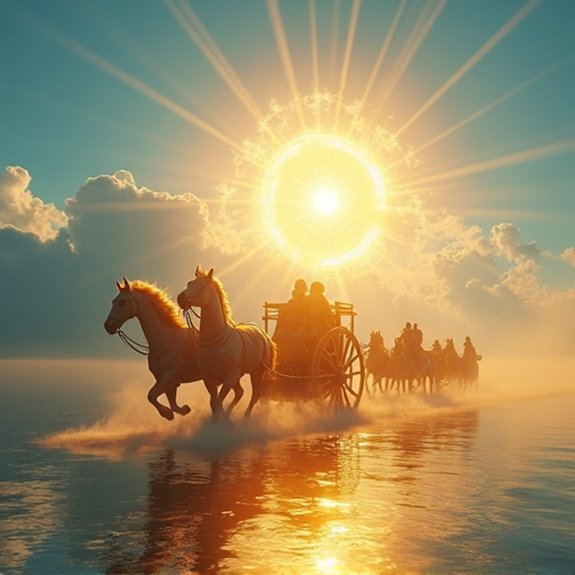
Throughout history, various cultures have reported witnessing phenomena they’ve interpreted as divine solar chariots crossing the sky. Greek historians documented citizens claiming they’d seen Apollo’s golden chariot during solar eclipses. Nordic peoples described Sól’s chariot racing across winter skies, pursued by wolves during particularly vivid auroras.
Medieval chronicles contain accounts of “burning wheels” appearing at dawn, which monks interpreted as Elijah’s fiery chariot. In 1561, Nuremberg residents witnessed what they called “celestial chariots” battling overhead—likely a complex sun dog phenomenon. Similar reports emerged from Basel five years later.
These sightings weren’t limited to Europe. Chinese astronomers recorded “dragon chariots” during unusual solar halos, while Aztec priests documented Tonatiuh’s journey during rare atmospheric events. Modern analysis suggests these witnesses observed legitimate optical phenomena but interpreted them through their mythological framework.
Common Theories or Explanations
Modern scholars have developed several frameworks to explain why sun chariot myths appear across unconnected cultures. The astronomical interpretation suggests ancient peoples naturally perceived the sun’s daily arc as a vehicle’s journey across the sky. This theory’s supported by cultures that tracked celestial movements for agricultural purposes.
Psychological frameworks propose these myths reflect universal human cognitive patterns. Jung’s collective unconscious theory argues the chariot represents humanity’s shared symbolic language for understanding cosmic order.
Some anthropologists favor cultural diffusion, claiming trade routes spread these stories from a single origin point. However, others champion independent invention, noting that wheels and horses were revolutionary technologies that naturally became metaphors for celestial phenomena.
Environmental theories link sun chariot prevalence to regions experiencing dramatic seasonal changes, where the sun’s path held existential importance.
Frequently Asked Questions
How Did Sun Chariot Myths Influence Modern Astronomy and Scientific Understanding?
Sun chariot myths didn’t directly influence modern astronomy but they’ve shown humanity’s early attempts to explain celestial movements. These stories motivated systematic observations that eventually led to heliocentric models and today’s scientific understanding.
What Archaeological Artifacts Depict Sun Chariots Across Different Cultures?
Archaeologists’ve discovered numerous sun chariot depictions: Denmark’s Trundholm sun chariot, Egyptian tomb paintings showing Ra’s solar barque, Greek pottery featuring Helios’s chariot, and India’s Konark Sun Temple wheels. These artifacts span Bronze Age through medieval periods.
How Are Sun Chariot Myths Represented in Contemporary Art and Literature?
Contemporary artists reimagine sun chariots through solar-powered installations and digital media, while fantasy authors incorporate them as divine vehicles. They’ve appeared in graphic novels, video games, and films, often symbolizing environmental themes and humanity’s relationship with nature.
What Rituals or Festivals Historically Celebrated Sun Chariot Deities?
Ancient cultures celebrated sun chariot deities through various festivals. Romans honored Sol Invictus with winter solstice ceremonies. Greeks performed rituals for Helios at Rhodes. Hindus still celebrate Surya during Makar Sankranti and Chhath Puja festivals.
How Do Sun Chariot Myths Compare to Lunar Chariot Traditions?
Sun chariot myths typically emphasize daily renewal and masculine deities who’re associated with order and time, while lunar chariot traditions feature feminine deities, monthly cycles, and mystery. Both explain celestial movement through divine transportation across heaven’s vault.

The Legend of the Red Thread of Fate

Mythical Bridges Between Worlds

The Raven in Mythology Around the World
About The Author
