The Legend of the Crystal Skull Motif
Crystal skulls have captivated collectors and mystics for decades, yet their true origins remain contested. While believers claim these artifacts hold ancient wisdom from lost civilizations, skeptics point to modern tool marks found on most specimens. The skulls’ emergence in the 19th century coincides suspiciously with Victorian society‘s obsession with the occult. What’s certain is that these enigmatic objects blur the line between archaeological fact and elaborate fiction.
Introduction
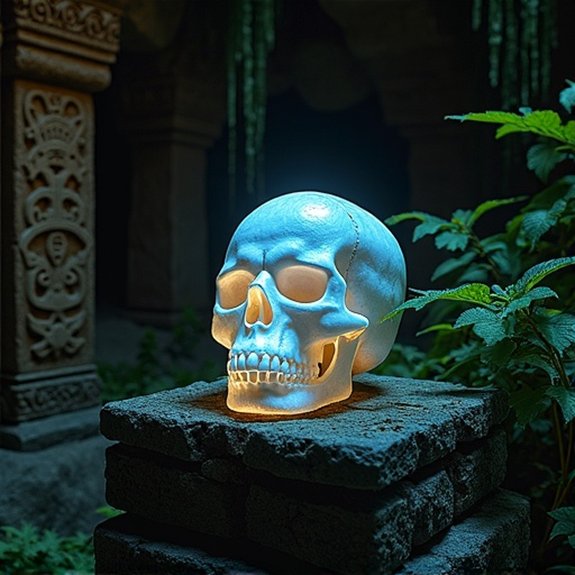
When ancient civilizations carved skulls from clear quartz crystal thousands of years ago, they couldn’t have imagined how these artifacts would captivate the modern world’s imagination. These mysterious objects have sparked debates among archaeologists, inspired Hollywood blockbusters, and fueled countless conspiracy theories. The crystal skull motif represents humanity’s enduring fascination with death, mysticism, and lost knowledge.
From pre-Columbian Mesoamerica to modern New Age movements, crystal skulls have transcended their origins as ritual objects to become powerful cultural symbols. They’ve appeared in museums, private collections, and popular media, each claiming unique supernatural properties or ancient wisdom. While most examples prove to be modern fabrications, the legend persists. The motif continues evolving, blending archaeological fact with fiction, creating a mythology that speaks to contemporary desires for connection with ancient mysteries.
Pre-Columbian Mesoamerican Skull Traditions
Although crystal skulls have captured modern imagination, authentic Pre-Columbian cultures possessed their own distinct skull traditions that bore little resemblance to the polished quartz artifacts popularized today. The Aztecs carved skull masks from jade, obsidian, and turquoise for ceremonial purposes, often adorning them with pyrite and shell inlays. They’d display real human skulls on tzompantli (skull racks) to honor gods and intimidate enemies.
Maya artisans created miniature skull pendants from jade, believing they’d protect wearers in the afterlife. Mixtec craftsmen fashioned intricate skull mosaics using turquoise tiles on human craniums. These cultures viewed skulls as symbols of death, rebirth, and divine power—not mystical objects containing ancient wisdom. Their skull art served specific religious and political functions within complex belief systems that modern crystal skull mythology doesn’t accurately represent.
Notable Cases or Sightings
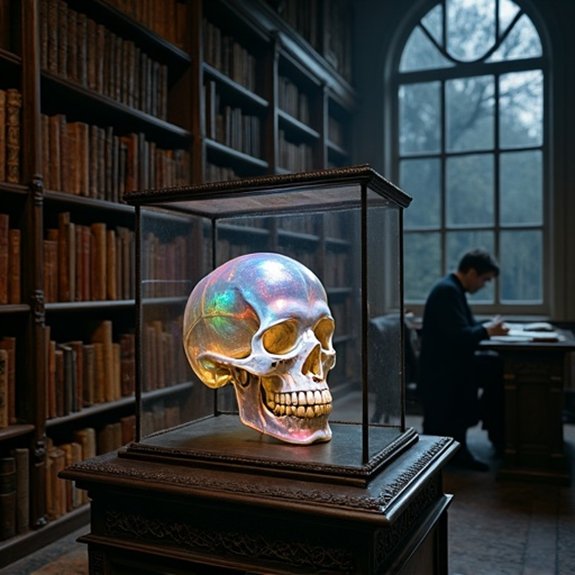
The Mitchell-Hedges skull stands as the most infamous crystal skull, allegedly discovered by British explorer F.A. Mitchell-Hedges in 1924 beneath a Mayan temple in Belize. His daughter Anna claimed she’d found it during excavation, though skeptics question this account. The British Museum houses another prominent specimen, acquired in 1897 from Tiffany & Co., while Paris’s Musée du Quai Branly displays a third major example.
Max, a Texas-based skull, gained attention through JoAnn Parks, who claimed it possessed healing powers. The Smithsonian received an anonymous crystal skull donation in 1992, later proven to be modern. Scientific analysis has revealed tool marks from rotary wheels on most specimens, technology unavailable to pre-Columbian cultures. These findings haven’t deterred believers who maintain the skulls possess mystical properties.
Common Theories or Explanations
Crystal skull enthusiasts propose various origins for these enigmatic artifacts, ranging from ancient Atlantean technology to extraterrestrial gifts. They’ve suggested the skulls serve as data storage devices, healing instruments, or consciousness amplifiers. Some believers claim they’re pre-Columbian Mesoamerican relics possessing supernatural powers.
Scientists offer mundane explanations. Most crystal skulls show modern tool marks under microscopic analysis, indicating 19th or 20th-century European manufacture. Researchers note that pre-Columbian cultures didn’t possess the wheel-cutting technology needed to create such precise objects. The skulls’ emergence coincided with Victorian spiritualism‘s peak and the antiquities trade’s growth.
Anthropologists explain their appeal through humanity’s fascination with death symbolism and crystalline materials’ perceived mystical properties. The skulls tap into archetypal imagery while satisfying modern desires for ancient mysteries.
Frequently Asked Questions
How Much Are Authentic Crystal Skulls Worth on the Antiquities Market Today?
Authentic pre-Columbian crystal skulls don’t exist according to experts. All known examples are modern forgeries worth little. If one were genuine, it’d likely fetch millions, but museums and archaeologists consider them 19th-20th century fakes.
What Tools and Techniques Are Used to Create Modern Crystal Skull Replicas?
Modern artisans use diamond-tipped rotary tools, CNC machines, and water-cooled grinding wheels to carve crystal skulls. They’ll employ ultrasonic drills for detail work and polishing compounds with felt wheels to achieve the final glossy finish.
Are There Any Museums Currently Displaying Crystal Skulls in Their Permanent Collections?
Yes, several museums display crystal skulls. The British Museum owns the famous “Skull of Doom,” while Paris’s Musée du Quai Branly and the Smithsonian previously exhibited skulls, though they’ve acknowledged these artifacts aren’t pre-Columbian.
What Safety Precautions Should Collectors Take When Handling or Storing Crystal Skulls?
Collectors should handle crystal skulls with padded gloves to prevent drops and fingerprints. They’ll need stable display cases away from direct sunlight, temperature extremes, and high-traffic areas. Regular dusting with soft cloths prevents surface damage.
How Can Buyers Distinguish Between Genuine Ancient Skulls and Modern Forgeries?
Buyers can’t distinguish genuine ancient skulls from modern forgeries because all known crystal skulls are modern creations. Scientific testing reveals they’re made with rotary tools unavailable in pre-Columbian times, confirming no authentic ancient examples exist.
What Secrets Are Hidden in Navajo Caves?
The Voynich Manuscript: Code Without a Key
Hidden Chambers Beneath the Great Pyramid
About The Author
