Spectral Soldiers: Ghost Armies
Throughout history, credible witnesses have reported seeing ghostly battalions marching across ancient battlefields. Military officers, historians, and locals’ve documented these spectral soldiers appearing in full uniform, sometimes reenacting their final battles. From Rome’s phantom legions to England’s ghostly cavalry, these accounts persist across cultures and centuries. What drives these supernatural manifestations? The answer lies buried in the intersection of collective trauma, geographic memory, and unexplained phenomena that science hasn’t yet decoded.
Introduction
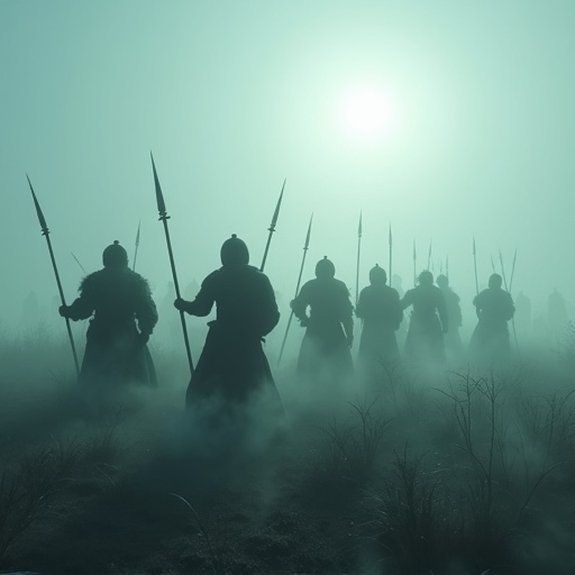
When shadows lengthen across abandoned battlefields and fog rolls through forgotten trenches, stories emerge of soldiers who’ve never left their posts. These spectral soldiers—ghostly warriors trapped between worlds—appear in military folklore from every major conflict in human history. They’re seen marching in formation through Civil War sites, manning phantom artillery in European fields, and patrolling Pacific islands where brutal battles once raged.
Witnesses describe transparent figures in outdated uniforms, carrying weapons from bygone eras. Some phantom armies replay their final battles nightly, while others stand eternal watch over sacred ground. These apparitions aren’t mere campfire tales. Credible observers, including officers and historians, have documented encounters with ghost armies that defy rational explanation, suggesting death doesn’t always discharge a soldier’s duty.
Ancient Roman Phantom Legions
The oldest documented ghost army sightings trace back to Rome’s mighty legions, whose spectral formations still march across Europe’s ancient roads. Britain’s Hadrian’s Wall hosts the most famous encounters—witnesses report seeing transparent soldiers in full battle gear patrolling the ancient fortification. They’ve heard Latin commands echo through fog and the rhythmic stomp of phantom boots on stone.
In 1953, Harry Martindale famously encountered Roman ghosts in York’s Treasurer’s House cellar. He watched twenty soldiers march through the wall, their legs visible only from the knees up—matching the original Roman road’s lower elevation. Germany’s Teutoburg Forest, where Varus lost three legions in 9 CE, regularly produces sightings of bloodied warriors wandering among trees. Local residents claim these spirits appear most frequently during September, coinciding with the battle’s anniversary.
Notable Cases or Sightings
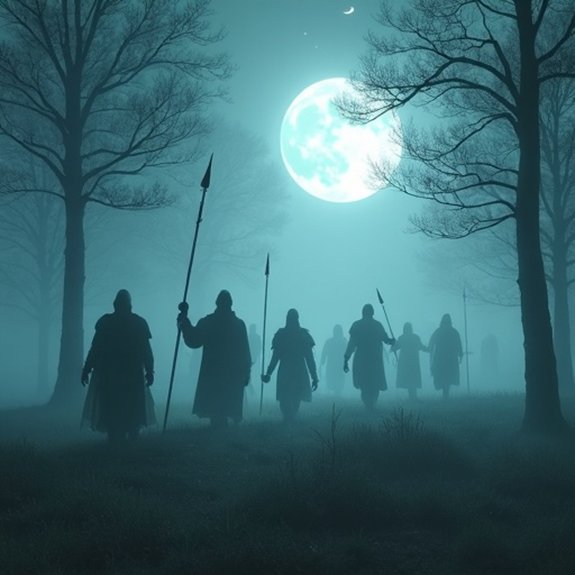
Though battlefield phantoms appear worldwide, several ghost army encounters stand out for their detailed witness accounts and historical verification. Dieppe’s beaches reportedly echo with ghostly gunfire every August 19th, marking the 1942 raid’s anniversary. Multiple witnesses have described hearing phantom bombardments and seeing spectral soldiers in the pre-dawn darkness.
At Marston Moor, England’s Civil War dead allegedly march across Yorkshire fields. In 1932, motorist Arthur Wright claimed he’d driven through columns of Roundhead cavalry that vanished upon contact.
Edge Hill’s phantom battle replays annually on October 23rd. King Charles I himself investigated reports in 1642, with royal commissioners confirming they’d witnessed the supernatural reenactment. Japan’s samurai armies supposedly haunt Sekigahara’s fields, while Antietam’s Bloody Lane produces unexplained musket smoke without fire.
Common Theories or Explanations
Scientists and paranormal researchers have proposed multiple explanations for these battlefield apparitions, ranging from psychological phenomena to environmental factors. Some experts suggest that intense emotional trauma imprints itself on locations, creating “stone tape” recordings that replay under specific conditions. They’ve theorized that electromagnetic fields near battlegrounds might trigger hallucinations or activate dormant memories in visitors’ minds.
Others propose that infrasound—frequencies below human hearing—could cause feelings of dread and visual distortions that witnesses interpret as ghostly soldiers. Skeptics argue these sightings stem from pareidolia, where people’s brains create familiar patterns from random stimuli. Meanwhile, quantum physicists have explored whether parallel dimensions occasionally overlap at sites of massive energy release. Each theory attempts to explain why thousands of witnesses report remarkably similar experiences at historic battlefields worldwide.
Frequently Asked Questions
Can Ghost Armies Physically Harm or Kill Living People Who Encounter Them?
Ghost armies can’t physically harm or kill living people they encounter. They’re ethereal manifestations that may cause psychological distress, fear, or panic, but they lack corporeal form to inflict actual physical wounds or death.
Are There Specific Rituals or Methods to Summon Spectral Soldiers Deliberately?
Various occultists claim they’ve summoned spectral soldiers through battlefield séances, blood rituals at massacre sites, or by reciting ancient war chants while burning military artifacts. However, historians can’t verify these methods actually work or produce results.
Do Ghost Armies Appear More Frequently During Certain Seasons or Weather Conditions?
Ghost armies don’t favor specific seasons, but witnesses report they’re most visible during foggy nights and electrical storms. They’ll manifest more clearly when atmospheric conditions create natural barriers between worlds, especially autumn’s misty twilights.
Have Any Governments Officially Investigated or Documented Ghost Army Sightings?
Yes, Britain’s Ministry of Defence investigated phantom Roman soldiers at Treasurer’s House, York. Japan’s government documented samurai ghost armies near ancient battlefields. Canada’s Department of National Defence recorded unexplained military formations at Plains of Abraham.
Can Animals See or React to Spectral Soldiers That Humans Cannot Perceive?
Many paranormal investigators report that animals, particularly dogs and horses, often react fearfully to alleged spectral soldier locations. They’ll refuse to enter certain battlefields, bark at empty spaces, or display signs of distress humans don’t understand.



About The Author
