Ghost Staircases That Lead Nowhere
Ghost staircases defy logic and disturb the eye. They’re architectural anomalies that climb toward sealed ceilings or descend into solid walls, frozen mid-journey to destinations that don’t exist. Urban explorers find them in abandoned buildings, historians document them in preserved estates, and architects can’t always explain why they’re there. These orphaned structures tell stories of interrupted plans, concealed passages, and sometimes, deliberate mysteries that’ve outlasted their creators.
Introduction
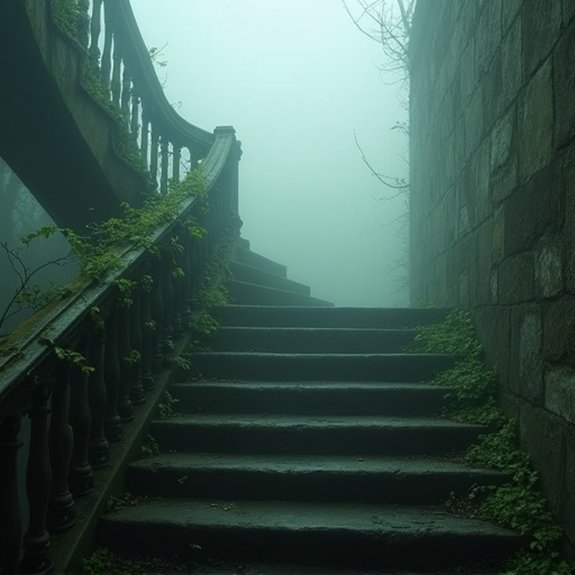
When old buildings undergo renovation or demolition, they sometimes leave behind architectural remnants that tell stories of their past—and among the most haunting of these are ghost staircases. These phantom structures appear as staircases attached to walls with no floors to reach, doorways that open to empty air, or steps that ascend into blank ceilings. They’re found in cities worldwide where rapid urban development has transformed neighborhoods, leaving fragments of demolished buildings clinging to surviving structures. New York’s exposed tenement stairs, London’s wartime bombing survivors, and Paris’s Haussmann-era remnants all showcase these architectural ghosts. They’ve become unexpected landmarks that capture public imagination, transforming from construction oversights into poignant memorials. These orphaned staircases represent more than failed demolition—they’re three-dimensional photographs of vanished lives and lost spaces.
Victorian Winchester Mystery House
Though most ghost staircases result from demolition or disaster, the Winchester Mystery House in San Jose, California, contains dozens of intentionally built stairs to nowhere—products of Sarah Winchester’s 38-year construction obsession. The widow of rifle magnate William Winchester believed she’d die if construction stopped, driving her to add rooms and features continuously from 1886 to 1922.
The mansion’s seven-story tower collapsed during the 1906 earthquake, leaving disconnected staircases suspended in space. Other stairs climb directly into ceilings, dead-end at walls, or terminate at sealed doors. One staircase ascends nine feet through forty-two two-inch steps. Another opens onto a fifteen-foot drop.
Today’s 160-room structure represents half the original building. Winchester’s architects couldn’t keep pace with her demands, resulting in the chaotic architectural anomalies that attract 12 million visitors annually.
Notable Cases or Sightings
Beyond Winchester’s architectural oddities, ghost staircases appear worldwide as haunting remnants of urban transformation. In London’s demolished tenements, exposed staircases cling to remaining walls where buildings once stood. New York’s abandoned subway stations feature stairs that ascend into sealed darkness, particularly the City Hall station’s ornate steps leading nowhere since 1945. In addition to these urban remnants, haunted tales from historic mansions evoke curiosity and fear, drawing visitors to their creaking hallways and shadowy corners. Each story whispers of long-forgotten inhabitants, who may still roam the elegant rooms, reminding us of the lives once lived within these walls. As dusk falls, the allure of such places deepens, inviting explorers to uncover the secrets hidden in their past.
Detroit’s Michigan Central Station showcases marble staircases climbing through gutted floors, while Berlin still preserves “Treppenhäuser” – solitary staircases from bombed WWII buildings. Philadelphia’s Eastern State Penitentiary contains a famous floating staircase, disconnected after partial demolitions.
Urban explorers’ve documented Chicago’s Damen Silos, where industrial stairs spiral upward without landings. Paris’s catacombs hide limestone steps carved centuries ago, ending at collapsed ceilings. These architectural ghosts aren’t supernatural but they’re equally unsettling.
Common Theories or Explanations
While architectural historians attribute most ghost staircases to interrupted construction or partial demolition, psychologists suggest these structures trigger deep-seated anxieties about incompleteness and abandoned purpose. Urban decay theorists argue they’re remnants of economic collapse—projects halted when funding dried up or developers fled. Structural engineers point to safety concerns that forced builders to seal upper floors while preserving staircases for potential future access.
Paranormal researchers claim electromagnetic fields concentrate around these dead-end structures, creating sensory distortions witnesses interpret as supernatural activity. Meanwhile, sociologists view them as symbols of broken promises—physical manifestations of communities’ unfulfilled aspirations. Some architects intentionally design non-functional staircases as artistic statements about life’s futility. Whether they’re construction failures, deliberate designs, or something unexplained, these orphaned staircases continue enchanting those who encounter them.
Frequently Asked Questions
Can Ghost Staircases Be Photographed or Do They Disappear on Camera?
Ghost staircases can’t be photographed since they don’t physically exist. They’re architectural illusions, paranormal phenomena, or metaphorical concepts that witnesses claim to see. Cameras capture only what’s physically present, so these mysterious staircases won’t appear in photographs.
Are There Any Safety Concerns When Encountering a Ghost Staircase?
Yes, explorers who’ve encountered ghost staircases report disorientation, temporal displacement, and memory gaps. They’ve experienced sudden vertigo, electromagnetic interference with devices, and psychological unease. Some claim they’ve aged hours while climbing for minutes.
Do Ghost Staircases Appear More Frequently in Certain Geographical Regions?
They don’t appear more frequently in specific regions. Ghost staircases manifest randomly across all geographical areas, though some paranormal researchers claim they’re slightly more common near historical sites, old battlefields, and areas with documented supernatural activity.
How Long Do Ghost Staircase Manifestations Typically Last Before Vanishing?
Most ghost staircase manifestations don’t follow predictable patterns, but witnesses report they typically last anywhere from several minutes to a few hours. Some rare cases persist for days before they’ll suddenly vanish without warning.
Can Animals Sense or See Ghost Staircases That Humans Cannot?
Animals often detect ghost staircases before humans do. Cats won’t cross certain thresholds, dogs bark at empty corners, and birds avoid specific aerial paths. Their heightened senses pick up electromagnetic disturbances that accompany these manifestations.

Haunted Mansions of the Gilded Age

Are We Being Watched Over Skinwalker Ranch?

Are Paranormal Encounters Tied to EMF Fields?
About The Author
