Ghosts of the Silk Road Caravans
The Silk Road‘s ancient trade routes hold more than just tales of commerce and cultural exchange. Merchants who’ve studied Persian chronicles know there’s something unsettling about the documented accounts of supernatural encounters along these paths. They’ve uncovered reports of ghostly camel bells echoing through abandoned passes and mysterious lights dancing across the Kyzylkum Desert. What these traders witnessed in those desolate stretches challenges conventional explanations of desert phenomena.
Introduction
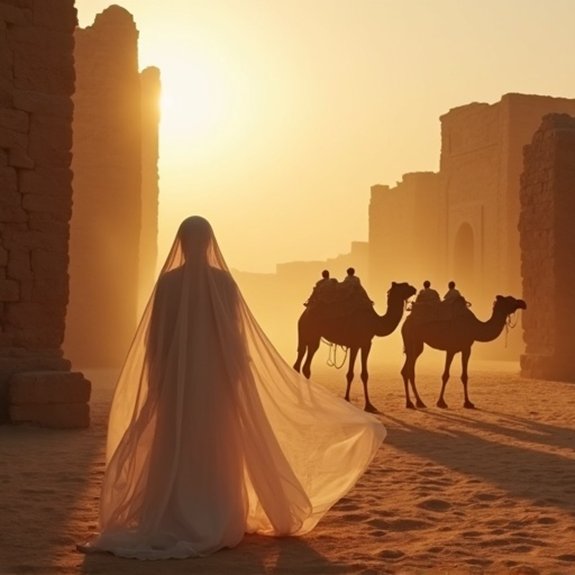
When ancient traders led their camels through the treacherous mountain passes and scorching deserts of Central Asia, they couldn’t have imagined their routes would shape civilizations for millennia to come. The Silk Road wasn’t a single path but a vast network of trade routes that connected China to the Mediterranean from the 2nd century BCE to the 15th century CE. Merchants exchanged silk, spices, precious metals, and ideas across 4,000 miles of challenging terrain. They’ve left behind abandoned caravanserais, forgotten cities, and countless artifacts buried in sand. Today’s archaeologists uncover these remnants, revealing stories of courage, commerce, and cultural exchange. The ghosts of these caravans still whisper through ruins scattered across deserts, their legacy etched into the foundation of modern global trade.
Ancient Persian Merchant Chronicles
While Roman historians focused on Mediterranean trade, Persian merchants meticulously documented their journeys along the Silk Road‘s most perilous stretches. These chronicles, preserved on clay tablets and papyrus scrolls, reveal extraordinary details about caravan life between 500 BCE and 650 CE.
Persian traders didn’t just record transactions—they mapped water sources, noted seasonal sandstorms, and catalogued which oasis towns harbored bandits. Their writings describe camel behavior during different moon phases and identify edible desert plants that saved countless lives. One merchant’s account from 312 BCE details a three-month crossing through the Taklamakan Desert, where his caravan encountered mirages that led travelers astray.
These documents prove Persian merchants weren’t merely traders but skilled survivalists who transformed the Silk Road from a death trap into a navigable commercial artery.
Notable Cases or Sightings
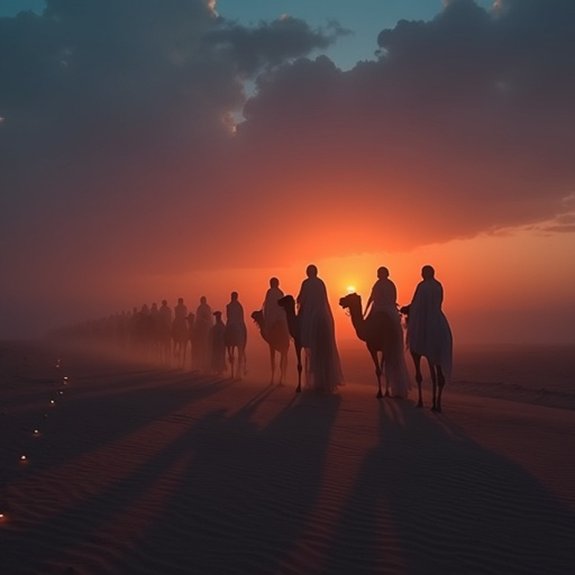
Though skeptics dismiss them as desert hallucinations, caravan guards and merchants have reported eerily consistent supernatural encounters along the Silk Road for over two millennia. The Taklamakan Desert’s “drumming sands” phenomenon has terrified travelers since 200 BCE, when Chinese chroniclers first documented phantom armies marching through moonlit dunes. In 1907, archaeologist Aurel Stein’s expedition recorded ghostly camel bells near Dunhuang’s abandoned watchtowers, where thirteenth-century Mongol raiders had massacred an entire caravan.
Modern sightings persist. In 1982, Soviet geologists photographed unexplained lights following ancient routes through Uzbekistan’s Kyzylkum Desert. Pakistani truckers won’t drive the Karakoram Highway’s “Ghost Bridge” section after midnight, citing apparitions of medieval traders. Most disturbing are Kazakhstan’s “walking fires”—luminous figures that’ve reportedly guided lost travelers to forgotten oasis ruins since the seventh century.
Common Theories or Explanations
Scientists and historians have proposed various explanations for these persistent phenomena, ranging from natural atmospheric effects to psychological responses to extreme isolation. Desert mirages created by temperature inversions can produce convincing illusions of moving caravans, complete with sounds carried across vast distances by unusual acoustic conditions. Some researchers point to infrasound—frequencies below human hearing that can trigger feelings of dread and visual hallucinations.
Psychologists suggest that exhausted travelers’ minds might construct familiar patterns from ambiguous stimuli, especially when expecting danger. The desert’s sensory deprivation amplifies this effect. Others propose that magnetic anomalies along certain routes affect brain function, while folklore experts argue these stories serve as cautionary tales, warning travelers about dangerous paths. Each theory attempts to demystify experiences that’ve haunted the Silk Road for centuries.
Frequently Asked Questions
What Modern Equipment Is Most Effective for Detecting Paranormal Activity Along Caravan Routes?
Paranormal investigators claim EMF detectors, thermal cameras, and digital audio recorders work best for capturing ghostly phenomena along ancient trade routes. They’ve documented unexplained electromagnetic spikes and temperature drops where caravans once traveled through desolate areas.
Are There Specific Months When Ghost Sightings Peak on the Silk Road?
Ghost sightings along the Silk Road reportedly peak during October and November when autumn sandstorms sweep through Central Asia. Local researchers’ve documented increased paranormal reports during these months, particularly near abandoned caravanserais in Uzbekistan and Xinjiang.
Which Contemporary Tour Companies Offer Ghost-Hunting Expeditions to Silk Road Sites?
Several tour companies don’t specifically advertise ghost-hunting expeditions to Silk Road sites. While operators like Wild Frontiers and Koryo Tours offer historical tours through ancient caravan routes, they haven’t marketed paranormal investigation experiences there.
Have Any Governments Officially Restricted Access to Haunted Caravan Locations?
No governments have officially restricted access to locations specifically because they’re considered haunted caravan sites. Authorities typically limit access to Silk Road areas for archaeological preservation, military security, or environmental protection reasons, not paranormal concerns.
What Safety Precautions Should Investigators Take When Exploring Reportedly Haunted Caravan Ruins?
Investigators should carry satellite phones, GPS devices, and emergency supplies when exploring haunted caravan ruins. They’ll need permits, local guides, and protective gear against unstable structures. It’s vital they inform authorities about their planned routes beforehand.

The Spirit of Kitty Hawk: First Flight Ghosts

The Ghosts of Gettysburg: New Eyewitness Reports

Apparitional Animals: Ghost Dogs, Cats, Birds
About The Author
