The 1950s UFO Panics: Mass Hysteria or Real Sighting?
The summer of 1952 saw Washington D.C.’s radar screens light up with unexplained objects hovering over the nation’s capital. Fighter jets scrambled while witnesses flooded police switchboards. Government officials couldn’t explain what thousands claimed they’d seen, and Project Blue Book‘s investigations raised more questions than answers. The phenomenon wasn’t isolated—similar reports poured in from credible sources nationwide. What triggered this unprecedented wave of sightings across America?
Introduction
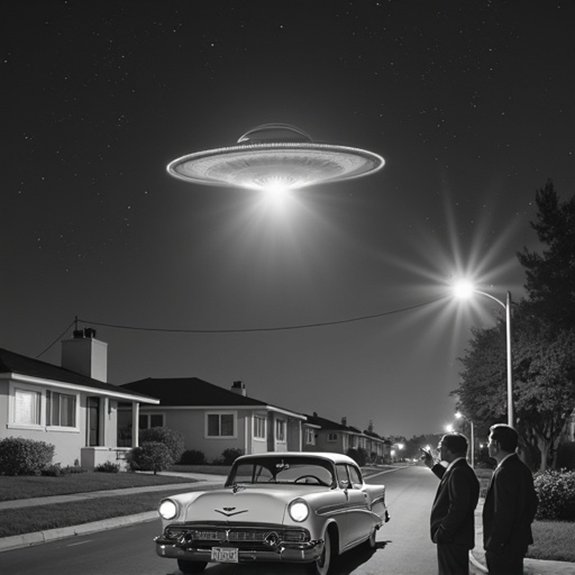
When mysterious objects began appearing in American skies during the early 1950s, they sparked a nationwide phenomenon that would define an era. Reports of strange lights and disc-shaped craft flooded police stations, newspapers, and military bases across the country. The Cold War’s heightened tensions amplified public anxiety, as Americans wondered whether they’d witnessed Soviet technology, weather balloons, or something otherworldly.
The Air Force launched Project Blue Book to investigate thousands of sightings, while Hollywood capitalized on the hysteria with science fiction films. Communities held sky-watching parties, and UFO clubs formed in major cities. Scientists debated explanations ranging from atmospheric phenomena to mass delusion. This period’s UFO panic wasn’t just about flying saucers—it reflected deeper fears about nuclear war, technological change, and humanity’s place in the universe.
Kenneth Arnold’s 1947 Encounter
Nine shiny objects flying in formation near Mount Rainier would forever change how Americans looked at the sky. On June 24, 1947, private pilot Kenneth Arnold spotted these mysterious craft while searching for a crashed military transport plane. He described them as crescent-shaped objects that moved like “saucers skipping on water,” traveling at an estimated 1,200 miles per hour—far exceeding any known aircraft’s capabilities.
Arnold’s account sparked immediate media frenzy. Newspapers coined the term “flying saucers,” though Arnold hadn’t used that exact phrase to describe their shape. His credibility as an experienced pilot and respected businessman made dismissing his story difficult. The sighting triggered thousands of similar reports nationwide within weeks, marking the birth of modern UFO phenomena and America’s enduring fascination with unidentified aerial objects.
Notable Cases or Sightings
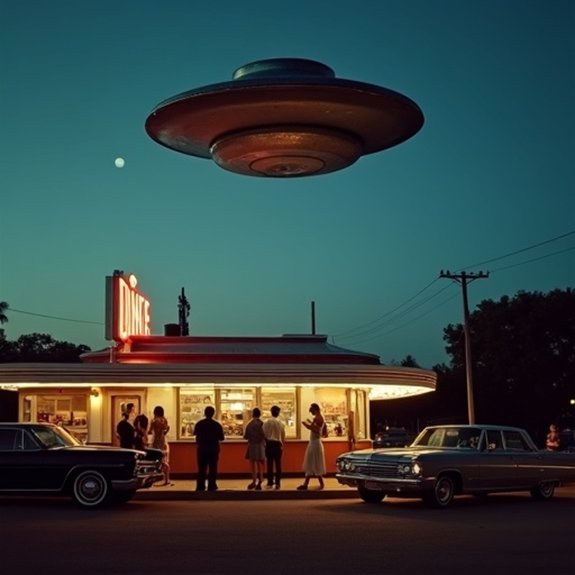
The summer of 1952 brought the most dramatic UFO flap in American history when mysterious objects swarmed over Washington, D.C.’s restricted airspace. Radar operators tracked multiple unidentified targets moving at impossible speeds over two consecutive weekends in July. Fighter jets scrambled but couldn’t intercept the objects, which vanished whenever aircraft approached. In addition to these perplexing sightings, numerous reports of foo fighter sightings during WWII emerged from pilots who encountered strange glowing orbs during combat missions. These mysterious phenomena have led to countless theories about their origin, ranging from advanced technology to extraterrestrial interventions. As eyewitness accounts poured in, the intrigue surrounding aerial phenomena only deepened, prompting further investigations long after the war had ended.
That same year, the Flatwoods Monster terrorized West Virginia when witnesses encountered a ten-foot-tall creature with glowing eyes after investigating a crashed object. In 1955, the Kelly-Hopkinsville encounter shocked Kentucky when a family claimed small, silvery beings attacked their farmhouse for hours.
The Levelland, Texas, sightings of 1957 stood out when multiple motorists independently reported their vehicles stalling as an egg-shaped craft approached. These cases weren’t isolated incidents—they represented thousands of reports flooding authorities nationwide.
Common Theories or Explanations
As these reports multiplied across America, scientists, military officials, and skeptics scrambled to explain what people were seeing. The Air Force’s Project Blue Book investigators attributed most sightings to weather balloons, atmospheric phenomena, or misidentified aircraft. Scientists pointed to temperature inversions that created optical illusions and ball lightning that resembled flying discs.
Psychologists offered different explanations. They argued mass hysteria spread through communities already anxious about Cold War tensions. Dr. Donald Menzel, a Harvard astronomer, insisted witnesses mistook natural phenomena like Venus or swamp gas for spacecraft. Military officials suggested Soviet surveillance devices might’ve triggered some reports. Meanwhile, believers countered that witnesses included trained pilots and police officers who wouldn’t confuse ordinary objects with structured craft. These competing theories intensified public debate about what truly filled America’s skies.
Frequently Asked Questions
How Did the UFO Panic Affect Popular Culture and Entertainment in the 1950S?
The UFO panic sparked Hollywood’s golden age of science fiction films, inspired comic books featuring alien invasions, and generated countless pulp novels. Television shows embraced extraterrestrial themes while toy manufacturers produced flying saucer merchandise nationwide.
What Role Did Cold War Tensions Play in Shaping Public UFO Beliefs?
Cold War tensions made Americans interpret mysterious aerial phenomena as Soviet threats rather than alien visitors. People’s fears of nuclear attack and communist infiltration shaped how they’d perceive unexplained lights, assuming they’re enemy surveillance technology.
How Did Different Countries Outside America Respond to the UFO Phenomenon?
Countries responded differently to UFO reports. Britain’s military investigated sightings systematically, France created official research groups, while Soviet media dismissed them as Western propaganda. Brazil documented encounters openly, and Japan’s public showed intense fascination with extraterrestrial possibilities.
What Psychological Factors Made People More Susceptible to UFO Hysteria?
Cold War anxieties made people fear Soviet technology and nuclear threats. Media’s sensational coverage amplified paranoia. Scientists’ inability to explain aerial phenomena created uncertainty. Conformist culture pressured witnesses to report similar experiences, reinforcing collective beliefs.
How Did the UFO Panic Impact Funding for Space and Aviation Research?
The UFO panic didn’t directly increase government space funding, but it heightened public interest in aerospace technology. Officials channeled concerns into legitimate research programs, indirectly boosting support for NACA’s expansion into NASA and military aviation projects.
The Tehran UFO Incident of 1976

Abandoned Military Bases and UFO Sightings

The Mystery of Alien Implants in Abductees
About The Author
