Are UFOs Sentient Beings?
The notion that UFOs aren’t vehicles but living entities has gained traction among researchers who’ve documented their shape-shifting abilities and seemingly intelligent responses to human presence. These aerial phenomena display characteristics that defy conventional explanations—they merge, split, and react to observers in ways that suggest awareness. What’s most compelling isn’t just their advanced capabilities, but their apparent decision-making that mirrors biological intelligence rather than programmed machinery.
Introduction
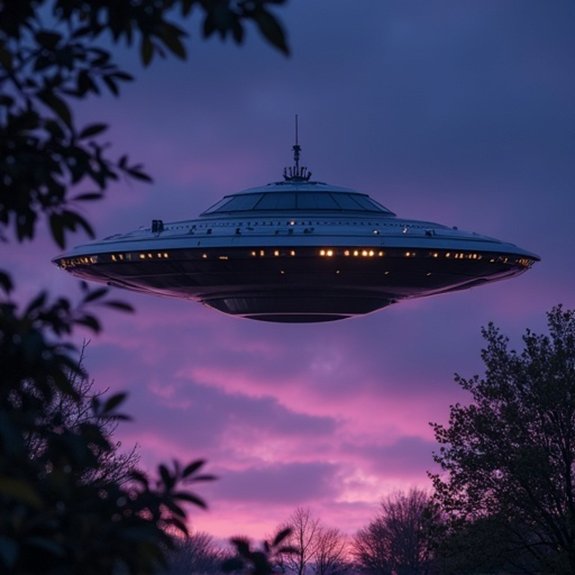
What if the unidentified objects darting through Earth’s skies aren’t machines at all, but living entities? This radical hypothesis challenges conventional assumptions about UFO phenomena. While most researchers assume these objects are advanced spacecraft, some scientists and theorists propose they’re conscious beings existing in forms beyond human comprehension.
The sentient UFO theory emerged from puzzling observations: objects that change shape instantaneously, respond to human thoughts, and defy known physics. These behaviors mirror biological adaptability more than mechanical operation. Plasma-based life forms, interdimensional organisms, or energy beings represent possibilities that stretch scientific imagination.
This perspective shifts the entire UFO discussion from questions about extraterrestrial technology to reflections on non-human consciousness. If UFOs are alive, humanity’s approach to understanding and potentially communicating with them requires complete reevaluation.
Ancient Astronaut Cave Paintings
The concept of living UFOs gains unexpected support from prehistoric art discovered across continents. Cave paintings from Australia’s Kimberley region depict “Wandjina” figures with large eyes and halo-like heads that researchers’ve linked to otherworldly visitors. Similar imagery appears in Utah’s Barrier Canyon, where 8,000-year-old pictographs show elongated beings with antenna-like projections.
Algeria’s Tassili n’Ajjer caves contain 10,000-year-old drawings of floating humanoids wearing what modern observers interpret as helmets or breathing apparatus. These figures often appear alongside disc-shaped objects hovering above human settlements. Val Camonica’s Italian petroglyphs feature beings with radiating crowns that ancient astronaut theorists believe represent conscious entities rather than mechanical craft. The recurring motif of eyes within circular vessels across disparate cultures suggests early humans may’ve perceived UFOs as living, watching presences rather than vehicles.
Notable Cases or Sightings
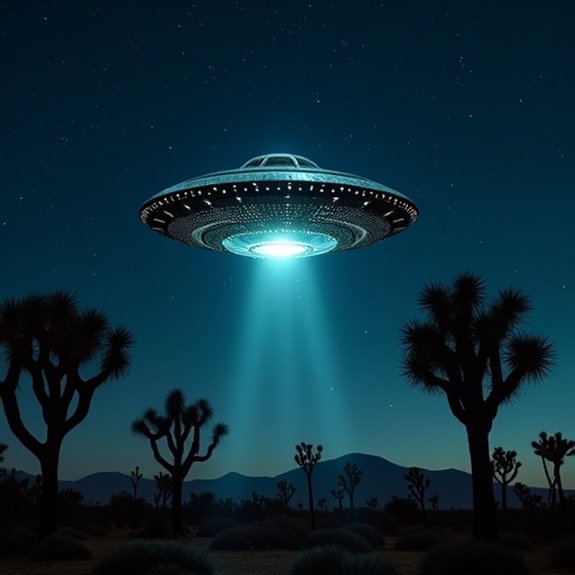
Kenneth Arnold’s 1947 encounter sparked modern UFO fascination when he witnessed nine crescent-shaped objects that moved like living creatures skipping across water near Mount Rainier. His description birthed the term “flying saucer” and suggested purposeful, organism-like movement.
The 1976 Tehran incident involved F-4 Phantom jets pursuing a brilliant object that disabled their weapons systems when approached. The UFO’s evasive maneuvers and selective interference with electronics demonstrated intelligent responses to threats.
Commander David Fravor’s 2004 “Tic Tac” encounter off California’s coast revealed an object without visible propulsion that mimicked his F/A-18’s movements before vanishing. The craft’s playful behavior suggested awareness and curiosity.
These cases share common elements: objects displaying reactive behavior, apparent consciousness of observers, and movements defying conventional physics while exhibiting what witnesses describe as sentient characteristics.
Common Theories or Explanations
Several competing theories attempt to explain why UFOs might exhibit sentient qualities rather than behaving as conventional craft. The plasma intelligence hypothesis suggests that atmospheric plasma formations could develop consciousness-like properties, responding to electromagnetic fields and human observation. Some researchers propose that UFOs aren’t vehicles but living organisms from parallel dimensions, capable of phasing between realities.
The artificial intelligence theory argues that advanced civilizations might’ve created autonomous probes with sophisticated decision-making capabilities, making them appear sentient. Meanwhile, the collective consciousness hypothesis posits that UFOs manifest from humanity’s shared psychic energy, explaining their responsive behavior to witnesses’ thoughts.
Carl Jung’s psychoid theory bridges psychology and physics, suggesting UFOs exist at the intersection of mind and matter, neither fully physical nor purely psychological phenomena.
Frequently Asked Questions
How Would We Communicate With Sentient UFOS if Contact Were Established?
Scientists would likely attempt mathematical or pictorial signals first, then analyze any returned patterns for structure. They’d use radio waves, light pulses, or quantum entanglement while AI systems work to decode potential linguistic frameworks.
What Ethical Considerations Arise if UFOS Are Confirmed as Sentient Beings?
Scientists would face profound ethical dilemmas regarding rights, protection, and treatment of sentient UFOs. They’d need to contemplate consent for study, potential harm from human technology, and whether Earth’s laws should extend to non-biological intelligence.
Could Sentient UFOS Have Different Concepts of Time and Space Perception?
They’d likely perceive time and space differently than humans do. Their consciousness might experience non-linear time, view multiple dimensions simultaneously, or sense spacetime as unified rather than separate concepts, fundamentally altering their reality perception.
What Legal Rights Would Sentient UFOS Have Under International Law?
Sentient UFOs wouldn’t have legal rights under current international law since existing frameworks don’t recognize non-human intelligence. They’d need new treaties establishing personhood criteria beyond human-centric definitions, similar to ongoing debates about AI and animal rights.
How Might Confirming UFO Sentience Affect Major World Religions?
Confirming UFO sentience would challenge most religions’ human-centric creation stories. Some faiths might expand theological frameworks to include extraterrestrial souls, while others could reject the findings. It’d likely spark intense debates about humanity’s special status and divine purpose.



About The Author
