The Washington D.C. UFO Photographs
During the summer of 1952, mysterious lights descended upon America’s capital, triggering military scrambles and nationwide panic. Photographers Al Chop and Shell Alpert captured compelling images of bright objects hovering near the Washington Monument and Capitol dome. These photographs, combined with radar confirmations and pilot testimonies, forced the Air Force into unprecedented public explanations. What they couldn’t explain, however, would reshape how the government handles unidentified aerial phenomena forever.
Introduction
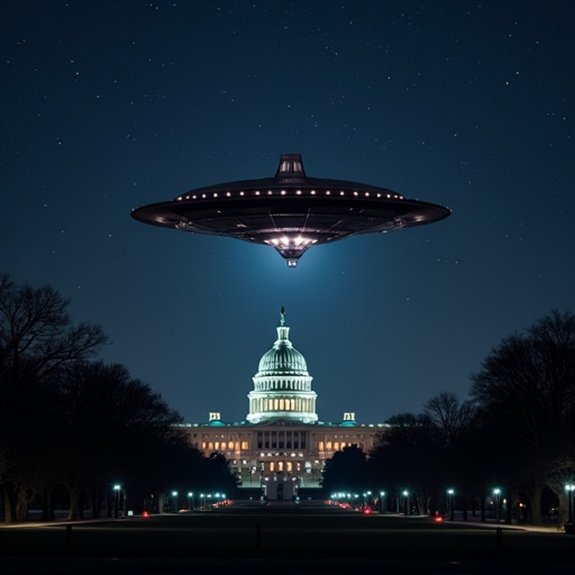
When mysterious lights appeared over the nation’s capital in July 1952, they sparked one of the most significant UFO flare-ups in American history. The incidents occurred over two consecutive weekends, with radar operators at Washington National Airport and Andrews Air Force Base tracking unidentified objects moving at extraordinary speeds. Air traffic controllers watched these anomalies perform impossible maneuvers, while civilian pilots reported visual confirmations of bright lights surrounding their aircraft.
The sightings triggered nationwide panic and prompted the Air Force’s largest press conference since World War II. Multiple photographers captured images of the phenomena, creating some of the era’s most controversial UFO documentation. These photographs became central evidence in debates about extraterrestrial visitation and government transparency regarding unidentified aerial phenomena.
952 Capitol Radar Incidents
As radar screens at Washington National Airport flickered to life on the night of July 19, 1952, air traffic controller Edward Nugent noticed something extraordinary—seven slow-moving objects in restricted airspace that shouldn’t have contained any aircraft. The objects moved at speeds between 100 and 130 mph before suddenly accelerating to incredible velocities. Harry Barnes, the senior controller, confirmed the anomalies on his scope. They weren’t equipment malfunctions—multiple radar sets tracked identical targets.
Andrews Air Force Base’s radar operators detected the same objects. Controllers watched the blips hover over the White House and Capitol building, then streak away at speeds exceeding 7,000 mph. The incidents repeated on July 26, prompting the Air Force to scramble F-94 interceptors. Pilots reported visual confirmation of bright lights that vanished when approached.
Notable Cases or Sightings
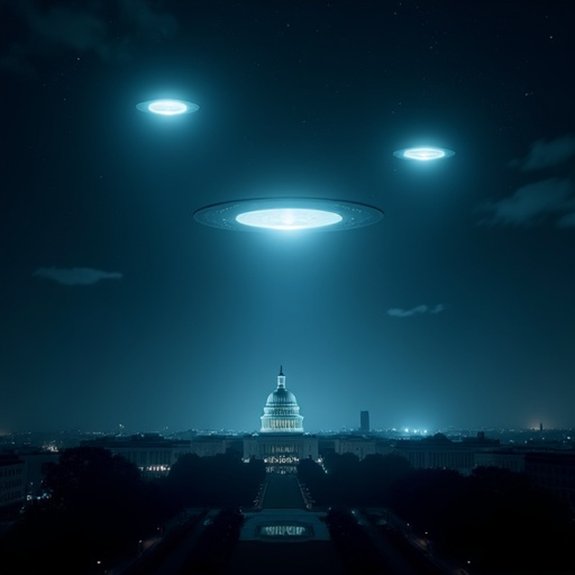
The radar incidents sparked a wave of civilian photography attempts across the capital. Throughout July 1952, dozens of witnesses captured mysterious lights hovering over landmarks. Photographer Al Chop documented several bright objects near the Washington Monument, while Shell Alpert’s famous image showed four luminous discs above the Capitol dome. The objects displayed unconventional flight patterns that defied conventional aircraft capabilities.
Military personnel weren’t exempt from sightings. Major Dewey Fournet observed orange-red lights performing sharp 90-degree turns at impossible speeds. Commercial pilot S.C. Pierman tracked six white lights from his cockpit for fourteen minutes, confirming ground radar readings. The National Airport’s control tower staff photographed objects that accelerated from hovering positions to over 7,000 mph. These cases provided compelling visual evidence that matched radar data, strengthening the credibility of witness testimonies.
Common Theories or Explanations
While government officials scrambled to explain the incidents, temperature inversion emerged as the leading scientific theory. This atmospheric phenomenon occurs when warm air traps cooler air beneath it, creating false radar returns that mimic solid objects. The Civil Aeronautics Administration supported this explanation, noting Washington’s humid summer conditions were ideal for such inversions.
Military analysts proposed alternative theories. Some suggested the radar operators misidentified conventional aircraft or weather balloons. Others blamed equipment malfunctions or electromagnetic interference from the city’s power grid. Captain Edward Ruppelt, who’d investigated the events for Project Blue Book, later questioned the temperature inversion theory, arguing it couldn’t account for the visual sightings by pilots and civilians. The Pentagon’s final position remained deliberately vague, acknowledging the radar anomalies while avoiding definitive conclusions about their origin.
Frequently Asked Questions
Where Can I View the Original UFO Photographs From the D.C. Incidents?
They can view original photographs at the National Archives in College Park, Maryland. Some images are digitized on the Project Blue Book Archive website. The Library of Congress also maintains copies of period newspaper photographs.
Were Any Military Personnel Disciplined for Their Testimonies About the Sightings?
No military personnel faced official discipline for their testimonies about the D.C. UFO sightings. Air traffic controllers and pilots who reported the incidents weren’t punished, though some faced informal pressure to downplay their accounts.
How Much Did the Government Spend Investigating These Specific UFO Incidents?
The government didn’t disclose specific costs for investigating the 1952 Washington D.C. UFO incidents. The Air Force’s Project Blue Book handled the cases within its existing budget, but they’ve never released itemized expenses for individual investigations.
Are There Any Museums or Exhibits Featuring Artifacts From These Events?
No physical artifacts exist from the 1952 Washington D.C. UFO incidents since they involved radar blips and lights. However, the National Archives holds related documents, and some aviation museums occasionally display reproductions of the photographs.
Which Specific Camera Models and Film Types Captured the UFO Photographs?
Photographers used various cameras including Speed Graphics and press cameras typical of 1952. They shot on standard black-and-white film stock, likely Kodak’s Tri-X or Plus-X. Specific camera models and film types weren’t consistently documented.

Aliens in Ancient Greece: Myth or Memory?
The “Ghost Rockets” of 1946

Did Ancient Civilizations Communicate With ETs Through Sound?
About The Author
