The Belgian UFO Flap of 1989–1990
Between November 1989 and April 1990, Belgium’s skies became the stage for one of history’s most credible UFO events. Thousands of witnesses, including police officers and military personnel, reported massive triangular craft performing impossible maneuvers above their cities. The Belgian Air Force scrambled F-16 fighters to intercept these objects, recording radar data that defied conventional explanation. What they discovered would challenge everything officials thought they knew about aerial phenomena.
Introduction
Between November 1989 and April 1990, thousands of Belgian citizens reported witnessing large, triangular objects moving silently through their skies, marking one of the most documented UFO waves in modern history. The phenomenon attracted unprecedented attention from military officials, police forces, and scientific researchers who’d typically dismiss such claims. Belgium’s Air Force scrambled F-16 fighters to intercept the objects, while radar stations tracked anomalous signals that defied conventional explanation.
The wave’s credibility stemmed from witnesses including police officers, military personnel, and government officials who couldn’t explain what they’d observed. Unlike typical UFO cases, Belgian authorities didn’t dismiss or ridicule the reports. Instead, they launched official investigations and released their findings publicly, making this event unique in UFO history.
November 29, 1989 Sighting
Two police officers patrolling near Eupen spotted a triangular craft with bright lights hovering above a field, initiating what would become Belgium’s most famous UFO encounter. The object displayed three bright white lights at its corners and a red light at its center. It moved silently across the sky, making sharp turns that defied conventional aircraft capabilities.
Over the next hour, the officers tracked the craft as it glided toward Kettenis. They contacted dispatch, prompting additional police units to respond. Multiple witnesses, including thirteen other officers, confirmed the sighting. The object’s estimated size ranged from 25 to 100 meters across. It maintained low altitude, sometimes hovering just above treetops. Air traffic control detected no conventional aircraft in the area. The craft eventually accelerated rapidly and disappeared, leaving investigators puzzled.
Notable Cases or Sightings
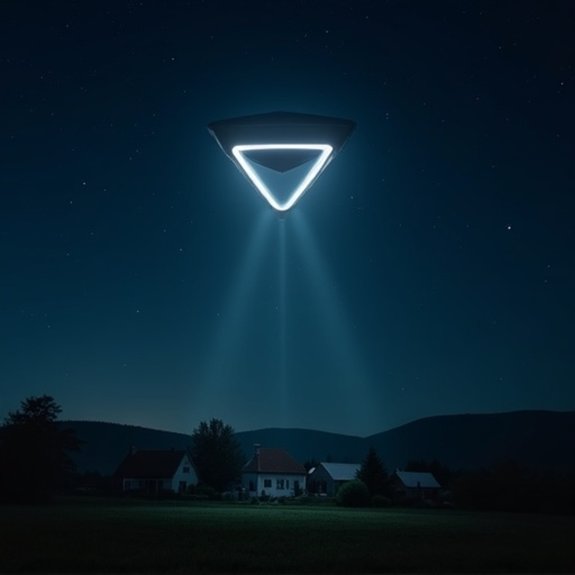
Throughout the Belgian UFO wave, several encounters stood out for their credibility and the quality of witness testimony. On March 30, 1990, two F-16 fighters scrambled from Beauvechain Air Base after multiple radar contacts. The jets’ onboard systems recorded objects accelerating from 280 to 1,700 km/h while dropping from 3,000 to 500 meters in seconds. Colonel Wilfried De Brouwer later confirmed these readings weren’t equipment malfunctions.
The December 1989 sightings near Eupen involved over 140 witnesses, including thirteen police officers who tracked a triangular craft for hours. Gendarmes Heinrich Nicoll and Hubert von Montigny observed it hovering silently above Lake Gileppe before it accelerated toward Germany.
Perhaps most compelling was the Petit-Rechain photograph taken in April 1990, showing a triangular object with three bright lights—though its authenticity remains debated.
Common Theories or Explanations
The extraordinary nature of these sightings prompted investigators to examine multiple explanations for the Belgian UFO wave. Skeptics‘ve proposed that witnesses misidentified conventional aircraft, particularly the then-classified F-117 Nighthawk stealth fighter. However, the U.S. Air Force denied operating these aircraft over Belgium during that period.
Some researchers suggested mass hysteria amplified by media coverage created a psychological contagion effect. Others theorized witnesses saw experimental military blimps or advertising dirigibles. The triangular shape descriptions led experts to reflect on secret NATO reconnaissance platforms.
Natural phenomena explanations included temperature inversions creating unusual light reflections and plasma formations in the atmosphere. Belgian Air Force radar operators initially contemplated equipment malfunctions, though multiple independent systems detected the anomalies. Despite extensive investigation, no single theory’s adequately explained all reported characteristics.
Frequently Asked Questions
What Was the Official Belgian Military Response to the UFO Incidents?
The Belgian Air Force scrambled F-16 fighter jets to intercept unidentified objects detected on radar. They couldn’t establish visual contact despite multiple attempts. Military officials later acknowledged the incidents but couldn’t explain the phenomena.
Did Any Physical Evidence or Debris Remain From the Encounters?
No physical evidence or debris remained from the Belgian UFO encounters. Despite thousands of witness reports, radar tracking, and military jet pursuits, investigators didn’t recover any material traces, landing marks, or physical artifacts from the incidents.
How Did the Belgian UFO Wave Eventually End?
The sightings gradually decreased in frequency throughout 1990 and fundamentally stopped by mid-1991. Authorities didn’t provide definitive explanations, public interest waned, and the phenomenon simply faded away without any official conclusion or resolution being reached.
Were Similar UFO Flaps Reported in Neighboring European Countries During This Period?
While Belgium experienced its intense UFO wave, neighboring countries didn’t report similar widespread flaps during 1989-1990. France, Germany, and the Netherlands recorded individual sightings but nothing matching Belgium’s coordinated mass observations and military involvement.
What Long-Term Impact Did These Events Have on Belgian UFO Research?
The Belgian UFO flap established SOBEPS as a leading civilian research organization, prompted military cooperation protocols for UFO investigations, and inspired Belgium’s scientific community to develop more systematic approaches for documenting and analyzing anomalous aerial phenomena.

Extraterrestrials in Ancient Sumerian Texts
The Wow! Signal: a Message From Space?

Governments and the Cover-Up of UFOs
About The Author
