The Socorro Incident: Sheriff’s Sighting
Before Officer Lonnie Zamora‘s encounter shocked the nation in 1964, New Mexico’s skies had already become a hotbed of unexplained aerial phenomena. The state’s remote deserts and military installations had attracted numerous UFO reports throughout the 1950s and early ’60s, each adding to a growing pattern of strange occurrences. What made Socorro different wasn’t just the witness’s credibility—it’s what investigators found at the scene that changed everything.
Introduction
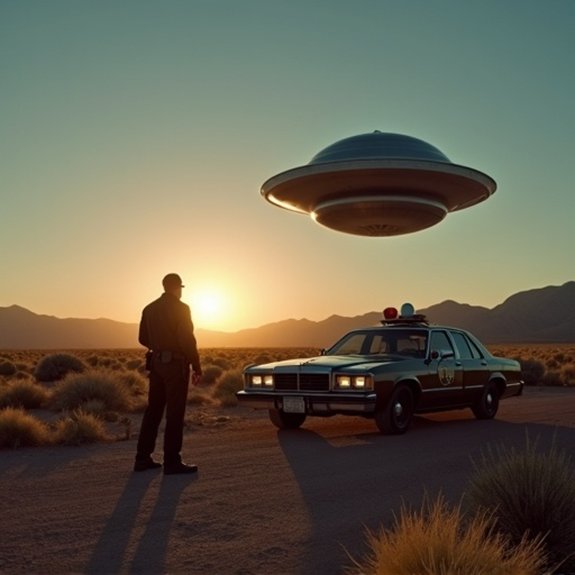
When police officer Lonnie Zamora reported seeing an egg-shaped craft and two small beings in the New Mexico desert on April 24, 1964, he didn’t expect his encounter to become one of the most compelling UFO cases in history. The Socorro incident stands apart from other UFO sightings because it involved a credible law enforcement witness who’d initially pursued what he thought was a speeding vehicle. Zamora’s detailed account included physical evidence at the landing site, including burned vegetation and impressions in the ground. The case attracted immediate attention from the Air Force’s Project Blue Book, the FBI, and civilian researchers. Despite extensive investigation, no conventional explanation has satisfied all the evidence. The incident’s enduring mystery has made it a cornerstone case in UFO research.
Pre-1964 New Mexico UFO Activity
Before Lonnie Zamora’s encounter captured international attention, New Mexico had already established itself as a hotspot for unexplained aerial phenomena. The state’s UFO history stretched back to the late 1940s, with hundreds of reports flooding local authorities and military installations. Residents frequently spotted strange lights zigzagging across desert skies, metallic discs hovering near atomic testing sites, and fast-moving objects that defied conventional explanation.
The 1947 Roswell incident had put New Mexico on the UFO map, though the military’s weather balloon explanation temporarily quieted public speculation. Throughout the 1950s, witnesses near White Sands Missile Range and Los Alamos reported cylindrical craft and glowing orbs. These sightings weren’t limited to civilians—pilots, police officers, and military personnel filed official reports describing objects that outmaneuvered jets and vanished instantly.
Notable Cases or Sightings
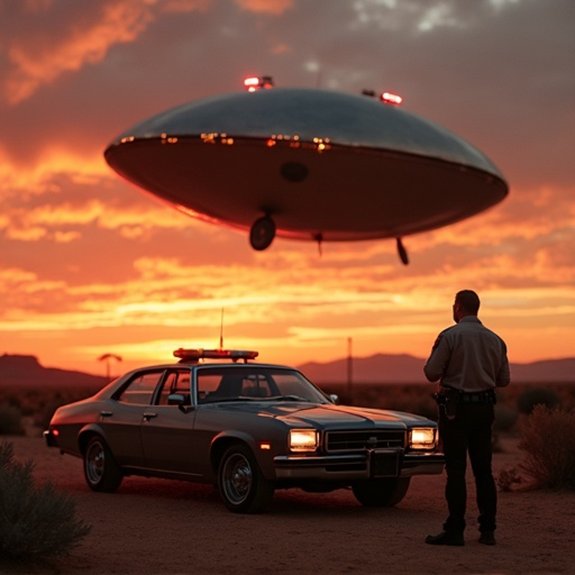
The Socorro incident of April 24, 1964, stands as New Mexico’s most thoroughly documented UFO encounter. Police officer Lonnie Zamora witnessed a white, egg-shaped craft with landing gear while pursuing a speeder outside Socorro. He observed two small figures in white coveralls near the object before it emitted a roaring flame and ascended rapidly into the sky.
The craft left physical evidence including burned vegetation, four rectangular landing impressions, and metal scrapings on a rock. Multiple witnesses reported seeing the object or its flame from different locations. Project Blue Book investigators, including astronomer J. Allen Hynek, couldn’t explain the sighting despite extensive investigation. The FBI and military examined the site within hours, documenting fresh traces before contamination occurred. Zamora’s credibility as a respected officer strengthened the case’s significance.
Common Theories or Explanations
While investigators have proposed numerous explanations for the Socorro incident over six decades, none have fully accounted for all the evidence Zamora reported. The Air Force’s Project Blue Book initially classified it as “unidentified” after ruling out aircraft, helicopters, and weather balloons. Some researchers’ve suggested a classified lunar landing test vehicle from White Sands Missile Range, though no records support this theory.
Skeptics proposed hoax scenarios involving local college students using pyrotechnics and props, but investigators couldn’t find evidence of staging. Others’ve theorized experimental military craft, plasma phenomena, or misidentified conventional aircraft under unusual conditions. The physical traces—burned vegetation, metal scrapings, and landing pad impressions—complicated dismissive explanations. Each theory’s struggled to explain the craft’s reported performance, the beings Zamora observed, and the immediate physical evidence documented by multiple witnesses who arrived shortly after.
Frequently Asked Questions
What Physical Evidence Was Collected From the Socorro Landing Site?
Investigators collected four wedge-shaped depressions in the ground, burned greasewood bushes, and vitrified sand at the site. They’d also documented metal scrapings on a rock and measured the landing pad impressions’ specific depths and spacing.
Did Lonnie Zamora Experience Any Health Effects After the Encounter?
Lonnie Zamora didn’t report any significant health effects after his encounter. He experienced temporary eye irritation from the bright light and felt shaken emotionally, but medical examinations found no radiation exposure or lasting physical harm.
How Did the Socorro Incident Impact Tourism in the Area?
The Socorro incident considerably boosted tourism in the small New Mexico town. Visitors flocked to see the landing site, local businesses created UFO-themed merchandise, and the town’s embraced its newfound fame as a UFO hotspot.
What Was Project Blue Book’s Official Classification of the Case?
Project Blue Book officially classified the Socorro incident as “unidentified” after their investigation couldn’t explain what Officer Lonnie Zamora witnessed. It’s remained one of Blue Book’s most puzzling cases, with investigators finding no conventional explanation.
Did Any Other Law Enforcement Officers Corroborate Zamora’s Account?
Yes, State Police Sergeant Sam Chavez arrived minutes after Zamora’s sighting and confirmed seeing smoldering brush and peculiar ground impressions at the scene, though he didn’t witness the craft itself that Zamora had reported seeing.
Did the Moon Landing Hide UFO Encounters?

Crop Circles: Hoaxes or Hidden Messages?

Is Hypnosis Unlocking Alien Abduction Memories?
About The Author
