The White Buffalo Calf Woman
The White Buffalo Calf Woman‘s appearance to the Lakota people marked a turning point that still reverberates through Native American spirituality today. She didn’t just deliver teachings—she fundamentally transformed how an entire culture understood their relationship with the cosmos. The sacred pipe she brought became more than a ceremonial object; it’s served as a bridge between worlds. But what makes certain white buffalo births spark nationwide pilgrimages and prophecy claims?
Introduction

When the Lakota people speak of their most sacred teachings, they’re referring to the gifts brought by White Buffalo Calf Woman, a holy figure who appeared to them generations ago. This spiritual being transformed Lakota culture by delivering the sacred pipe and seven essential ceremonies that still guide the nation today. Her story represents one of Native America’s most significant religious narratives, establishing the foundation for Lakota spiritual practices and social order.
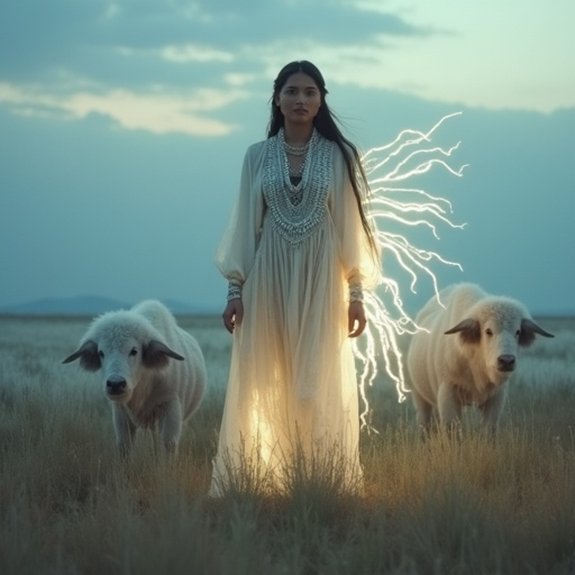
The account describes how she emerged during a time of great hardship, when the people desperately needed guidance. She appeared as a beautiful woman dressed in white buckskin, carrying a bundle that contained the sacred chanunpa (pipe). Through her teachings, she established the proper relationships between humans, nature, and the spirit world that continue shaping Lakota identity.
Lakota Sacred Pipe Ceremony
Before White Buffalo Calf Woman departed from the Lakota people, she entrusted them with the chanunpa—the sacred pipe that would become the cornerstone of their spiritual practice. She taught them that the pipe’s bowl represents the earth and all living things, while its stem symbolizes everything that grows. When joined together, they create a bridge between the physical and spiritual worlds.
The ceremony involves loading the pipe with kinnikinnick, a sacred tobacco mixture, while offering prayers in the six directions: west, north, east, south, sky, and earth. Participants sit in a circle, passing the pipe clockwise. Each person takes a puff, releasing smoke that carries prayers to Wakan Tanka, the Great Spirit. The ritual strengthens community bonds and maintains harmony between humans and nature.
Notable Cases or Sightings
The sacred teachings of White Buffalo Calf Woman gained renewed significance in 1994 when a white buffalo calf named Miracle was born on a farm in Janesville, Wisconsin. This birth marked the first documented white buffalo in decades, drawing thousands of Native American visitors who viewed it as a prophetic sign. Miracle’s coat changed colors throughout her life, shifting from white to black, red, and yellow—matching the four colors sacred to many Plains tribes.
Since then, several other white buffalo calves have been born across North America. Lightning Medicine Cloud arrived in 2011 in Texas, while Wyoming’s Buffalo Field Campaign documented another birth in 2012. Each sighting reinforces tribal prophecies about unity and spiritual awakening. These rare occurrences, happening roughly once in ten million births, continue to inspire ceremonial gatherings and prayers.
Common Theories or Explanations
While spiritual significance dominates discussions of white buffalo births, scientists point to several genetic mechanisms that can produce these rare animals. Leucism, a partial loss of pigmentation, creates pale coloration while maintaining dark eyes. Albinism, though rarer, results in complete pigment absence, including pink eyes. Some white buffalo carry recessive genes that only manifest when both parents contribute the trait.
Crossbreeding with cattle has introduced additional genetic variations into bison populations. Beefalo hybrids sometimes display unusual coloration patterns, including white coats. Environmental factors during fetal development can also affect pigmentation.
Geneticists estimate the natural occurrence at one in ten million births. Modern DNA testing helps researchers distinguish between true genetic conditions and temporary color changes that some calves experience before developing normal brown coats.
Frequently Asked Questions
What Specific Teachings Did White Buffalo Calf Woman Give About Women’s Roles?
White Buffalo Calf Woman taught that women hold sacred power as life-givers and keepers of spiritual knowledge. She emphasized women’s roles as protectors of ceremonies, maintainers of family harmony, and carriers of cultural wisdom.
How Do Other Native American Tribes Interpret the White Buffalo Calf Woman Story?
While the White Buffalo Calf Woman’s primarily a Lakota sacred figure, neighboring Plains tribes recognize her significance through shared ceremonies. Some interpret her teachings through their own spiritual frameworks, though they’ll generally respect Lakota authority.
What Songs or Prayers Are Traditionally Associated With White Buffalo Calf Woman?
Traditional Lakota prayers include the Seven Sacred Rites songs she brought, particularly the Chanupa (Sacred Pipe) ceremonies’ chants. The Buffalo Dance songs and women’s coming-of-age prayers directly honor her teachings about life’s sacred cycles.
How Has the Prophecy Influenced Modern Lakota Political and Social Movements?
The prophecy’s strengthened contemporary Lakota resistance movements, environmental activism, and sovereignty efforts. It’s inspired unity among tribes, reinforced cultural revitalization programs, and provided spiritual framework for protests like Standing Rock’s water protection campaign.
What Artistic Depictions Exist of White Buffalo Calf Woman in Traditional Crafts?
Traditional Lakota artisans depict White Buffalo Calf Woman in quillwork, beadwork on ceremonial regalia, painted buffalo hides, and carved pipestone. She’s often shown transforming between woman and white buffalo forms, holding the sacred pipe.

Do Ancient Spirits Still Guard Sacred Lands?

The House Spirits: Domovoi, Lares, Etc

The Fairy Ring: Portal Myths
About The Author
