The Lost Cities of the Silk Road
The Silk Road’s abandoned cities don’t just vanish—they’re buried beneath centuries of sand and silence. Archaeologists have uncovered Niya and Loulan, once-prosperous trading hubs that mysteriously collapsed into ruin. These ghost towns hold preserved artifacts, ancient documents, and architectural remains that shouldn’t exist in such pristine condition. What forced thousands of merchants and residents to flee their homes? The answer lies in a perfect storm of environmental and human disasters.
Introduction
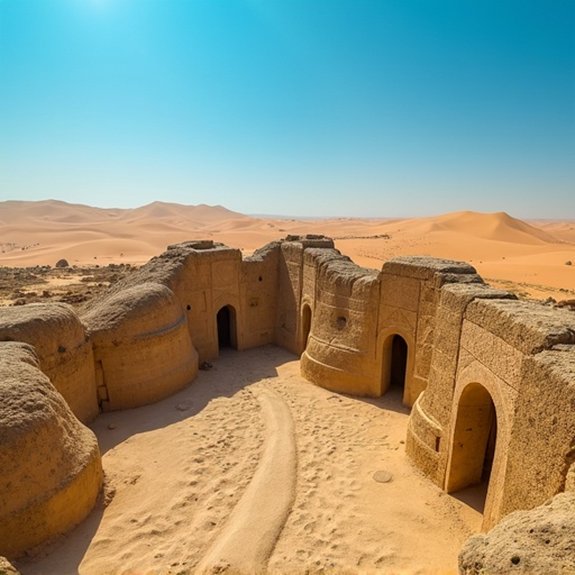
When ancient traders first ventured across the vast deserts and mountains of Central Asia, they couldn’t have imagined their routes would spawn some of history’s most magnificent cities. The Silk Road connected East and West for over 1,500 years, creating a network of trade routes that stretched from China to the Mediterranean. Along these paths, thriving metropolises emerged as essential stops for merchants, pilgrims, and adventurers.
These cities became centers of cultural exchange, where Buddhist monks shared wisdom with Islamic scholars, and Chinese silk met Roman gold. Many flourished for centuries before vanishing beneath sand dunes or crumbling into ruins. Today, archaeologists uncover their remains, revealing stories of innovation, prosperity, and sudden abandonment that reshape our understanding of ancient civilization.
Ancient Trade Route Establishment
Although Chinese emperors initially sought horses from Central Asian nomads, their diplomatic missions accidentally created the foundation for history’s most influential trade network. Zhang Qian’s expedition in 138 BCE opened pathways that’d transform civilizations. His thirteen-year journey revealed interconnected oasis towns stretching from China through Central Asia to the Mediterranean.
Merchants quickly recognized these routes’ potential. They established caravanserais at strategic intervals, creating supply chains that moved silk, spices, and precious stones across continents. Local rulers built fortified trading posts, taxing goods while providing security against bandits. These settlements grew into prosperous cities.
The network wasn’t a single road but multiple branches adapting to seasonal conditions and political changes. Traders rarely completed the entire journey; instead, they’d exchange goods at intermediate points, creating a relay system that efficiently moved merchandise across 4,000 miles.
Notable Cases or Sightings
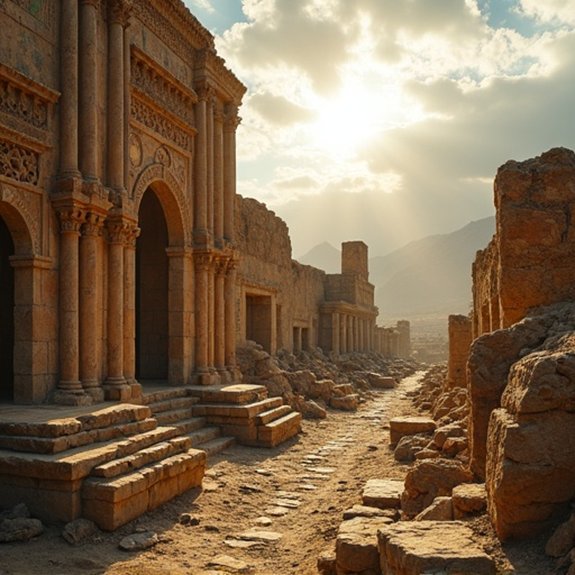
These thriving commercial hubs that dotted the Silk Road eventually met mysterious fates, leaving behind ruins that archaeologists have rediscovered over centuries. In 1907, Aurel Stein uncovered Niya, a desert city in China’s Taklamakan that’d been abandoned since the fourth century. The site yielded perfectly preserved wooden tablets and textiles in the dry sand.
Merv in Turkmenistan, once the world’s largest city, was rediscovered by Russian archaeologists in the 1880s after Mongol invasions destroyed it in 1221. Similarly, Otrar in Kazakhstan revealed multiple occupation layers when Soviet teams excavated it in the 1970s.
Perhaps most dramatically, China’s Loulan emerged from sand dunes in 1980, complete with mummified remains. These discoveries’ve transformed understanding of Silk Road civilizations and their sudden disappearances.
Common Theories or Explanations
While archaeologists’ve uncovered these lost cities‘ physical remains, explaining their abandonment requires examining multiple environmental and human factors. Climate change theory dominates scholarly discussions, as evidence shows the region experienced severe droughts between 200-600 CE. Rivers that once sustained these urban centers shifted course or dried completely, forcing mass migrations.
Political instability offers another explanation. The Mongol invasions disrupted established trade networks, while competing empires redirected caravan routes through different territories. Maritime trade’s rise in the 15th century further diminished overland commerce’s importance.
Disease outbreaks likely accelerated decline. Plague bacteria found in ancient burial sites suggests epidemics swept through densely populated trading hubs. Combined with economic pressures, these factors created cascading failures that cities couldn’t survive.
Frequently Asked Questions
What Modern Technology Is Used to Discover Buried Silk Road Cities Today?
Archaeologists use satellite imagery, ground-penetrating radar, and LiDAR technology to detect buried Silk Road cities. They’ve combined drone surveys with infrared scanning to reveal ancient structures hidden beneath desert sands and vegetation across Central Asia.
Can Tourists Visit Any Recently Discovered Silk Road Archaeological Sites?
Yes, tourists can visit several recently discovered Silk Road sites. China’s opened Shimao and Loulan ruins to visitors, while Kazakhstan’s allowing limited access to Otrar. However, many sites aren’t fully excavated or lack tourist infrastructure.
How Are Artifacts From Lost Cities Preserved After Excavation?
Archaeologists preserve excavated artifacts through careful cleaning, documentation, and stabilization. They’ll apply conservation treatments to prevent deterioration, store items in climate-controlled facilities, and use specialized packaging materials that protect against humidity, temperature changes, and physical damage.
What Languages Did Merchants Speak in These Ancient Trading Cities?
Merchants in ancient Silk Road trading cities spoke diverse languages including Sogdian as the primary trade tongue, alongside Persian, Arabic, Chinese, Sanskrit, and Turkic languages. They’d often learn multiple languages to conduct successful business transactions.
Are There Any Ongoing Excavation Projects Currently Seeking Lost Silk Road Cities?
Yes, archaeologists’re actively excavating several sites. China’s conducting digs along the Taklamakan Desert’s edges, while international teams explore Kazakhstan’s medieval settlements. Uzbekistan’s researchers investigate buried caravanserais, and satellite technology helps identify promising unexplored locations.

Is There a Secret Society Guarding Ancient Artifacts in the Rockies?

Did Ancient Cultures Communicate Through Pyramids?

The Underworld Passage of the Incas
About The Author
