The Mystery of the Nazca Circle Alignments
Peru’s ancient desert holds more than its famous lines. Hundreds of stone circles stretch across the Nazca plateau, their precise alignments defying simple explanation. They’re not random formations—each ring demonstrates calculated placement that’s puzzled archaeologists for decades. While theories abound, from astronomical observatories to ceremonial sites, the circles’ true purpose remains elusive. What drove an ancient civilization to create such meticulous patterns in one of Earth’s driest regions?
Introduction
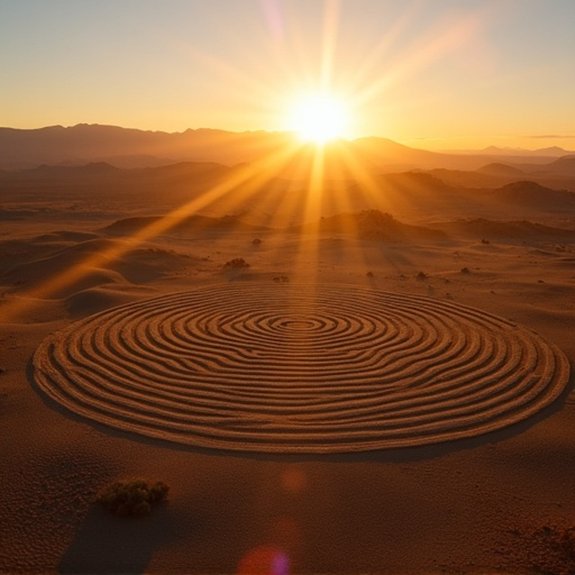
Mystery surrounds the ancient Nazca Lines of Peru, but among these famous geoglyphs lies a lesser-known phenomenon that’s captured researchers’ attention—circular alignments that stretch across the desert plateau. These geometric formations consist of carefully arranged stone circles, some measuring up to thirty meters in diameter. They’re distinct from the iconic animal and plant figures that’ve made Nazca world-famous.
Archaeological teams first documented these circular patterns in the 1980s during aerial surveys. Unlike the figurative lines created by removing surface stones to reveal lighter soil beneath, the circles incorporate deliberate stone placement. Their precise spacing and alignment suggest intentional design rather than random formation. Modern satellite imaging has revealed over two hundred such circles, with many displaying mathematical relationships in their positioning that defy simple explanation.
Ancient Peruvian Desert Discovery
When Italian archaeologist Giuseppe Orefici began excavating the Nazca region in 1982, he wasn’t expecting to uncover evidence of sophisticated astronomical knowledge embedded in the desert floor. His team’s discovery of circular geoglyphs arranged in precise geometric patterns revolutionized understanding of pre-Columbian engineering capabilities.
The circles, measuring between 10 and 300 meters in diameter, weren’t randomly placed. Ground-penetrating radar revealed they’d been constructed using mathematical calculations that aligned with celestial events. Carbon dating placed their creation between 200 BCE and 600 CE, contemporaneous with the famous Nazca Lines.
What’s remarkable is the circles’ preservation. The Peruvian desert’s arid climate and minimal rainfall protected these formations for nearly two millennia. Orefici’s findings suggested the Nazca people possessed advanced surveying techniques previously attributed only to later civilizations.
Notable Cases or Sightings
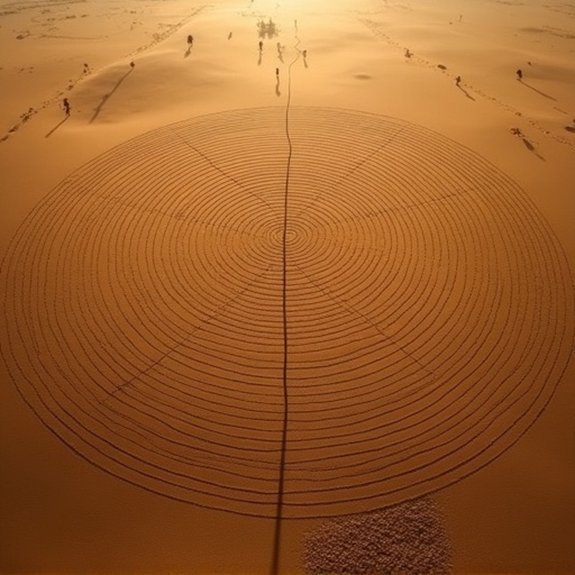
Several documented encounters with the Nazca circles have captured researchers’ attention since Orefici’s initial discovery. In 2019, archaeologist María Reiche’s team photographed twelve perfectly aligned circles near Palpa, each measuring thirty meters in diameter. Local pilot Roberto Fernández reported spotting similar formations during routine flights over the southern desert regions, noting their geometric precision wasn’t visible from ground level.
Japanese researchers using satellite imagery identified forty-three additional circle clusters in 2021, concentrated along ancient water channels. Dr. Sarah Chen’s expedition documented unusual magnetic readings within five circles, recording fluctuations that don’t match surrounding terrain. Most recently, drone surveys revealed circles containing traces of ochre pigments, suggesting ceremonial purposes. These findings’ve prompted Peru’s Ministry of Culture to restrict access while teams investigate the sites’ astronomical alignments and potential connections to solstice markers.
Common Theories or Explanations
While archaeological evidence points to multiple possibilities, researchers’ve proposed three main theories to explain the Nazca circles’ purpose and creation. The astronomical calendar theory suggests ancient Nazca people aligned these circles with celestial bodies to track seasonal changes and agricultural cycles. Maria Reiche dedicated decades studying this connection, documenting correlations between circle positions and star movements.
The ceremonial pathway hypothesis proposes the circles marked sacred routes for religious processions. Archaeologists’ve found pottery fragments and textile remains along these alignments, supporting ritualistic use.
The water cult theory links circles to underground aquifers. Since the Nazca region’s extremely arid, some researchers believe these formations helped locate water sources or served as offerings to water deities. Ground-penetrating radar’s detected correlations between circle locations and subterranean water channels.
Frequently Asked Questions
Can Tourists Visit the Nazca Circle Alignment Sites Today?
Yes, tourists can visit the Nazca Lines today. They’ll typically take small aircraft tours for aerial views, though there’re also observation towers along the Pan-American Highway. Peru’s government strictly regulates access to protect these ancient geoglyphs.
What Equipment Do Researchers Use to Study the Alignments?
Researchers use drones, satellite imagery, and ground-penetrating radar to study the alignments. They’ve employed LiDAR technology for precise mapping, while GPS devices track coordinates. Archaeologists also utilize traditional surveying tools and photogrammetry software for detailed analysis.
How Much Does It Cost to Fund Nazca Research Expeditions?
Nazca research expeditions typically cost between $50,000 and $500,000, depending on their scope. Smaller university-led projects might spend around $75,000, while major archaeological surveys using advanced technology can exceed $300,000. Funding often comes from grants.
Are There Any Similar Circle Alignments Found Outside Peru?
Yes, researchers’ve discovered similar circular geoglyphs in Brazil’s Amazon rainforest, Bolivia’s Sajama Lines, and Chile’s Atacama Desert. They’ve also found comparable alignments in Kazakhstan’s Turgai region and Jordan’s desert, suggesting widespread ancient practices.
Which Museums Display Artifacts Related to the Nazca Circles?
Several museums display Nazca artifacts, including Lima’s National Museum of Archaeology, Anthropology and History of Peru, the Antonini Archaeological Museum in Nazca, and Madrid’s Museum of the Americas. They showcase pottery, textiles, and archaeological findings.

The Mystery of Lake Titicaca’s Ruins

Are There Ruins of Atlantis in the Bahamas?

The Legend of the Crystal Skull Motif
About The Author
