Myths of the Undersea Kingdoms
Humanity’s oldest civilizations whispered of kingdoms beneath the waves. They spoke of golden cities, immortal rulers, and technologies that defied understanding. From Plato’s detailed accounts to sailors’ sworn testimonies, these stories persist across millennia and continents. Scientists can’t explain why identical myths emerged in cultures that never interacted. The ocean floor remains 80% unmapped, and recent discoveries of ancient submerged structures raise uncomfortable questions about what else lies hidden below.
Introduction
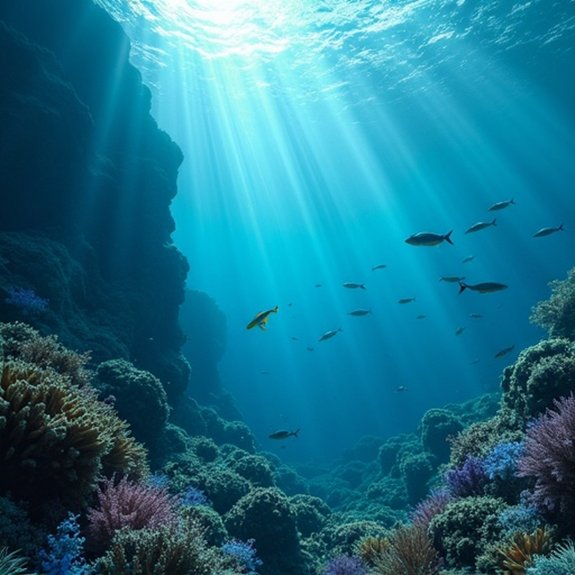
While ancient mariners once feared the ocean’s depths as territories of monsters and chaos, they also whispered of magnificent cities beneath the waves. These undersea kingdoms have captivated humanity’s imagination for millennia, appearing in folklore from every continent touched by the sea. From Atlantis to the Japanese dragon palace of Ryūgū-jō, these mythical realms share striking similarities despite originating in isolated cultures.
The stories typically describe advanced civilizations ruled by powerful deities or supernatural beings who’ve mastered the ocean’s mysteries. They’re often portrayed as paradise-like territories where immortal beings possess treasures and knowledge beyond mortal comprehension. These myths served multiple purposes: they explained natural phenomena like tsunamis and whirlpools, warned against maritime hubris, and offered hope that somewhere beneath the terrifying surface lay wonder and wisdom.
Ancient Greek Atlantis Texts
Although countless undersea kingdom myths exist worldwide, Plato’s account of Atlantis remains the most influential and debated. The Greek philosopher described this advanced civilization in two dialogues, “Timaeus” and “Critias,” written around 360 BCE. He claimed Egyptian priests told Solon about an island empire that existed 9,000 years earlier beyond the Pillars of Hercules.
Plato’s texts detail Atlantis’s concentric rings of water and land, its powerful navy, and advanced engineering. The civilization supposedly conquered much of Europe and Africa before Athens defeated it. Following this defeat, earthquakes and floods sank the entire island in a single day. Scholars can’t agree whether Plato invented Atlantis as a philosophical allegory about hubris or based it on actual historical events. His vivid descriptions sparked centuries of speculation about lost undersea civilizations.
Notable Cases or Sightings
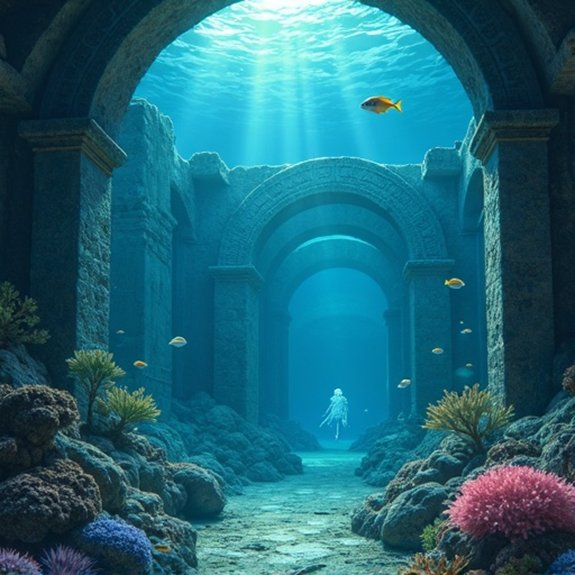
What drives modern explorers to search for underwater kingdoms when ancient texts offer so few concrete clues? Modern technology’s revealed intriguing discoveries that fuel speculation. In 1968, pilots spotted the Bimini Road—limestone formations off the Bahamas that some claim are Atlantean ruins. Scientists argue they’re natural beach rock, but believers aren’t convinced.
Japan’s Yonaguni Monument presents another puzzle. Discovered in 1985, this massive underwater structure features terraced platforms and right angles that seem artificial. Marine geologist Masaaki Kimura insists it’s man-made, while skeptics attribute its shape to tectonic activity.
The Cuban underwater city, detected through sonar in 2001, shows symmetrical stone structures 2,000 feet below sea level. Though investigations stalled, the site’s geometric patterns continue attracting researchers who wonder if they’ve found evidence of prehistoric civilization.
Common Theories or Explanations
Since geological events can dramatically reshape coastlines, scientists propose that real cities might’ve inspired underwater kingdom myths. Tsunamis, earthquakes, and rising sea levels have submerged numerous settlements throughout history. The Mediterranean’s ancient port of Heracleion vanished beneath Egypt’s waters, while Jamaica’s Port Royal sank during a 1692 earthquake.
Psychologists suggest these myths reflect humanity’s fascination with unexplored frontiers. The ocean’s vastness triggers imagination, and its inaccessibility creates perfect conditions for fantastical stories. Some researchers link underwater kingdom tales to cultural memories of post-glacial flooding that occurred 10,000 years ago.
Marine biologists point to misidentified phenomena. Underwater volcanic activity produces sounds resembling construction or voices. Bioluminescent organisms create mysterious lights that sailors have mistaken for underwater cities. These natural explanations don’t diminish the myths’ cultural significance but offer rational perspectives on their origins.
Frequently Asked Questions
How Do Undersea Kingdom Myths Vary Across Different Cultures Worldwide?
Undersea kingdom myths differ notably across cultures. Greeks imagined Poseidon’s palace, Japanese folklore features Ryūjin’s dragon territory, Celtic traditions describe underwater fairy lands, while Caribbean tales tell of Aycayia’s domain. Each culture’s geography shapes their unique aquatic mythologies.
What Role Do Undersea Kingdoms Play in Modern Fiction and Entertainment?
Undersea kingdoms dominate modern entertainment as settings for fantasy adventures, environmental allegories, and superhero origins. They’re featured in blockbuster films, video games, and novels, often exploring themes of hidden civilizations, ecological preservation, and humanity’s relationship with oceans.
Are There Any Scientific Expeditions Currently Searching for Lost Underwater Civilizations?
Scientists aren’t actively searching for mythical undersea kingdoms, but archaeologists regularly explore submerged ancient sites like Egypt’s Thonis-Heracleion and India’s Dwarka. They’re investigating real settlements that flooded due to rising sea levels, not fictional civilizations.
How Have Undersea Kingdom Myths Influenced Maritime Folklore and Superstitions?
Undersea kingdom myths’ve profoundly shaped maritime folklore, inspiring sailors’ tales of mermaids luring ships to doom, phantom cities glimpsed beneath waves, and taboos against whistling at sea. They’ve created superstitions about appeasing ocean deities for safe passage.
What Technology Is Used to Investigate Potential Underwater Archaeological Sites?
Archaeologists deploy remotely operated vehicles (ROVs), side-scan sonar, magnetometers, and sub-bottom profilers to map seafloor features. They’ll use multibeam echosounders for detailed bathymetry and autonomous underwater vehicles (AUVs) to survey vast areas efficiently.


About The Author
