The Brick Temples of the Indus Valley
The brick structures of the Indus Valley have puzzled archaeologists since their discovery in the 1920s. What they’ve found doesn’t match expectations – no grand temples dominate these ancient cities. Instead, Harappa and Mohenjo-daro reveal massive platforms and ritual bathing areas that hint at something different. These standardized constructions suggest the Harappans practiced their faith in ways that challenge everything scholars thought they knew about ancient religious architecture.
Introduction
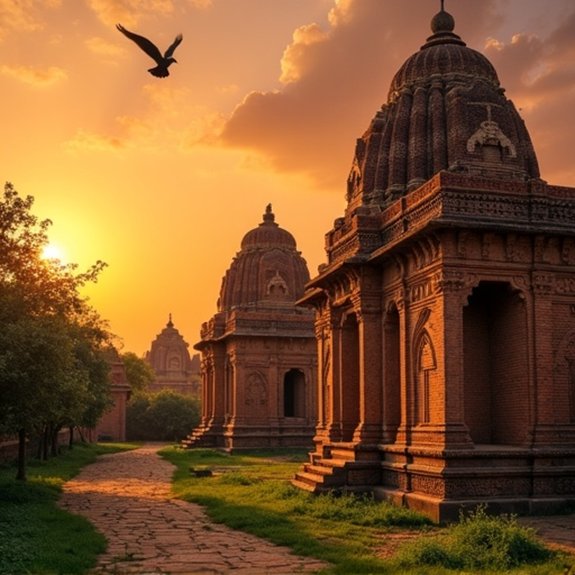
The ancient brick temples scattered across the Indus Valley stand as silent witnesses to one of humanity’s earliest urban civilizations. These structures, dating from 2600 to 1900 BCE, reveal sophisticated architectural knowledge that predated many later civilizations. Archaeologists have discovered numerous temple remains in Harappa, Mohenjo-daro, and Kalibangan, each displaying remarkable uniformity in construction techniques.
The builders used standardized fired bricks in a 4:2:1 ratio, creating structures that’ve survived millennia. They incorporated advanced drainage systems, ritual bathing areas, and elevated platforms for religious ceremonies. Unlike contemporary Mesopotamian temples, these structures don’t feature elaborate decorations or inscriptions. Instead, they emphasize functional design and structural integrity. Their discovery has revolutionized understanding of Indus Valley religious practices and challenged previous assumptions about the civilization’s spiritual life.
Archaeological Discoveries in 1920S
Modern understanding of these ancient structures began with groundbreaking excavations in the 1920s. British archaeologist John Marshall led the Archaeological Survey of India’s teams at Harappa and Mohenjo-daro between 1921 and 1927. They’d uncovered something extraordinary—an entire Bronze Age civilization previously unknown to history.
The excavators found massive brick platforms, ritual bathing areas, and what they initially interpreted as temple complexes. R.D. Banerji’s work at Mohenjo-daro revealed the Great Bath, while Daya Ram Sahni’s Harappa excavations exposed granaries and assembly halls. These discoveries challenged existing theories about ancient Indian history.
Marshall’s team documented standardized brick ratios of 4:2:1 and sophisticated drainage systems. They’ve noted that religious structures weren’t clearly identifiable, sparking debates that continue today about whether the Indus Valley civilization built conventional temples at all.
Notable Cases or Sightings

Three distinct sites have yielded the most compelling evidence for possible temple structures in the Indus Valley civilization. At Kalibangan, archaeologists uncovered fire altars and a massive platform that’s sparked debate about ritualistic purposes. The site’s seven fire pits arranged in a row suggest organized ceremonial activities.
Mohenjo-daro’s Great Bath represents another intriguing case. While it’s primarily considered a public bathing facility, some scholars argue its elaborate construction and central location indicate religious significance. The watertight brick structure features steps leading down from both ends.
At Dholavira, excavators found a unique terraced structure with multiple divisions that doesn’t match typical residential or administrative buildings. Its elevated position and distinct architectural features have led researchers to propose it served spiritual functions, though definitive proof remains elusive.
Common Theories or Explanations
While archaeological evidence remains fragmentary, scholars have developed several competing theories to explain the apparent absence of monumental temples in Indus Valley cities. Some researchers propose that religious practices centered on domestic shrines and open-air platforms rather than grand structures. They’ve identified possible ritual bathing areas and fire altars suggesting decentralized worship.
Another theory suggests temples were built with perishable materials like wood, leaving no archaeological traces. Proponents point to post holes and foundation marks as potential evidence. A third explanation argues that Harappan society didn’t emphasize religious hierarchy, resulting in egalitarian spiritual practices without need for impressive temples. Some scholars even question whether brick structures previously classified as granaries or assembly halls might’ve served religious functions, challenging traditional interpretations of Indus urban planning.
Frequently Asked Questions
How Can Tourists Visit Brick Temple Sites in the Indus Valley Today?
Tourists can’t visit brick temples from the Indus Valley civilization because archaeologists haven’t found any temples at these sites. They’ve discovered residential areas, public baths, and granaries at Harappa and Mohenjo-daro, but no temples.
What Preservation Methods Are Used to Protect Brick Temples From Erosion?
Archaeologists apply chemical consolidants to strengthen fragile bricks, install protective shelters over excavated structures, and create drainage systems that divert rainwater. They’ve also developed specialized mortars for repointing joints and use laser cleaning techniques.
Are There Any Ongoing Excavations of Brick Temples Currently Happening?
Archaeological teams aren’t currently excavating brick temples in the Indus Valley region. Most recent work’s focused on settlement sites and urban areas rather than religious structures, though researchers continue surveying and documenting previously discovered temple remains.
What Tools and Techniques Do Archaeologists Use to Study Brick Temple Structures?
Archaeologists employ ground-penetrating radar, 3D laser scanning, and photogrammetry to map brick temple structures. They’ll use magnetometry to detect buried walls, conduct chemical analysis on mortar, and create digital reconstructions from excavation data.
How Do Brick Temples Compare Architecturally to Stone Temples Elsewhere?
Brick temples typically feature thicker walls and smaller interior spaces than stone temples. They can’t support the massive domes and intricate carvings that stone allows. However, brick construction enables faster building and distinctive geometric patterns.

The Mystery of Gobeki’s Animal Reliefs

The City of Z: A Jungle Mystery

The Secrets of Oak Island Treasure
About The Author
