The Builders of Puma Punku
The ancient builders of Puma Punku created something that shouldn’t exist. They carved massive stone blocks with laser-like precision and fitted them together like a three-dimensional puzzle, all without modern tools. These 130-ton megaliths display complex geometric patterns that’ve baffled engineers for decades. How did a pre-Columbian civilization achieve what today’s technology would struggle to replicate? The answer challenges everything archaeologists thought they knew about ancient capabilities.
Introduction
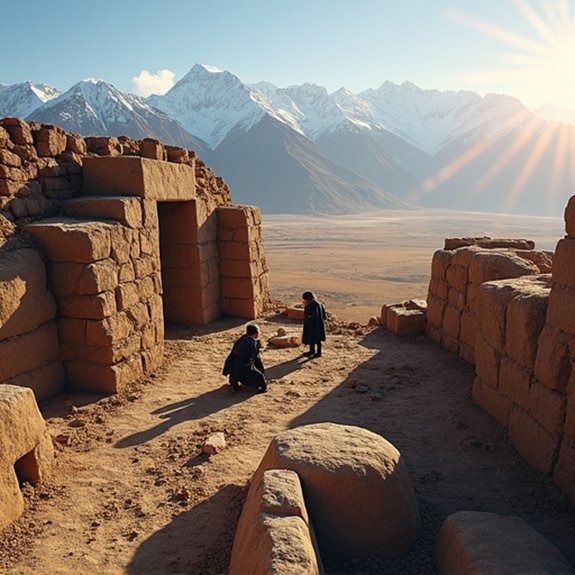
When visitors first encounter the massive stone blocks scattered across Bolivia’s high plateau, they’re witnessing the remains of Puma Punku—one of South America’s most enigmatic archaeological sites. Located near Lake Titicaca at 12,800 feet above sea level, this pre-Columbian complex forms part of the larger Tiwanaku site. The ruins feature precisely cut andesite and sandstone blocks, some weighing over 130 tons, arranged in what archaeologists believe was once a magnificent temple complex.
The site’s builders achieved remarkable engineering feats around 536-600 CE, creating interlocking stones with such accuracy that they’ve survived centuries of earthquakes. Their construction methods remain largely mysterious, as the civilization left no written records. Today, Puma Punku continues to challenge researchers’ understanding of ancient technological capabilities.
Tiwanaku Civilization’s Architectural Marvel
The Tiwanaku civilization transformed the Andean highlands into a powerful state that flourished between 500 and 1000 CE, with Puma Punku representing their supreme architectural achievement. Located near Lake Titicaca in Bolivia, this temple complex showcases precision stonework that’s baffled researchers for decades.
The site’s H-shaped blocks, weighing up to 130 tons, display machine-like accuracy with perfectly straight edges and uniform depths. Builders carved intricate interlocking systems without metal tools, creating joints so precise they don’t require mortar. The andesite and sandstone blocks feature complex geometric patterns and mysterious drill holes that appear impossibly uniform.
Puma Punku’s platform measured approximately 167 by 117 meters, elevated above the surrounding landscape. Its builders transported massive stones across challenging terrain, then shaped them with techniques that remain unexplained today.
Notable Cases or Sightings
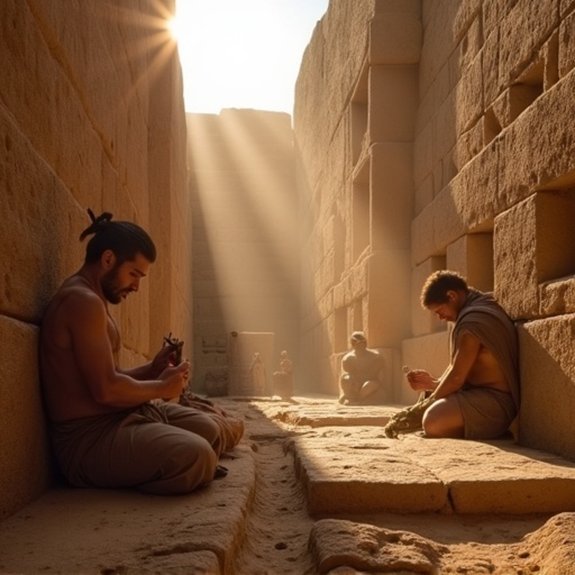
Although mainstream archaeology attributes Puma Punku to the Tiwanaku civilization, several controversial claims have emerged linking the site to extraterrestrial visitors. Ancient astronaut theorists point to the H-blocks’ precise engineering and interlocking designs as evidence of advanced technology. They’ve highlighted the site’s massive andesite stones, some weighing over 130 tons, questioning how pre-Columbian peoples transported them from quarries 10 miles away.
Author Erich von Däniken popularized these theories in his 1968 book, suggesting the structures couldn’t have been built without alien assistance. Television programs like “Ancient Aliens” have featured Puma Punku extensively, focusing on the stones’ laser-like cuts and perfect right angles. Local Aymara legends describing “sky people” who helped construct the site have fueled further speculation about otherworldly involvement.
Common Theories or Explanations
While ancient astronaut theorists propose extraterrestrial involvement, archaeologists and engineers have developed several evidence-based explanations for Puma Punku’s construction. The Tiwanaku civilization possessed sophisticated stone-working techniques, using bronze tools, wooden wedges, and abrasive sand to shape andesite and sandstone blocks. They’d employed a standardized measurement system, evidenced by recurring proportions throughout the site’s architecture.
Engineers suggest the massive stones were transported using wooden rollers, ropes, and ramps—methods proven effective in experimental archaeology. The precision cuts likely resulted from repetitive grinding with harder stones and metal tools. Archaeological evidence indicates Puma Punku’s construction occurred around 536-600 CE, during Tiwanaku’s peak. The site’s abandonment coincided with severe drought conditions that destabilized the region’s agricultural systems, forcing population dispersal rather than mysterious disappearance.
Frequently Asked Questions
What Tools Did the Builders Use to Cut the Precise Stone Blocks?
The builders likely used bronze and copper tools, stone hammers, and grinding stones to cut Puma Punku’s precise blocks. They’ve left no definitive records, but archaeologists believe they employed advanced techniques without modern machinery.
How Many Workers Were Involved in Constructing Puma Punku?
Archaeologists don’t know exactly how many workers built Puma Punku, but they estimate hundreds to thousands participated. The massive project likely required rotating teams of laborers, skilled stoneworkers, and engineers over several construction phases.
What Was the Original Purpose or Function of the Puma Punku Complex?
Archaeologists believe Puma Punku served as a ceremonial and religious center for the Tiwanaku civilization. It’s thought to have functioned as a sacred space for rituals, astronomical observations, and possibly elite gatherings around 500-600 CE.
How Long Did It Take to Complete the Construction of Puma Punku?
Archaeologists can’t determine exactly how long Puma Punku’s construction took, but they estimate it occurred over several centuries during the Tiwanaku culture’s peak between 500-1000 CE, with multiple building phases contributing to the complex’s development.
Where Were the Massive Stone Blocks Quarried and Transported From?
The builders quarried the massive andesite blocks from quarries on Mount Ccapia, approximately 10 kilometers away. They transported the red sandstone from a site 10 kilometers distant, while limestone came from the Copacabana Peninsula, 90 kilometers across Lake Titicaca.

Hidden Chambers Beneath the Great Pyramid

Are There Sunken Temples Off the Coast of Japan?

The Lost Kingdom in Madagascar
About The Author
