The Disappearance of Mohenjo-daro
The ruins of Mohenjo-daro sprawl across Pakistan’s Indus River valley, silent witnesses to one of archaeology’s greatest puzzles. Around 1900 BCE, this thriving metropolis vanished from history—its 40,000 residents simply gone. No bodies fill the streets. No siege marks scar the walls. The city’s advanced drainage systems and granaries sit perfectly preserved, as if everyone just walked away one day and never returned.
Introduction
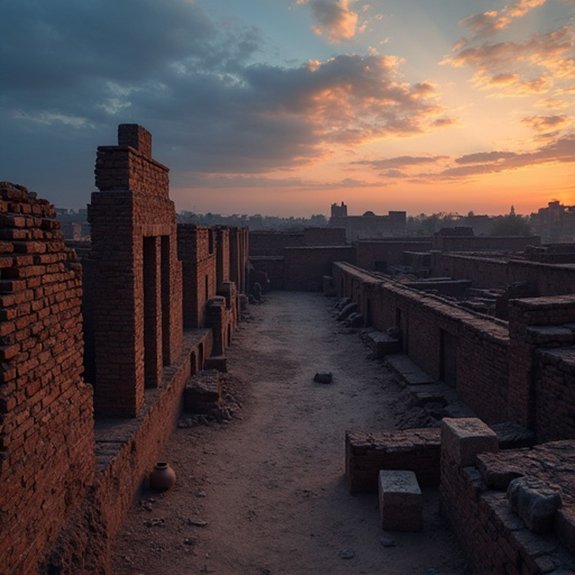
When archaeologists first excavated the ancient city of Mohenjo-daro in the 1920s, they uncovered one of history’s most puzzling mysteries. This Bronze Age metropolis, located in modern-day Pakistan, once thrived as part of the Indus Valley Civilization around 2500 BCE. Its sophisticated urban planning featured grid-pattern streets, advanced drainage systems, and multi-story brick buildings that housed nearly 40,000 residents.
Yet by 1900 BCE, Mohenjo-daro’s inhabitants had vanished. They didn’t leave behind written records explaining their departure, and the city shows no signs of warfare or sudden catastrophe. Instead, archaeologists found an orderly abandonment—as if the population simply walked away. This enigma has captivated researchers for a century, spawning theories ranging from climate change to river shifts, but none fully explain why one of antiquity’s greatest cities disappeared.
Indus Valley’s Urban Planning Marvel
The mystery of Mohenjo-daro’s abandonment becomes even more perplexing when examining the city’s remarkable infrastructure. Archaeological evidence reveals a metropolis that shouldn’t have failed. The city’s grid system featured perfectly straight streets intersecting at right angles, with main thoroughfares reaching forty feet wide. Engineers had constructed an advanced drainage network beneath every street, connecting homes through covered channels to prevent contamination.
Each house possessed private wells and bathing platforms linked to the city’s sewage system—innovations that wouldn’t appear in European cities for millennia. The Great Bath, a watertight pool measuring twelve by seven meters, demonstrated their mastery of hydraulic engineering. Standardized fired bricks built multi-story structures that’ve survived 4,500 years. This level of sophistication suggests a stable, organized society that’d invested heavily in permanence, making its sudden desertion all the more baffling.
Notable Cases or Sightings
How did archaeologists first stumble upon this lost civilization? In 1856, British engineers building the Karachi-Lahore railway discovered ancient bricks near Harappa. They’d unknowingly used Indus Valley artifacts as ballast for 93 miles of track. The site’s significance wasn’t recognized until 1921, when archaeologist Daya Ram Sahni began formal excavations.
R.D. Banerji discovered Mohenjo-daro in 1922, initially believing he’d found a Buddhist stupa. John Marshall, Director-General of the Archaeological Survey of India, connected both sites to the same civilization. His team uncovered the Great Bath, granaries, and residential complexes. Ernest Mackay’s 1927-1931 excavations revealed the city’s sophisticated drainage system and standardized weights. Mortimer Wheeler’s 1950 dig exposed defensive fortifications, though his invasion theory’s been disputed. These discoveries transformed understanding of Bronze Age civilizations.
Common Theories or Explanations
Since Mohenjo-daro’s abandonment around 1900 BCE, researchers have proposed multiple theories to explain the civilization’s mysterious decline. Climate change remains the leading explanation, with evidence suggesting the monsoons shifted eastward, causing severe droughts that crippled agriculture. The Indus River’s course likely changed too, disrupting the city’s water management systems.
Other scholars point to economic factors. Trade networks with Mesopotamia collapsed, potentially destabilizing Mohenjo-daro’s economy. Some archaeologists believe overcrowding and poor sanitation triggered disease outbreaks that decimated the population.
The invasion theory, once popular, has lost support. There’s no archaeological evidence of warfare or conquest. Instead, experts now favor gradual decline over catastrophic collapse. The population probably migrated slowly to other regions as conditions worsened, abandoning the once-great city to time.
Frequently Asked Questions
Can Tourists Visit Mohenjo-Daro Ruins Today?
Yes, tourists can visit Mohenjo-daro’s ruins in Pakistan’s Sindh province. They’ll find preserved streets, buildings, and the Great Bath. UNESCO protects the site, though visitor numbers are limited to prevent damage to the ancient structures.
What Preservation Efforts Are Currently Protecting the Site?
UNESCO’s monitoring the site while Pakistan’s government restricts visitor access and covers excavated areas during monsoons. They’re installing protective shelters, controlling groundwater levels, and using chemical treatments to prevent salt damage to the ancient bricks.
How Much Does Excavation at Mohenjo-Daro Cost Annually?
Pakistan’s government typically allocates between $500,000 to $1 million annually for Mohenjo-daro’s excavation and conservation work, though UNESCO and international donors occasionally provide additional funding when the site’s deteriorating conditions require emergency interventions.
Which Museums Display Mohenjo-Daro Artifacts?
Major museums displaying Mohenjo-daro artifacts include Pakistan’s National Museum in Karachi, which holds the site’s primary collection. Delhi’s National Museum, London’s British Museum, and New York’s Metropolitan Museum also showcase significant pieces from the ancient city.
What Modern Technology Is Used to Study the Ruins?
Archaeologists use ground-penetrating radar, satellite imagery, and LiDAR scanning to map Mohenjo-daro’s buried structures. They’ve employed drone photography, 3D modeling software, and isotope analysis to study artifacts, while digital reconstruction helps visualize the ancient city.

The Yup’ik Underwater Structures

Is There a Curse on the Lost Colony of Roanoke?

The Identity of the Man in the Iron Mask
About The Author
