The Disappearance of the Harappan Civilization
The Harappan Civilization‘s vanishing act around 1900 BCE isn’t what archaeologists first imagined. These sophisticated urban centers didn’t fall to invaders or natural disasters in a single catastrophic event. Instead, evidence reveals something far more puzzling—a gradual abandonment spanning centuries, with entire populations seemingly dissolving into the landscape. What force could’ve dismantled one of humanity’s earliest urban experiments so thoroughly that it’d remain hidden for nearly 4,000 years?
Introduction
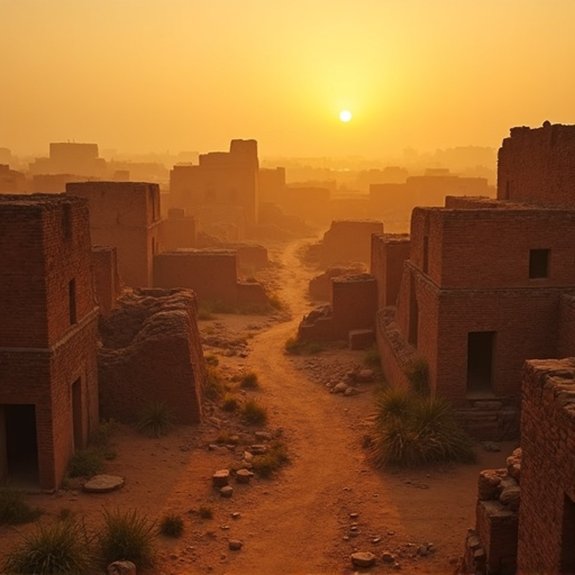
When archaeologists first uncovered the ancient cities of Harappa and Mohenjo-daro in the 1920s, they’d stumbled upon one of history’s most intriguing mysteries. The Harappan civilization, also known as the Indus Valley Civilization, flourished between 2600 and 1900 BCE across modern-day Pakistan and northwestern India. This Bronze Age society built sophisticated urban centers with advanced drainage systems, standardized weights and measures, and undeciphered script. At its peak, it encompassed over 1,500 settlements and housed five million people.
Around 1900 BCE, these thriving cities began their decline. Within centuries, the civilization vanished, leaving behind abandoned ruins. Scientists haven’t reached consensus on what caused this collapse. Theories range from climate change and drought to invasion, disease, or economic breakdown. The civilization’s disappearance remains one of archaeology’s enduring puzzles.
Rise of Indus Valley Cities
Long before their mysterious disappearance, the Harappan people built some of the ancient world’s most remarkable cities. Around 2600 BCE, urban centers like Harappa and Mohenjo-daro emerged along the Indus River basin. These cities weren’t random settlements—they’d mastered urban planning with grid-pattern streets, sophisticated drainage systems, and standardized brick construction.
The Harappans developed multi-story houses equipped with private wells and bathrooms connected to covered sewers. Their Great Bath at Mohenjo-daro demonstrates advanced hydraulic engineering. Population estimates suggest these cities housed 30,000 to 60,000 residents at their peak.
They established extensive trade networks reaching Mesopotamia and Central Asia. Uniform weights, measures, and seals indicate centralized administration. By 2500 BCE, over 1,000 settlements dotted the region, making it humanity’s largest Bronze Age civilization.
Notable Cases or Sightings
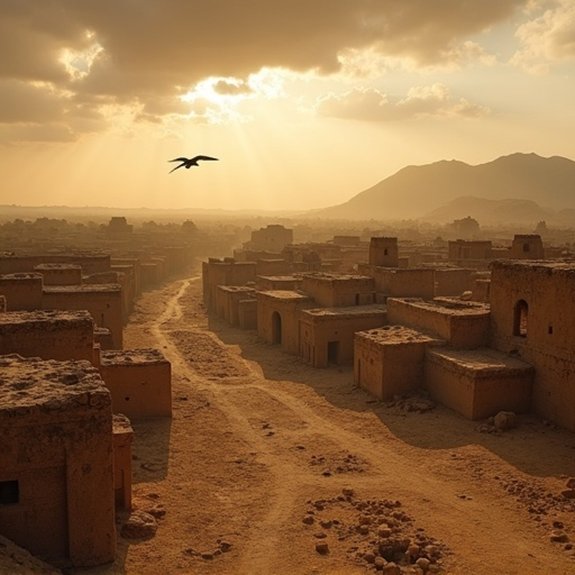
Multiple archaeological discoveries have revealed the final chapters of Harappan cities through layers of abandonment and decay. At Dholavira, archaeologists found evidence of systematic dismantling where residents removed wooden structures and valuable materials before leaving. The site’s water reservoirs show they’d dried up completely during the final occupation phase.
Kalibangan’s excavations uncovered abandoned houses with scattered skeletal remains, suggesting some inhabitants couldn’t escape deteriorating conditions. At Harappa itself, the upper levels contain cruder pottery and makeshift structures, indicating declining craftsmanship as the civilization weakened.
Mohenjo-daro’s famous “massacre” skeletons weren’t victims of invasion but likely died from disease during the city’s final days. These sites collectively demonstrate that Harappan cities didn’t disappear suddenly—they’re witnessing a gradual, painful decline over several generations.
Common Theories or Explanations
These archaeological findings have sparked decades of debate about what caused the Harappan Civilization’s collapse. Climate change remains the leading theory, with evidence showing the monsoon’s gradual weakening around 2000 BCE dried up the Ghaggar-Hakra river system. This environmental shift would’ve devastated agriculture and forced mass migrations eastward.
Some researchers argue that tectonic activity redirected major rivers, particularly the Sutlej, away from Harappan settlements. Others point to possible invasions, though there’s no evidence of widespread warfare or destruction.
Disease outbreaks and economic decline also feature prominently in explanations. Trade networks with Mesopotamia collapsed around this period, potentially triggering urban abandonment. Most scholars now favor a combination of factors rather than a single cause, suggesting the civilization didn’t vanish but gradually transformed and relocated.
Frequently Asked Questions
What Modern Archaeological Techniques Are Used to Study Harappan Sites Today?
Archaeologists use satellite imagery, ground-penetrating radar, and LiDAR to locate buried structures. They’re employing DNA analysis on skeletal remains, isotope studies on artifacts, and digital 3D modeling to reconstruct sites without extensive excavation.
How Did the Harappan Script System Work and Why Can’t We Decipher It?
The Harappan script used 400-600 pictographic symbols written right to left. Scholars can’t decipher it because there’s no bilingual text like the Rosetta Stone, inscriptions are extremely short, and the underlying language remains unknown.
What Happened to the Harappan People After Their Cities Were Abandoned?
The Harappan people didn’t vanish but gradually migrated eastward and southward into the Ganges plain and peninsular India. They’ve integrated with local populations, abandoned urban centers, and adopted rural lifestyles while continuing certain cultural practices.
Which Museums House the Most Significant Harappan Artifacts and Collections?
Pakistan’s National Museum in Karachi holds the largest collection, including the famous “Priest King” sculpture. India’s National Museum in Delhi displays extensive pottery and seals. Harappa Museum and Mohenjo-daro Museum showcase significant on-site discoveries.
How Does Harappan Urban Planning Compare to Other Ancient Civilizations?
Harappan cities showcased superior urban planning with grid-pattern streets, advanced drainage systems, and standardized brick construction. They’d surpassed contemporary Mesopotamian and Egyptian cities in sanitation infrastructure, though they lacked monumental architecture like pyramids or ziggurats.

The Lost City of El Dorado

Did Ancient Cultures Communicate Through Pyramids?

Who Were the Cahokians — and Why Did They Disappear?
About The Author
