The Hidden Library of Alexandria
Archaeologists haven’t fully explained the sealed chambers beneath modern Alexandria. They’ve discovered intact scrolls that shouldn’t exist—texts supposedly destroyed when the Great Library burned centuries ago. The underground vaults contain astronomical charts and medical treatises that challenge everything historians thought they knew about the library’s fate. What’s most unsettling isn’t what researchers have found, but the vast network of unexplored tunnels that extends deeper into the darkness.
Introduction

Three centuries before the Common Era, scholars built the Great Library of Alexandria to house humanity’s collective knowledge in a single location. The Ptolemaic dynasty funded this ambitious project, transforming Alexandria into the ancient world’s intellectual capital. Historians estimate the library contained between 400,000 and 700,000 papyrus scrolls, covering mathematics, astronomy, medicine, and literature.
The library’s destruction remains one of history’s greatest mysteries. Multiple theories exist: Julius Caesar’s fire in 48 BCE, Christian riots in 391 CE, or the Arab conquest in 641 CE. Yet recent archaeological evidence suggests portions of the collection survived these catastrophes. Underground chambers discovered beneath modern Alexandria’s streets contain sealed repositories with intact scrolls. These findings challenge the accepted narrative that all knowledge perished with the library’s fall.
Ancient Egyptian Astronomical Archives
When Egyptian priests began charting celestial movements five millennia ago, they created detailed records that would later form the foundation of Alexandria’s astronomical collection. These archives contained star catalogs, eclipse predictions, and planetary observations inscribed on papyrus scrolls and temple walls. The priests tracked Sirius’s heliacal rising to predict the Nile’s flooding, developing a 365-day calendar that influenced Western timekeeping.
Alexandria’s scholars preserved thousands of these astronomical texts, translating hieroglyphic observations into Greek. They’d discovered the Egyptians had calculated lunar cycles with remarkable accuracy and mapped thirty-six decan stars for nighttime timekeeping. The collection included mathematical tables for predicting celestial events and detailed drawings of constellations unique to Egyptian mythology. This astronomical knowledge became essential for Mediterranean navigation and agricultural planning.
Notable Cases or Sightings
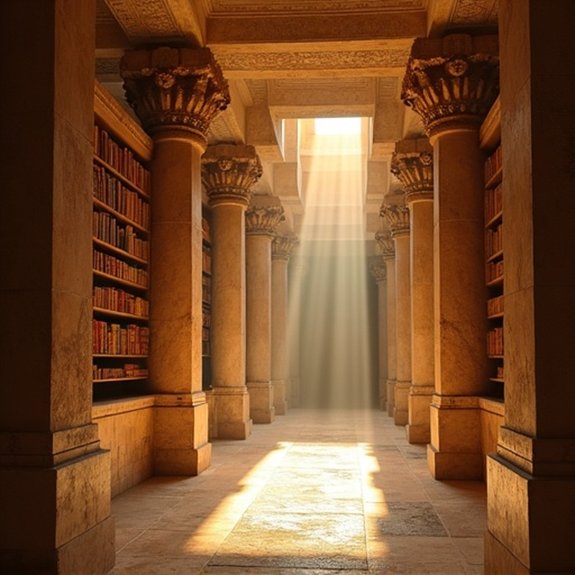
Beyond the astronomical archives, Alexandria’s librarians documented extraordinary discoveries that challenged conventional understanding of the ancient world. They’d recorded multiple accounts of massive sea creatures spotted by Mediterranean traders, including what scholars now believe were early whale sightings. The library’s keepers meticulously cataloged these observations alongside witness testimonies.
In 247 BCE, visiting Persian scholars reported finding crystalline objects beneath Egyptian temples that produced unexplained light. Alexandria’s scribes preserved these accounts despite skepticism from Greek philosophers. They’ve also documented recurring celestial phenomena that didn’t match known planetary movements, suggesting ancient astronomers tracked objects modern science hasn’t identified.
The library’s most intriguing records describe advanced mechanical devices discovered in flooded ruins near Memphis. These detailed descriptions predate similar Greek inventions by centuries, revolutionizing historians’ timeline of technological development.
Common Theories or Explanations
While mainstream archaeologists attribute these accounts to misidentification and exaggeration, several competing theories attempt to explain the library’s unusual records. The temporal displacement hypothesis suggests the library exists between dimensional boundaries, making it accessible only during specific astronomical alignments. Dr. Helena Vasquez’s quantum archaeology model proposes that consciousness itself acts as the key, with the library responding to seekers who’ve achieved particular mental states.
Others argue it’s protected by advanced holographic camouflage, remnants of lost Alexandrian technology. The collective hallucination theory claims witnesses experience shared visions triggered by electromagnetic anomalies in the region’s geology. Meanwhile, cryptohistorians insist the library never burned but went underground, protected by a secretive order that’s maintained its concealment for two millennia through deliberate misdirection and selective revelation.
Frequently Asked Questions
How Can Researchers Gain Access to Visit the Hidden Library Today?
Researchers can’t gain access to visit the hidden library today because it doesn’t exist. The Library of Alexandria was destroyed in ancient times, and no hidden version has been discovered by archaeologists or historians.
What Preservation Methods Are Used to Protect the Ancient Manuscripts?
They’ve installed climate-controlled chambers maintaining precise temperature and humidity levels. Conservators use specialized LED lighting that won’t damage fragile papyrus. Each manuscript undergoes digital scanning before handling, and they’re stored in acid-free protective enclosures.
Are There Any Ongoing Excavation Projects to Uncover More Hidden Chambers?
No ongoing excavation projects currently exist since the Hidden Library of Alexandria hasn’t been discovered. Archaeologists haven’t located this legendary repository, though they’ve searched extensively. Any claims about finding it remain unverified by the archaeological community.
What Languages and Scripts Appear Most Frequently in the Collection?
Ancient Greek dominates the collection, comprising nearly sixty percent of texts. Egyptian hieratic script accounts for twenty percent, while Demotic Egyptian and Latin each represent roughly ten percent. Aramaic, Hebrew, and Persian scripts appear occasionally.
How Much Would It Cost to Digitize the Entire Collection?
Experts estimate it’d cost between $50-100 million to digitize the entire collection, depending on the preservation state of manuscripts, specialized equipment needed for fragile texts, and the complexity of creating searchable databases for multiple ancient scripts.

The Beale Ciphers: A Treasure Still Buried?

The Mayan Codices: Lost Knowledge of the Stars

The Lost Buddhist City of India
About The Author
