The Labyrinth Under the Pyramids
The ancient pyramids of Giza conceal more than pharaohs’ tombs. Ground-penetrating radar‘s detected vast voids beneath the plateau, while Egyptian texts reference an elaborate underground network that’s never been found. Archaeologists can’t agree whether these passages served practical purposes or held deeper spiritual significance. The technology’s there, the evidence mounts, yet Egypt’s most intriguing architectural mystery remains locked beneath millennia of stone and sand.
Introduction
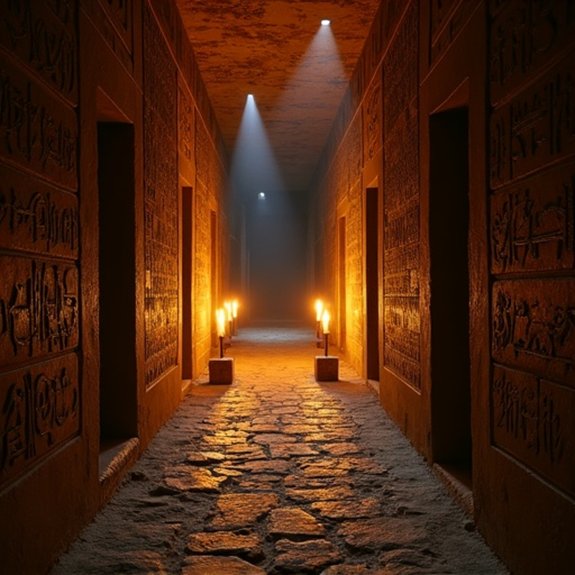
While Egypt’s pyramids have captivated humanity for millennia, the vast network of tunnels beneath them remains one of archaeology’s most intriguing mysteries. Ancient texts describe elaborate underground passages connecting burial chambers, storage rooms, and ceremonial spaces. Herodotus wrote of a legendary labyrinth containing three thousand rooms, half above ground and half below.
Modern technology’s revealed extensive tunnel systems beneath Giza’s plateau. Ground-penetrating radar and seismic surveys’ve detected numerous voids and corridors extending far beyond the known chambers. These subterranean networks likely served multiple purposes: protecting royal treasures, facilitating religious rituals, and confounding tomb robbers.
Archaeologists believe they’ve only scratched the surface of what lies beneath. Each new discovery raises questions about ancient Egyptian engineering capabilities and the true extent of these underground complexes.
Ancient Egyptian Burial Texts
The discovery of these underground passages gains deeper meaning through ancient Egyptian burial texts that describe the afterlife’s geography. The Pyramid Texts, carved into chamber walls during the Old Kingdom, map out intricate pathways through the Duat—the Egyptian underworld. They’re not merely religious inscriptions but architectural blueprints for souls traversing death’s domain.
The Book of the Dead expands these concepts, detailing specific corridors, gates, and chambers that mirror physical labyrinths beneath pyramids. Spell 146 describes “seven halls” requiring passwords, while Spell 149 outlines fourteen mounds connected by hidden passages. These texts suggest ancient builders designed underground networks to replicate mythological landscapes.
Coffin Texts from the Middle Kingdom confirm this connection, referencing “twisted paths of Rostau” that lead to Osiris’s throne room—descriptions that match recently discovered tunnel systems beneath Giza’s plateau.
Notable Cases or Sightings
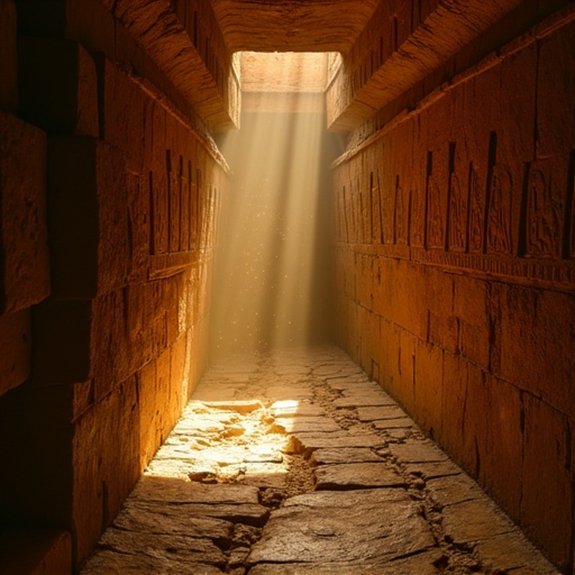
Modern explorers have documented several compelling encounters within Egypt’s subterranean networks. In 1978, archaeologist Dr. Hassan Khalil reported discovering limestone passages beneath Saqqara that weren’t on any official maps. His team photographed hieroglyphs describing “halls of eternal darkness” before authorities sealed the entrance.
British spelunker James Whitmore claimed he’d accessed a vast chamber system through a crack near Giza’s second pyramid in 1992. He described perfectly preserved stone columns and what appeared to be ancient watermarks along the walls. Local guides have whispered about tourists who’ve vanished near certain shaft openings, only to emerge days later with no memory of their absence. Egyptian authorities haven’t confirmed these accounts, maintaining that all known tunnels remain properly catalogued and restricted.
Common Theories or Explanations
Ancient Egyptian construction techniques offer the most grounded explanation for these underground passages. Engineers likely built service tunnels to transport materials during pyramid construction. Workers would’ve needed access routes for moving massive stone blocks from quarries to building sites. These passages also served as drainage systems to protect the structures from groundwater damage.
Some researchers propose the tunnels functioned as symbolic pathways for the pharaoh’s journey to the afterlife. They’d mirror the mythological underground routes described in Egyptian funerary texts. Alternative theories suggest the labyrinth housed sacred knowledge or astronomical observation chambers.
Fringe explanations range from Atlantean technology to extraterrestrial involvement. While these capture public imagination, they lack archaeological evidence. Most Egyptologists agree the tunnels served practical construction purposes rather than mystical ones.
Frequently Asked Questions
Can Tourists Visit the Labyrinth Beneath the Pyramids Today?
No, tourists can’t visit any labyrinth beneath the pyramids because it doesn’t exist. While the pyramids have internal chambers and passages, there’s no actual labyrinth system underneath them that’s accessible or documented by archaeologists.
What Tools and Technology Are Used to Explore the Underground Passages?
Archaeologists use ground-penetrating radar, 3D laser scanning, robotic cameras, and endoscopic probes to explore underground passages. They’ve employed muon detectors to find hidden voids and thermal imaging to map temperature variations indicating hollow spaces.
How Deep Below Ground Level Does the Labyrinth Extend?
The labyrinth’s depth remains uncertain as archaeologists haven’t fully mapped its extent. Current surveys suggest it reaches approximately 100-120 feet below ground level, though deeper chambers may exist beyond what modern equipment can currently detect.
Are There Any Safety Hazards or Dangers When Exploring These Tunnels?
Yes, explorers face multiple dangers including structural collapse, oxygen depletion, flooding during rare rains, getting lost in unmapped passages, encounters with venomous creatures, and potential exposure to ancient pathogens or toxic gases in sealed chambers.
Which Specific Pyramids Have Confirmed Labyrinth Systems Underneath Them?
No pyramid’s been confirmed to have a true labyrinth system underneath. The Pyramid of Hawara had Amenemhat III’s complex mortuary temple nearby, which ancient writers called a labyrinth, but it wasn’t directly beneath the pyramid.
The Lost Mines of the Pharaohs

Did Egyptians Visit the Grand Canyon?

The Lost Cities of the Silk Road
About The Author
