The Legend of Lyonesse Revisited
The ancient tale of Lyonesse won’t fade from Cornwall’s collective memory. Medieval scribes first documented this sunken kingdom‘s existence, describing fertile lands that vanished beneath Atlantic waves in a single catastrophic night. Today’s fishermen still report catching fragments of petrified wood and seeing stone formations during extreme low tides. What they’re discovering challenges everything historians thought they knew about Britain’s western coastline and its forgotten past.
Introduction
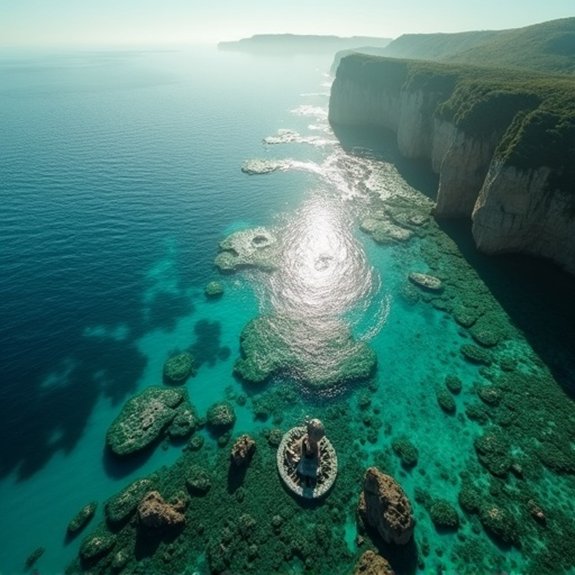
When medieval chroniclers first penned tales of a sunken kingdom off Cornwall‘s coast, they couldn’t have imagined how their stories would captivate audiences for centuries. The legend of Lyonesse describes a vast land that once connected Cornwall to the Isles of Scilly, complete with one hundred and forty churches, prosperous towns, and fertile fields. According to tradition, the sea swallowed this kingdom in a single catastrophic night, leaving only one survivor who rode his white horse to safety.
Modern scholars trace the legend’s origins to Celtic mythology, Arthurian romance, and possible folk memories of actual flooding events. The story appears in various forms throughout British literature, from Geoffrey of Monmouth’s chronicles to Tennyson’s poetry. Today, archaeologists and geologists continue investigating whether Lyonesse represents historical truth or pure fiction.
Medieval Chronicles Mention Sunken Kingdom
The earliest written accounts of Lyonesse emerged during the medieval period, when monastic scribes and court historians documented Britain’s legendary past. Geoffrey of Monmouth’s “Historia Regum Britanniae” (1136) first connected the sunken territory to Arthurian mythology, describing it as a flourishing kingdom that vanished beneath the waves in a single night.
Later chronicles expanded these tales. The “Chronicon ex Chronicis” mentions Lyonesse as King Arthur’s birthplace, while French romances placed Tristan’s homeland there. William of Worcester’s 15th-century writings specifically located the lost land between Cornwall and the Scilly Isles, claiming it contained 140 parish churches before the catastrophic flood.
These medieval texts weren’t merely fantasy. They often referenced local oral traditions and incorporated geographical details that suggested genuine folk memories of coastal flooding events.
Notable Cases or Sightings
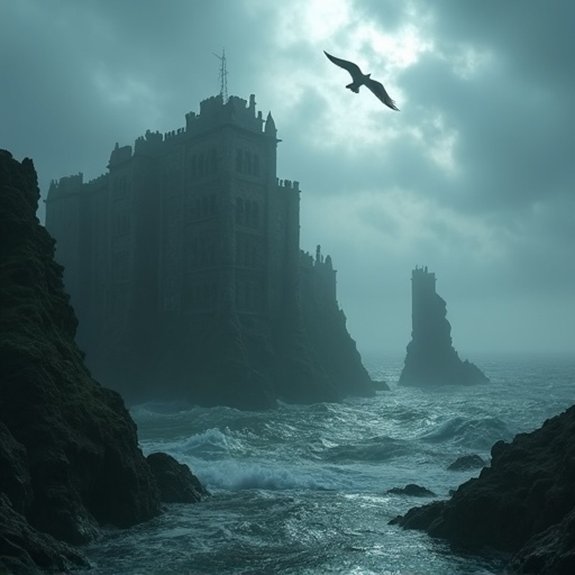
Although skeptics dismiss them as folklore, fishermen off Cornwall’s coast have reported remarkable encounters with Lyonesse’s remnants for centuries. In 1936, Stanley Baron claimed he’d seen stone walls beneath calm waters near Seven Stones reef. Local trawler captain James Richards documented catching his nets on what he believed were ancient structures thirty feet below the surface in 1967.
The most compelling account came from diver Derek Tangye in 1985. He’d photographed geometric formations off Land’s End that resembled building foundations. Marine archaeologists later examined his images but couldn’t definitively confirm their origin. During extreme low tides, locals have spotted blackened tree stumps between St. Michael’s Mount and the Isles of Scilly. These sightings consistently occur in areas where medieval maps placed Lyonesse’s boundaries.
Common Theories or Explanations
How did an entire kingdom vanish beneath the waves? Scholars have proposed several explanations for Lyonesse’s disappearance. Geologists point to post-glacial flooding that submerged land bridges between Cornwall and the Isles of Scilly during the Mesolithic period. They’ve identified submerged forests and ancient field systems on the seabed, suggesting gradual inundation rather than catastrophic collapse.
Medieval historians argue Lyonesse represents collective memories of actual flooding events, possibly conflating multiple incidents into one dramatic legend. Celtic mythology experts see parallels with other sunken land stories like Ys and Cantre’r Gwaelod, suggesting a common Indo-European flood myth adapted to local geography.
Some researchers propose the legend arose from misinterpretations of Roman texts describing Britannia’s coastline. Others believe it’s purely literary invention, created to enhance Arthurian romance narratives.
Frequently Asked Questions
Are There Any Modern Archaeological Expeditions Planned to Search for Lyonesse?
No modern archaeological expeditions are currently planned to search for Lyonesse. Scientists don’t consider it a viable archaeological site since it’s a mythical land from Arthurian legend, not a historically documented location that actually existed.
What Specific Artifacts Have Been Recovered That Might Link to Lyonesse?
No artifacts have been definitively linked to Lyonesse. Some researchers’ve pointed to medieval pottery fragments and stone anchors found off Cornwall’s coast, but archaeologists can’t confirm these items connect to the legendary sunken kingdom.
How Does the Lyonesse Legend Compare to Similar Sunken Land Myths Worldwide?
Lyonesse shares striking parallels with Atlantis, Lemuria, and Ys—all feature advanced civilizations destroyed by divine punishment through catastrophic flooding. They’re typically located near current coastlines and involve warnings ignored by prideful inhabitants before their doom.
Can Tourists Visit Locations Associated With the Lyonesse Legend Today?
Yes, tourists can visit Cornwall’s coast where Lyonesse supposedly sank. They’ll find St. Michael’s Mount, the Isles of Scilly, and Land’s End offer connections to the legend through local tours, museums, and storytelling experiences.
What Role Does Lyonesse Play in Contemporary Cornish Cultural Identity?
Lyonesse strengthens Cornwall’s mythic heritage, inspiring local artists, writers, and musicians who’ve woven it into modern works. It’s become a symbol of Cornwall’s lost lands, reinforcing regional distinctiveness and attracting cultural tourism to the peninsula.



About The Author
