The Lost City of Tiahuanaco
High in the Bolivian Andes, Tiahuanaco’s massive stone blocks defy conventional explanations. Engineers can’t fully explain how pre-Columbian builders transported 100-ton andesite slabs across difficult terrain without wheels or draft animals. The site’s precision-cut H-blocks and intricate interlocking stones suggest advanced techniques that shouldn’t have existed in 500 CE. What’s more puzzling is why this thriving metropolis suddenly vanished, leaving behind monuments that challenge everything archaeologists thought they knew.
Introduction
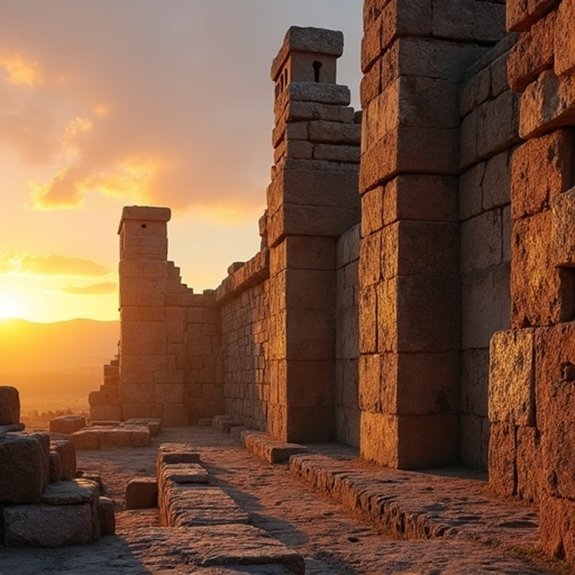
When Spanish conquistadors first encountered the massive stone ruins near Lake Titicaca in the 16th century, they couldn’t believe indigenous peoples had built such monumental structures. They’d discovered Tiahuanaco, one of South America’s most enigmatic archaeological sites. Located in modern-day Bolivia at 12,500 feet above sea level, this pre-Columbian city once served as the capital of a powerful civilization that dominated the region from 500 to 1000 CE.
The site’s precisely cut stone blocks, some weighing over 100 tons, showcase advanced engineering techniques that still puzzle researchers today. Tiahuanaco’s builders created elaborate drainage systems, massive ceremonial platforms, and intricately carved monoliths without metal tools or wheeled vehicles. The city’s influence stretched across the Andes, establishing trade networks and spreading distinctive artistic styles throughout ancient South America.
Ancient Pre-Incan Construction Methods
Master stonemasons at Tiahuanaco developed construction techniques that modern engineers still struggle to replicate. They carved massive andesite blocks weighing up to 130 tons with such precision that they fit together without mortar. The joints between stones measure less than a millimeter wide—so tight that a knife blade can’t slip between them.
Workers transported these megalithic blocks across Lake Titicaca on reed boats, then hauled them overland using rope, wooden rollers, and human labor. They’d cut stone using bronze tools and stone hammers, achieving perfectly flat surfaces through patient grinding with sand and water. The builders incorporated an interlocking system where stones locked into place through precisely carved notches and grooves. This technique created structures that’ve survived earthquakes for over 1,500 years.
Notable Cases or Sightings
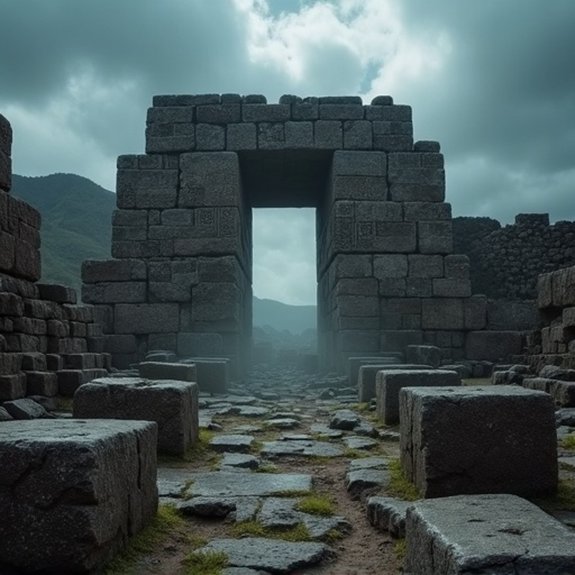
Throughout the centuries following Tiahuanaco’s abandonment around 1000 CE, explorers and archaeologists have documented remarkable discoveries that continue to reshape our understanding of this enigmatic site. Spanish conquistador Pedro Cieza de León first described the ruins in 1549, noting massive stone blocks that seemed impossibly moved. In 1903, Arthur Posnansky’s excavations revealed the site’s astronomical alignments and proposed it was 17,000 years old—a controversial dating still debated today.
The 1960s brought Bolivian archaeologist Carlos Ponce Sanginés’ systematic excavations, uncovering the Semi-Subterranean Temple‘s carved heads. Most recently, ground-penetrating radar detected buried structures beneath the Akapana pyramid in 2018, suggesting Tiahuanaco’s true extent remains hidden. These findings’ve transformed what researchers thought they knew about pre-Columbian engineering capabilities.
Common Theories or Explanations
While mainstream archaeology dates Tiahuanaco to roughly 500-1000 CE, competing theories about the site’s origins and purpose have captivated researchers for decades. Some archaeologists propose it served as a pilgrimage center for ancient Andean cultures, drawing worshippers to its massive stone temples. Others suggest it functioned as an astronomical observatory, with its precisely aligned structures tracking celestial movements.
Alternative researchers’ve pushed more controversial ideas. They claim the site’s actually 15,000 years old, pointing to alleged astronomical alignments and weathering patterns. Some theorists argue advanced pre-flood civilizations built Tiahuanaco using lost technologies, explaining the site’s massive stone blocks and precise cuts. A few even propose extraterrestrial involvement, citing the complex stonework’s similarity to other mysterious ancient sites worldwide. These fringe theories remain unsupported by scientific evidence.
Frequently Asked Questions
How Much Does It Cost to Visit Tiahuanaco Today?
Visitors typically pay around 100 Bolivianos (about $15 USD) to enter Tiahuanaco’s archaeological site. The ticket includes access to both ruins and museums. Prices vary for international tourists, students, and Bolivian nationals who receive discounts.
What Is the Best Time of Year to Visit the Ruins?
The best time to visit Tiahuanaco’s ruins is during Bolivia’s dry season from May to October. Visitors’ll enjoy clear skies and comfortable temperatures. June and July offer the coldest but clearest weather for exploring the ancient site.
Are Guided Tours Available at the Archaeological Site?
Yes, guided tours are available at Tiahuanaco’s archaeological site. Visitors can hire local guides at the entrance who’ll explain the ruins’ history, architecture, and cultural significance. Tours typically last 2-3 hours and are offered in multiple languages.
How Do I Get to Tiahuanaco From La Paz?
Travelers can reach Tiahuanaco from La Paz by taking a public bus from the cemetery district, which takes about 90 minutes. They’ll also find tour operators offering day trips with transportation included from the city.
What Facilities and Amenities Are Available for Visitors at the Site?
Visitors’ll find a museum showcasing artifacts, restrooms, and a ticket office at Tiahuanaco’s entrance. The site offers guided tours, informational signs, and designated walking paths. There’s limited food service, so travelers should bring water and snacks.

The Disappearance of the Harappan Civilization

The Mystery of Lake Titicaca’s Ruins

The Rendlesham Pyramid Theory
About The Author
