The Maya Collapse: Astronomical Causes?
The Maya civilization’s sudden collapse around 900 CE doesn’t fit neatly into conventional explanations. While archaeologists point to drought and warfare, ancient codices tell a different story—one of mysterious “fire shields” streaking across night skies and “star walkers” appearing before major city abandonments. These celestial accounts, dismissed by mainstream scholars, might hold vital answers. What if the Maya’s advanced astronomical knowledge actually documented the cosmic events that triggered their downfall?
Introduction
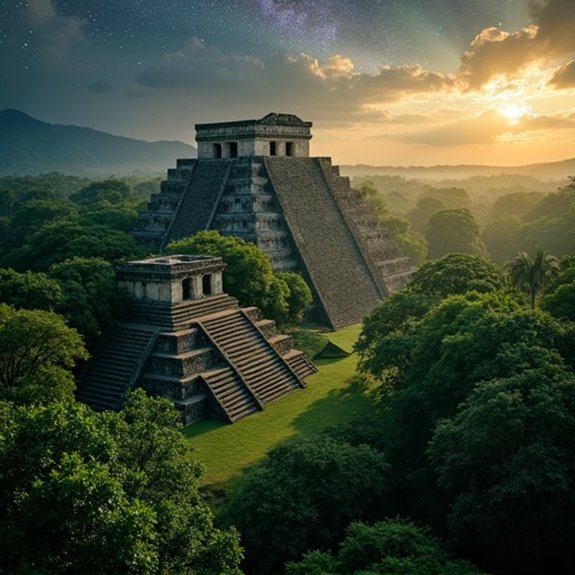
When the Classic Maya civilization mysteriously collapsed between 800 and 1000 CE, one of history’s most advanced societies vanished from the tropical lowlands of Mesoamerica. Cities that’d thrived for centuries suddenly emptied as millions abandoned their homes, leaving behind magnificent pyramids and palaces to be reclaimed by jungle vegetation. Scholars have debated this enigma for decades, proposing theories ranging from warfare and disease to environmental degradation and drought.
Recent archaeological evidence suggests astronomical phenomena may’ve played a significant role in the Maya’s downfall. The civilization’s deep connection to celestial cycles influenced their agriculture, politics, and religious practices. Understanding how astronomical events potentially triggered or accelerated the collapse requires examining the Maya’s sophisticated knowledge of the cosmos and their vulnerability to disruptions in expected celestial patterns.
Maya Civilization’s Peak Achievements
Before examining how astronomical disruptions may’ve contributed to their demise, it’s worth recognizing the extraordinary heights the Maya reached during their Classic Period (250-900 CE). They built massive stone cities featuring pyramids that soared over 200 feet high, with Tikal and Calakmul housing populations exceeding 50,000 residents. Their astronomers tracked Venus’s movements with remarkable precision, predicted solar eclipses centuries in advance, and created calendars more accurate than those used in medieval Europe.
Maya mathematicians developed the concept of zero independently, while scribes recorded history in elaborate hieroglyphic texts. They engineered sophisticated water management systems, including reservoirs and underground storage chambers called chultunes. Their trade networks stretched from central Mexico to Honduras, exchanging jade, obsidian, and cacao across thousands of miles.
Notable Cases or Sightings
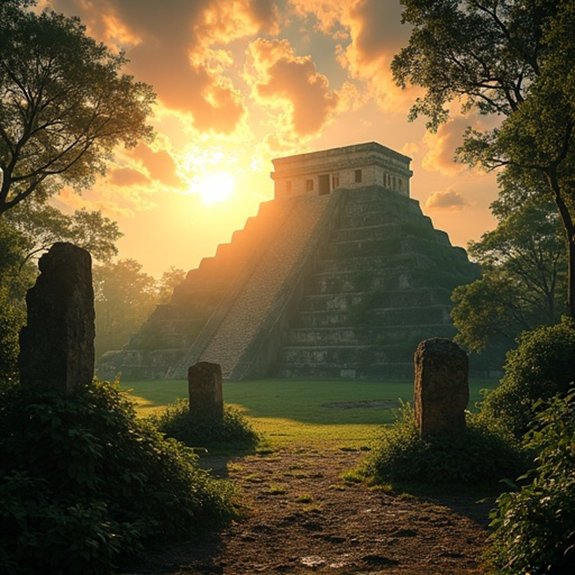
How might unexplained aerial phenomena have influenced the Maya’s sudden abandonment of their greatest cities? Several Maya codices describe “star walkers” descending from the sky during the civilization’s decline. The Dresden Codex depicts luminous objects hovering above Copán before its 9th-century abandonment. Similar accounts appear in Palenque’s inscriptions, where priests recorded “fire shields” that appeared months before the city’s collapse.
Archaeological evidence supports these observations. Vitrified stones found at Tikal don’t match typical lightning damage patterns. Magnetic anomalies detected at abandoned sites correlate with the codices’ timeline of sightings. Most intriguingly, multiple cities recorded identical celestial events on the same dates, suggesting they weren’t observing natural astronomical phenomena. These consistent reports across distant Maya centers hint that something extraordinary occurred during their civilization’s mysterious decline.
Common Theories or Explanations
These mysterious accounts have led researchers to propose several explanations for the Maya collapse, though mainstream archaeology favors environmental and societal factors. Severe droughts between 800-1000 CE likely devastated agricultural systems, causing widespread famine. Overpopulation strained resources while deforestation degraded soil quality. Political fragmentation sparked warfare between city-states, disrupting trade networks.
Alternative theorists suggest astronomical triggers. Some argue that increased solar activity or cosmic radiation affected climate patterns and human behavior. Others propose that the Maya’s advanced astronomical knowledge revealed an impending catastrophe they couldn’t prevent. A few researchers point to potential asteroid impacts or atmospheric changes from volcanic eruptions elsewhere.
While evidence strongly supports environmental causes, the civilization’s sophisticated understanding of celestial cycles continues to fuel speculation about whether they’d predicted their own demise through astronomical observations.
Frequently Asked Questions
How Can Modern Archaeologists Accurately Date Maya Astronomical Observations and Celestial Events?
Modern archaeologists date Maya astronomical observations by cross-referencing hieroglyphic inscriptions with computer models of ancient sky positions. They’ll compare recorded celestial events in Maya codices with calculated planetary cycles and eclipse patterns from astronomy software.
What Specific Research Methods Do Scientists Use to Study Maya Collapse Theories?
Scientists analyze ancient pollen samples, study sediment cores from lakes, examine skeletal remains for malnutrition signs, map settlement patterns through LiDAR technology, and correlate climate data with hieroglyphic texts that record droughts and conflicts.
Are There Any Living Maya Descendants Who Maintain Ancient Astronomical Knowledge?
Yes, millions of Maya descendants still practice traditional astronomy today. They’ve preserved ancient calendar systems, celestial observations, and agricultural timing methods. Guatemala’s daykeepers maintain sacred calendars while indigenous communities continue tracking Venus cycles and seasonal markers.
How Much Would It Cost to Conduct Comprehensive Archaeological Studies on This Topic?
Thorough archaeological studies examining astronomical causes of Maya collapse would cost $5-20 million. They’d require multi-year excavations, advanced dating technologies, astronomical modeling software, and interdisciplinary teams of archaeologists, astronomers, and climate scientists working across multiple sites.
Which Museums Have the Best Collections of Maya Astronomical Artifacts and Codices?
Dresden’s Saxon State Library holds the famous Dresden Codex, while Madrid’s Museo de América displays the Madrid Codex. Mexico City’s National Museum of Anthropology showcases extensive Maya astronomical artifacts, including carved stelae and calendar stones.

The Legend of Lyonesse Revisited

What Happened to the Vanished Village of Anjikuni?

Did Ancient Giants Build Mysterious Stone Circles in North America?
About The Author
