The Mystery of Lake Titicaca’s Ruins
Lake Titicaca’s depths conceal more than they reveal. At 12,500 feet above sea level, the world’s highest navigable lake harbors submerged temples, gold artifacts, and stone structures that shouldn’t exist beneath its waters. Archaeologists can’t explain how the Tiwanaku civilization‘s ruins ended up on the lakebed. Local legends speak of sunken cities and divine catastrophes, but science suggests something far stranger happened to this ancient culture.
Introduction
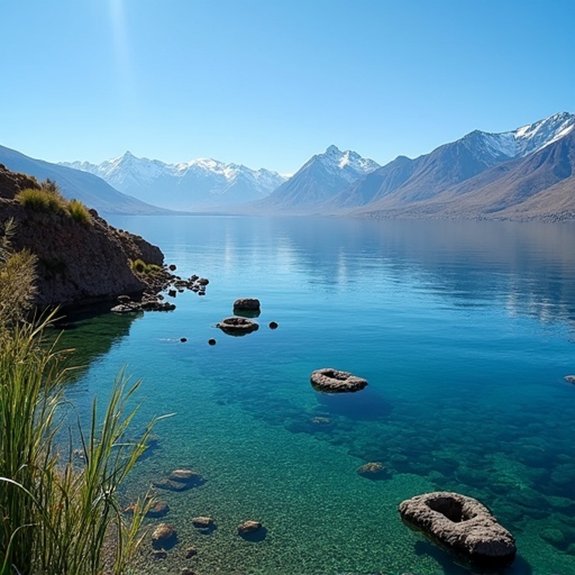
Something extraordinary lies hidden beneath the dark waters of Lake Titicaca, the world’s highest navigable lake straddling the border between Peru and Bolivia. At 12,500 feet above sea level, this ancient body of water conceals archaeological treasures that’ve puzzled researchers for decades. Divers have discovered stone structures, terraces, and walls dating back over 1,000 years, suggesting a sophisticated pre-Columbian civilization once thrived here.
The ruins aren’t limited to the lake’s depths. Nearby islands contain mysterious temples and ceremonial sites that challenge conventional understanding of Andean history. Local Aymara and Quechua peoples have long spoken of sunken cities and sacred places beneath the waves. Modern technology now confirms what indigenous oral traditions have maintained for centuries—Lake Titicaca holds secrets that could rewrite South American prehistory.
Ancient Tiwanaku Civilization’s Sacred Waters
While modern archaeologists struggle to piece together the puzzle of Lake Titicaca‘s submerged structures, the ancient Tiwanaku civilization viewed these waters as the birthplace of their world. They believed their creator god Viracocha emerged from the lake’s depths to form the sun, moon, and first humans. The Tiwanaku people dominated the region from 500 to 1000 CE, establishing their capital near the lake’s southern shores.
They’ve left behind massive stone temples and intricate gold offerings discovered underwater. Divers found ceremonial artifacts deliberately placed on the lakebed, including puma-shaped vessels and incense burners. The civilization built reed boats to navigate the sacred waters, conducting rituals on floating islands. Their descendants, the Aymara people, still consider specific underwater sites as portals to the divine domain.
Notable Cases or Sightings
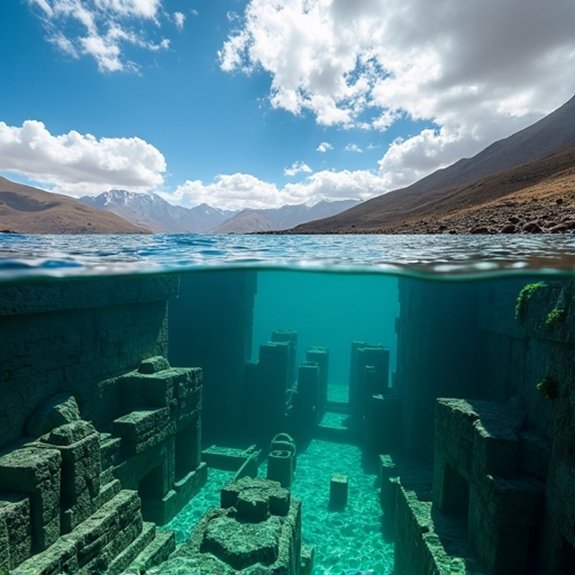
The 2000 Akakor expedition uncovered temple-like structures 20 meters beneath Lake Titicaca‘s surface, sparking international attention. Italian scientists led by Lorenzo Epis documented stone terraces, roads, and walls dating back 1,500 years. They’ve linked these ruins to the pre-Incan Tiwanaku culture.
In 1992, American explorer Johan Reinhard discovered ancient offerings near Khoa reef, including gold artifacts and ceremonial vessels. Local fishermen regularly report seeing submerged stone formations during drought periods when water levels drop.
Bolivia’s government authorized underwater archaeological surveys in 2013. Teams found additional ceramic fragments and stone anchors suggesting maritime activity. Jacques Cousteau’s 1968 expedition mapped anomalous sonar readings but couldn’t conclusively identify structures. Recent side-scan sonar technology’s revealed more extensive ruins than previously thought, though access remains restricted for preservation.
Common Theories or Explanations
These underwater discoveries have prompted researchers to develop several theories about how ancient structures ended up beneath Lake Titicaca’s surface. Geologists suggest tectonic activity raised the lake’s water level over centuries, submerging coastal settlements. They’ve identified evidence of ancient shorelines at lower elevations, supporting gradual flooding scenarios.
Archaeologists propose the ruins represent ceremonial sites deliberately built in shallow waters during periods of drought when lake levels dropped considerably. Carbon dating indicates some structures predate known Tiwanaku civilization by centuries, suggesting earlier advanced cultures inhabited the region.
Climate scientists point to dramatic environmental changes during the Younger Dryas period, when rapid glacial melting could’ve flooded existing settlements. However, local indigenous oral traditions describe a great flood that destroyed ancient cities, adding cultural validation to scientific hypotheses about catastrophic water level changes.
Frequently Asked Questions
Can Tourists Visit the Underwater Ruins at Lake Titicaca?
No, tourists can’t visit the underwater ruins at Lake Titicaca. The structures lie too deep for recreational diving, and Bolivia’s government restricts access to protect these archaeological sites. Only authorized research teams explore them.
What Equipment Is Needed to Explore the Submerged Structures?
Divers need specialized scuba gear, underwater cameras, and sonar equipment to explore the submerged structures. They’ll require dry suits for the cold water, powerful lights for visibility, and GPS devices for mapping the archaeological sites.
Are There Any Ongoing Archaeological Excavations at the Lake?
Yes, archaeologists’re actively excavating several sites around Lake Titicaca. Teams from Bolivia and Peru regularly conduct underwater surveys near Khoa reef, while researchers explore coastal settlements and ceremonial platforms that’ve revealed pre-Columbian artifacts and structures.
How Deep Underwater Are the Ruins Located?
Archaeologists’ve discovered ruins at various depths in Lake Titicaca, with most structures lying between 5 to 20 meters underwater. The temple complex near Khoa reef sits approximately 6 meters below the surface, while deeper artifacts reach 30 meters.
What Permits Are Required for Diving Expeditions to the Ruins?
Diving expeditions require permits from Bolivia’s Ministry of Cultures and Tourism. They’ll need archaeological authorization, environmental clearance from local authorities, and approved dive operator certification. Peru’s side demands similar documentation through their National Institute of Culture.

The Hidden Pyramid of Bosnia

The Hidden Library of Alexandria
The Mystery of Oak Island’s Flood Tunnels
About The Author
