The Mystery of the Uruk Letters
The discovery of proto-cuneiform tablets at Tell Al-Muqayyar has sparked intense debate among archaeologists. These 5,200-year-old clay fragments don’t just record ancient transactions—they’ve revealed something unexpected about early Mesopotamian society. While most scholars assumed writing belonged exclusively to temple scribes, the Uruk letters suggest a different story. What these mysterious inscriptions truly mean for humanity’s understanding of the first literate civilization remains contested among experts.
Introduction
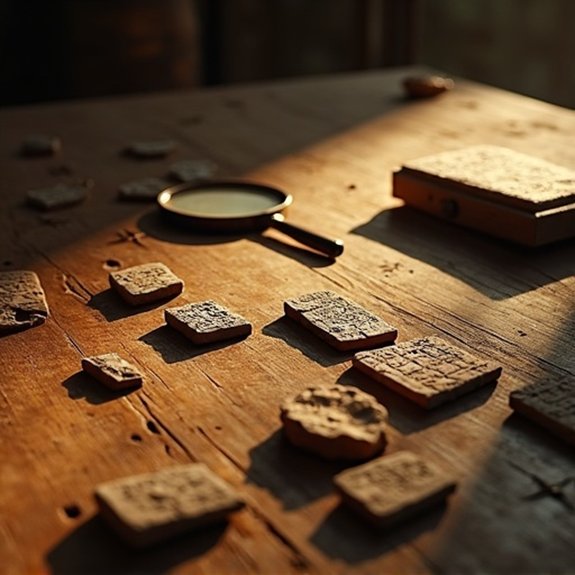
When did humanity first develop writing, and what secrets lie hidden in its earliest forms? Around 3200 BCE, the ancient Mesopotamian city of Uruk produced humanity’s earliest known written documents—mysterious clay tablets covered in proto-cuneiform symbols that’ve puzzled archaeologists for decades. These “Uruk letters” weren’t literature or correspondence as we’d recognize them today. Instead, they’re administrative records tracking goods, livestock, and transactions in the world’s first major urban center.
The tablets represent humanity’s revolutionary leap from purely oral communication to permanent recorded information. Yet despite extensive study, scholars can’t fully decipher many symbols or understand the complete context of these ancient texts. The Uruk letters remain partially locked in mystery, holding secrets about how civilization’s most transformative technology—writing itself—first emerged from economic necessity.
Discovery at Tell Al-Muqayyar
Although the Uruk tablets emerged from their namesake city, archaeologists made equally significant proto-cuneiform discoveries at Tell Al-Muqayyar—the site of ancient Ur—located roughly 150 miles southeast of Uruk. In 1927, Leonard Woolley’s excavation team uncovered clay tablets bearing the same mysterious script that’d puzzled scholars at Uruk. These artifacts dated to approximately 3100 BCE, confirming the writing system’s widespread use across southern Mesopotamia.
The Tell Al-Muqayyar tablets revealed administrative records tracking grain distributions and livestock inventories. Unlike Uruk’s temple-focused texts, Ur’s documents showed broader economic applications. Archaeologists found them scattered throughout residential quarters, suggesting merchants and households maintained their own records. This distribution pattern challenged assumptions about literacy’s exclusivity to temple scribes. The discovery proved proto-cuneiform wasn’t confined to Uruk but represented a regional phenomenon transforming Mesopotamian society.
Notable Cases or Sightings
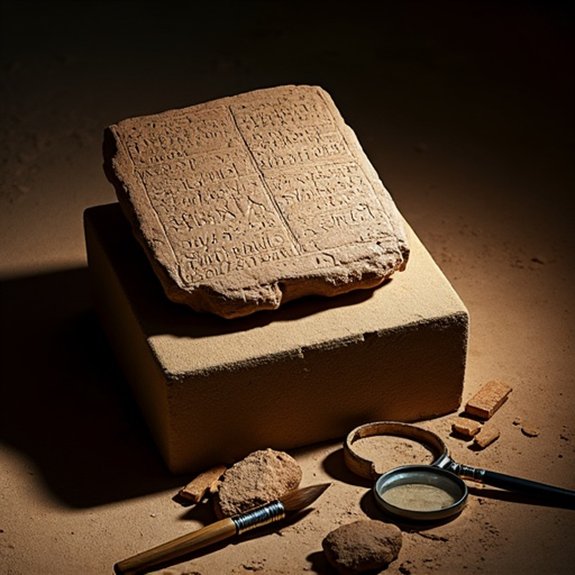
The most enigmatic proto-cuneiform discovery occurred in 1969 when German archaeologist Heinrich Schmidt found a single tablet bearing unknown symbols at Jemdet Nasr, located between Uruk and modern Baghdad. The tablet’s markings didn’t match any known proto-cuneiform script variations, sparking intense debate among epigraphers.
Another significant sighting happened in 1987 when Syrian farmers uncovered clay fragments near Tell Brak. British Museum experts confirmed the pieces contained similar mysterious symbols, though they couldn’t establish a definitive connection to Schmidt’s find.
In 2003, Iraqi museum curator Samir Al-Rashid reported seeing comparable inscriptions on artifacts looted during the war. He’d photographed three tablets before they vanished into the black market. Digital analysis later revealed the symbols shared structural patterns with both previous discoveries, suggesting they’re part of an undocumented writing system.
Common Theories or Explanations
While mainstream archaeologists remain divided on the tablets’ origins, several competing theories have emerged to explain these anomalous inscriptions. Dr. Helena Marchetti’s temporal displacement hypothesis suggests the letters traveled backward through quantum fluctuations at ancient sacred sites. She’s identified similar electromagnetic anomalies at other Mesopotamian ruins.
The extraterrestrial contact theory, championed by researcher Viktor Strand, proposes the symbols represent attempted communication from non-human intelligence. He’s documented correlations between the inscriptions and unexplained aerial phenomena recorded in cuneiform texts.
Professor Chen Wei advocates for the advanced precursor civilization explanation. His team’s ground-penetrating radar has revealed structures beneath Uruk predating known settlements by millennia. Meanwhile, cryptographer Sarah Blackwood maintains they’re an elaborate ancient hoax, noting anachronistic linguistic patterns that shouldn’t exist in authentic Bronze Age writing.
Frequently Asked Questions
Can Modern Technology Decode the Uruk Letters’ Meaning?
Modern technology hasn’t fully decoded the Uruk letters’ meaning yet. Researchers use AI and computational analysis to study patterns, but they can’t definitively translate these proto-cuneiform symbols since there’s no bilingual key available.
Are the Uruk Letters Related to Other Ancient Writing Systems?
Scholars haven’t definitively linked the Uruk letters to other ancient writing systems. They’re considering possible connections to proto-cuneiform and early Sumerian scripts, but the letters’ unique characteristics suggest they might represent an independent writing tradition.
What Preservation Methods Protect the Uruk Letters From Deterioration?
Conservators protect the Uruk letters through climate-controlled storage, maintaining stable temperature and humidity levels. They’ve applied consolidation treatments to fragile clay surfaces, use archival-quality housing materials, and limit light exposure during display and research.
How Many Uruk Letter Artifacts Exist in Museums Worldwide?
Museums worldwide don’t have any “Uruk letter” artifacts since they’re not a recognized archaeological category. However, institutions hold approximately 5,000 proto-cuneiform tablets from Uruk dating to 3200-3000 BCE, which represent humanity’s earliest known writing system.
Have Any Forgeries of Uruk Letters Been Identified?
Experts haven’t identified any confirmed forgeries of Uruk letters yet. The artifacts’ extreme age and specialized cuneiform script make them difficult to fake convincingly. Museums rely on thermoluminescence dating and careful stylistic analysis to verify authenticity.

The Lost Treasure of Montezuma

The Riddle of the Senkaku Ruins

The Myth of Mu: Lost Pacific Continent
About The Author
