The Valley of the Golden Mummies
Egypt’s Bahariya Oasis holds an ancient secret that stunned archaeologists in 1996. Dr. Zahi Hawass’s team uncovered a massive Greco-Roman necropolis containing over 250 mummies adorned with golden masks, spanning seven centuries of burial practices. The site’s revealed something unexpected about this remote desert location—it wasn’t just a backwater settlement. The elaborate burials and precious materials suggest Bahariya harbored mysteries about trade, wealth, and cultural fusion that challenge previous assumptions.
Introduction
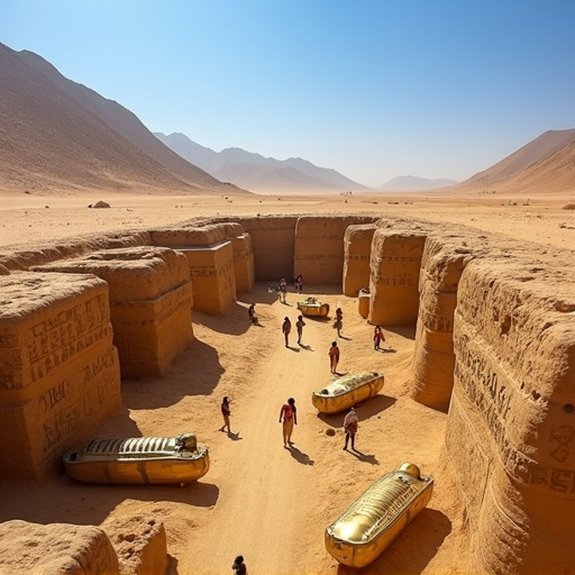
When archaeologist Zahi Hawass stumbled upon a tomb entrance in Egypt’s Bahariya Oasis in 1996, he couldn’t have predicted he’d discovered one of the most spectacular archaeological finds of the modern era. The site contained an enormous Greco-Roman cemetery with thousands of mummies, many adorned with golden masks and cartonnage. Dating from 332 BCE to 395 CE, these burials revealed how ancient Egyptians blended traditional practices with Greek and Roman influences during this transforming period. The discovery earned its nickname “The Valley of the Golden Mummies” from the gilded decorations that covered numerous bodies. Excavations have uncovered over 250 mummies so far, though archaeologists estimate the cemetery holds approximately 10,000 burials across six square kilometers, making it Egypt’s largest known Greco-Roman necropolis.
Bahariya Oasis Discovery Date
Three years before the new millennium, a donkey’s hoof broke through desert sand to reveal what would become Egypt’s most significant Greco-Roman archaeological discovery. In 1996, a guard’s donkey stumbled into a hole near the Temple of Alexander the Great in Bahariya Oasis, exposing an ancient tomb entrance. Dr. Zahi Hawass, then Egypt’s chief archaeologist, led the excavation team that uncovered the site’s extraordinary scope.
The accidental discovery occurred 230 miles southwest of Cairo in Egypt’s Western Desert. Initial excavations revealed mummies adorned with golden masks and gilded cartonnage, dating from 332 BCE to 395 CE. The team’s systematic exploration identified multiple burial chambers containing hundreds of well-preserved mummies. This chance encounter transformed archaeological understanding of Bahariya’s importance as a prosperous wine-producing region during Greco-Roman times.
Notable Cases or Sightings
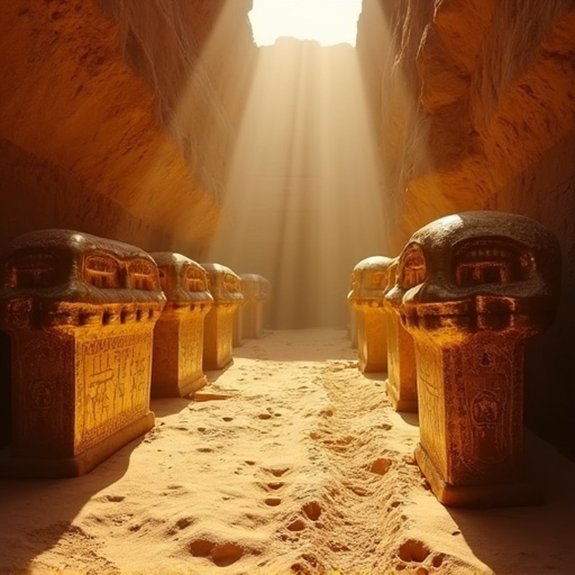
The excavation team’s most remarkable discovery emerged from Tomb 54, where archaeologists found a mummy wearing an intricate golden mask depicting the god Osiris. This particular mummy’s chest plate featured detailed scenes of protective deities, while its wrappings contained perfectly preserved linen dating to the Greco-Roman period.
Another significant find occurred in Tomb 62, which housed four family members arranged in a unique cross pattern. The father’s mummy displayed exceptional cartonnage work with gilded reliefs showing the weighing of the heart ceremony. His wife’s remains included jewelry still wrapped within the bandages.
Tomb 1 revealed children’s mummies with golden masks smaller than typical adult versions. These masks showed distinctive artistic features that weren’t seen elsewhere in the necropolis, suggesting different workshop origins or temporal variations in burial practices.
Common Theories or Explanations
Archaeological analysis of these discoveries has led researchers to develop several theories about the necropolis’s extensive use and social significance. Experts believe the site served Bahariya Oasis’s middle class during the Greco-Roman period, when Egypt’s economy flourished through wine production and trade routes. The golden masks and elaborate decorations suggest these weren’t elite burials but prosperous merchants who’d adopted Hellenistic burial customs while maintaining Egyptian traditions.
The mummies’ varied artistic styles indicate multiple workshops operated simultaneously, serving different economic classes. Some archaeologists propose the site’s expansion coincided with Roman agricultural reforms that enriched local landowners. The mixing of Greek, Roman, and Egyptian burial practices demonstrates Bahariya’s role as a cultural crossroads. Dating evidence suggests the necropolis remained active for over 600 years.
Frequently Asked Questions
How Much Does It Cost to Visit the Valley of the Golden Mummies?
The entrance fee isn’t publicly standardized as the Valley of the Golden Mummies in Bahariya Oasis, Egypt, requires visitors to purchase tickets through local tour operators. Prices typically range from $10-30 depending on the package selected.
What Preservation Techniques Are Used to Maintain the Mummies Today?
Conservators maintain the mummies using climate-controlled environments with regulated temperature and humidity levels. They’ve implemented specialized ventilation systems, apply protective consolidants to fragile areas, and conduct regular monitoring while limiting direct handling and visitor exposure.
Can Tourists Photograph the Mummies Inside the Tombs?
No, tourists can’t photograph the mummies inside the tombs. Egypt’s antiquities authorities strictly prohibit flash photography and often ban all cameras to protect the fragile artifacts from light damage and preserve the site’s integrity.
What Tools and Equipment Were Used During the Excavation Process?
Archaeologists used brushes, trowels, and dental picks for delicate cleaning. They employed ground-penetrating radar to locate tombs, cameras for documentation, and protective containers for transport. Sieves helped recover small artifacts from excavated soil.
How Many Archaeologists Are Currently Working at the Site?
The current number of archaeologists working at the site isn’t publicly documented. The excavation team’s size varies depending on seasonal work, funding availability, and specific project phases. Egypt’s Ministry of Tourism and Antiquities oversees staffing decisions.
Did Egyptians Visit the Grand Canyon?

The Tower of Babel: Myth Vs Reality
Who Really Built Stonehenge?
About The Author
