The Walls of Jericho: Biblical Mystery
The ancient walls of Jericho have puzzled archaeologists for over a century. They’ve uncovered multiple layers of destruction at the site, but none align perfectly with the biblical timeline of Joshua’s conquest. Carbon dating suggests the city’s fortifications fell centuries before the Israelites supposedly arrived. Yet certain evidence—collapsed walls, burned grain stores, and abandoned ruins—hints at a catastrophic event that mirrors the scriptural account. What really happened remains disputed.
Introduction

The ancient walls of Jericho have captivated archaeologists and historians for over a century, standing as one of humanity’s earliest examples of urban fortification. Located near the Jordan River in the West Bank, Jericho’s defensive structures date back approximately 10,000 years, making them among the world’s oldest known walls.
The site’s gained prominence through the biblical account in the Book of Joshua, which describes the walls’ miraculous collapse after the Israelites marched around them for seven days. This narrative’s sparked intense debate between religious scholars and archaeologists about historical accuracy and archaeological evidence. Multiple excavations since the 1860s have revealed complex layers of construction and destruction, though researchers haven’t reached consensus on correlating these findings with biblical events. The walls remain a focal point for understanding ancient Near Eastern civilization and religious history.
Ancient Canaanite Fortress City
During the Middle and Late Bronze Ages (2000-1200 BCE), Jericho emerged as a significant Canaanite stronghold controlling essential trade routes between Mesopotamia and Egypt. The city’s strategic position near the Jordan River crossing made it invaluable for merchants and armies alike.
Archaeological evidence reveals massive fortification walls, some reaching twenty feet high with foundations six feet thick. The city’s double-wall system included an outer retaining wall and an inner defensive wall, creating a formidable barrier against invaders. Between these walls, residents built homes and storage facilities.
Jericho’s inhabitants worshipped Canaanite deities and practiced sophisticated agriculture using spring-fed irrigation systems. The city’s prosperity attracted various conquering forces throughout its history. Its destruction layers suggest multiple sieges and rebuilding phases before the famous biblical account.
Notable Cases or Sightings
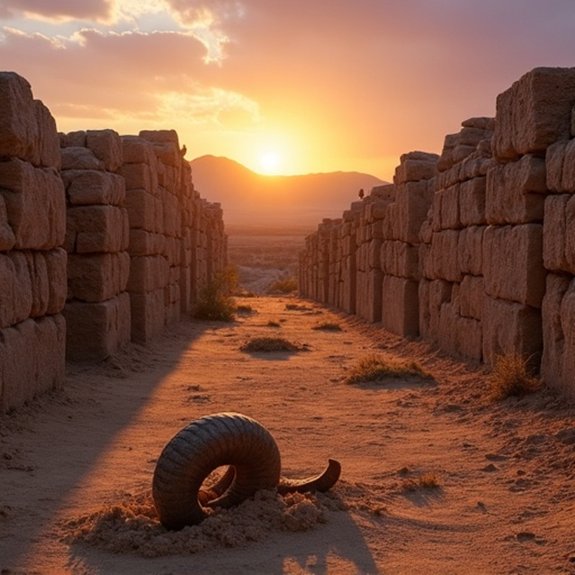
Several archaeological excavations have uncovered compelling evidence of Jericho’s ancient walls, though debates persist about their exact dating and connection to biblical events. British archaeologist Kathleen Kenyon‘s 1950s expedition revealed collapsed mudbrick walls dating to the Middle Bronze Age. Earlier, John Garstang’s 1930s dig found destruction layers he’d attributed to Joshua’s conquest around 1400 BCE.
German-Austrian teams discovered the tower structure in 1907, while Charles Warren first identified the tell in 1868. Ernst Sellin and Carl Watzinger’s work between 1907-1909 exposed massive fortification systems. Bryant Wood’s later analysis challenged Kenyon’s conclusions, arguing the city’s destruction matched biblical chronology. Italian-Palestinian excavations since 1997 have revealed Neolithic walls predating any biblical timeline. These findings haven’t resolved the controversy but they’ve enriched understanding of Jericho’s complex archaeological record.
Common Theories or Explanations
While archaeologists and biblical scholars have proposed numerous explanations for Jericho’s fallen walls, three main theories dominate academic discourse. The earthquake hypothesis suggests seismic activity destroyed the fortifications, as the Jordan Valley sits on an active fault line. Proponents cite geological evidence of ancient earthquakes coinciding with Jericho’s destruction timeline.
The siege warfare theory argues conventional military tactics brought down the walls. Extended sieges weakened mud-brick structures, while battering rams and undermining techniques caused structural collapse. Some scholars propose the biblical account describes standard Bronze Age warfare metaphorically.
The erosion model attributes the walls’ fall to natural deterioration. Centuries of weathering, combined with poor maintenance during political instability, led to gradual structural failure. This theory explains archaeological evidence showing multiple destruction layers across different time periods.
Frequently Asked Questions
Can Tourists Visit the Archaeological Site of Ancient Jericho Today?
Yes, tourists can visit ancient Jericho’s archaeological site in the West Bank. They’ll explore excavated remains dating back over 10,000 years, including ancient walls, towers, and settlements that’ve made it one of the world’s oldest continuously inhabited cities.
What Modern Scientific Dating Methods Have Been Used at Jericho?
Archaeologists’ve employed radiocarbon dating on organic materials, pottery typology analysis, and stratigraphic examination at Jericho. They’ve also used magnetometry surveys and thermoluminescence dating on ceramics to establish chronologies for the site’s multiple occupation layers.
How Much Would an Archaeological Excavation at Jericho Cost?
A major archaeological excavation at Jericho would cost between $500,000 to $2 million annually. Smaller projects run $50,000-$200,000 per season. Costs cover permits, equipment, specialists’ salaries, lab analysis, and site preservation. Funding typically comes from universities.
Are There Any Museums Displaying Artifacts From Jericho’s Walls?
Several museums display artifacts from Jericho excavations, including the British Museum, Israel Museum, and Rockefeller Museum in Jerusalem. They’ve showcased pottery, tools, and other finds, though no definitive remains of the biblical walls exist.
What Permits Are Required to Conduct Research at the Site?
Researchers must obtain permits from the Israeli Antiquities Authority and Palestinian Department of Antiquities since Jericho’s in the West Bank. They’ll need academic sponsorship, detailed research proposals, and coordination with local authorities for excavation work.

The Underworld Passage of the Incas

The Legend of El Dorado: Gold City Explored

The Sphinx’s Missing Riddle
About The Author
