Underwater Pyramids in Yonaguni
Beneath Japan’s coastal waters lies a mystery that’s divided scientists for decades. The Yonaguni Monument‘s massive stone terraces and precise angles shouldn’t exist according to conventional geology. Yet there they sit, 25 meters below the surface, defying simple explanation. Some experts see nature’s handiwork in the formations’ sharp edges and flat platforms. Others can’t dismiss the drainage channels and symmetrical steps that mirror ancient construction techniques found nowhere else underwater.
Introduction
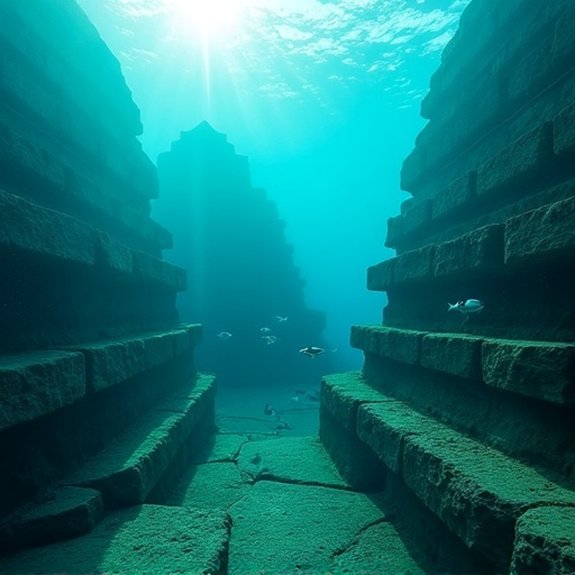
While diving off the coast of Yonaguni Island in 1986, Japanese scuba instructor Kihachiro Aratake stumbled upon what would become one of marine archaeology’s most controversial discoveries. He’d found massive underwater rock formations featuring sharp edges, flat surfaces, and geometric patterns that resembled ancient architecture. Located near Japan’s westernmost point, these structures sit 25 meters below the ocean’s surface and stretch across an area larger than a football field.
Scientists can’t agree on their origin. Some researchers believe they’re remnants of an ancient civilization that sank thousands of years ago. Others insist natural geological processes created these formations through tectonic activity and erosion. The debate’s intensified as divers have documented stepped terraces, right angles, and what appear to be carved pathways throughout the site.
Discovery by Kihachiro Aratake
On a routine dive to observe hammerhead sharks in March 1986, Kihachiro Aratake ventured into unexplored waters south of Yonaguni Island. The local dive shop owner hadn’t expected to find anything unusual at the site locals called Iseki Point. Instead, he encountered massive stone formations resting on the seabed at depths of 5 to 40 meters.
Aratake’s discovery revealed terraced structures with sharp angles, flat surfaces, and what appeared to be carved steps. The main formation stretched approximately 100 meters long and 25 meters tall. He’d stumbled upon geometric patterns that didn’t match typical underwater rock formations in the region. Word of his find spread quickly through Japan’s diving community, attracting marine geologists and archaeologists. The structures’ origin sparked immediate debate—were they man-made monuments or natural geological formations?
Notable Cases or Sightings
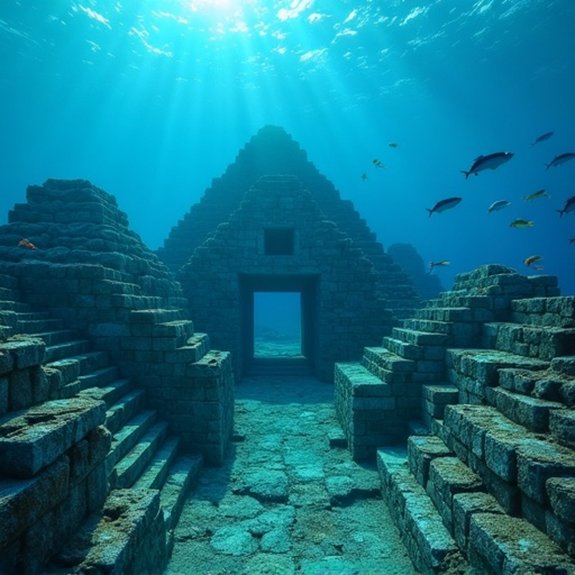
Several prominent researchers have documented distinct features within the Yonaguni monument since Aratake’s initial discovery. Marine geologist Masaaki Kimura‘s spent decades mapping the site’s terraces, steps, and triangular pools. He’s identified what appear to be drainage channels and post holes carved into the rock formations.
In 1997, geologist Robert Schoch examined the structures during multiple dives. While he acknowledged the monument’s unusual characteristics, Schoch attributed most features to natural geological processes. Graham Hancock‘s 2001 expedition brought international attention when he filmed the site’s massive platforms and right-angled corners for television documentaries.
Japanese researchers have cataloged specific formations, including a structure they’ve nicknamed “The Turtle” due to its distinctive shape. Divers regularly report seeing what looks like a carved face and pyramid-shaped sections measuring approximately 25 meters in height.
Common Theories or Explanations
Since the monument’s discovery sparked intense debate, two primary explanations have emerged for the Yonaguni structures. Geologists supporting natural formation point to the region’s sandstone and mudstone composition, which fractures along predictable planes. They’ve identified similar terraced formations throughout the Ryukyu Islands created by tectonic activity and erosion. The area’s frequent earthquakes could’ve carved the angular features over millennia.
Conversely, archaeologists favoring human construction highlight the structure’s precise right angles, symmetrical terraces, and apparent stairways. They’ve noted tool marks on some surfaces and discovered nearby stone artifacts. Proponents suggest it’s a remnant of an advanced civilization from the last ice age, when sea levels were 100 meters lower. Some researchers propose a hybrid theory: natural formations modified by ancient inhabitants for ceremonial or practical purposes.
Frequently Asked Questions
Can Tourists Dive to Explore the Yonaguni Structures?
Yes, tourists can dive to explore the Yonaguni structures. They’ll need advanced open water certification due to strong currents. Local dive operators offer guided tours year-round, though conditions are best from May to October.
What Is the Exact Depth of the Monument Site?
The Yonaguni Monument’s main terraces sit at depths ranging from 5 to 40 meters below sea level. The shallowest formations start around 5 meters, while the deepest sections extend to approximately 25-40 meters underwater.
How Much Does a Guided Diving Expedition Typically Cost?
Guided diving expeditions to the Yonaguni Monument typically cost between $300-500 per person for a two-tank dive. Local operators charge varying rates depending on the season, with prices including equipment rental and boat transportation fees.
What Marine Life Inhabits the Area Around the Structures?
Hammerhead sharks frequently patrol these waters, while sea turtles, barracuda, and manta rays also visit the area. Divers’ll encounter colorful reef fish, moray eels, and during winter months, they might spot migrating humpback whales nearby.
Are There Similar Underwater Formations Found Elsewhere in Japan?
Yes, Japan’s coastal waters contain several similar formations. Divers’ve discovered comparable stone terraces near Chatan and Kerama in Okinawa. Taiwan’s waters also feature analogous structures, suggesting these formations aren’t unique to Yonaguni’s famous underwater monument site.
Civilizations Erased by Natural Disasters

The Lost Villages Under the Caspian

Did Ancient Cultures Communicate Through Pyramids?
About The Author
