The Myth of the Phoenix and Rebirth
The phoenix doesn’t just die—it chooses its own destruction. This legendary bird’s calculated self-immolation has captivated civilizations for millennia, yet its origins trace back to something far more ancient than most realize. Egypt’s Bennu bird, rising from the Nile’s primordial waters, established a blueprint for immortality that’d reshape mythology across continents. What drove ancient peoples to document supposed sightings of this creature, and why do their accounts share such striking similarities?
Introduction
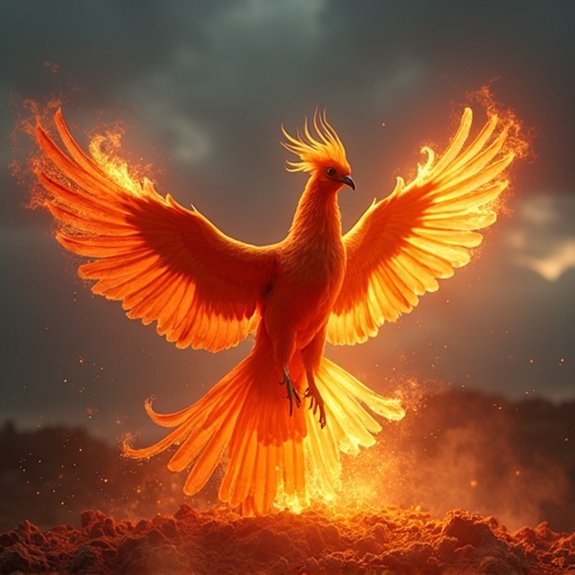
When ancient civilizations gazed at the sky and witnessed the sun’s daily death and rebirth, they couldn’t help but imagine a creature that embodied this eternal cycle. The phoenix emerged from this collective imagination as a magnificent bird that’s consumed by flames only to rise from its own ashes. This mythical creature has captivated humanity for millennia, appearing in Egyptian, Greek, Chinese, and Arabian folklore with distinct variations.
The phoenix represents humanity’s deepest yearning for renewal and second chances. It’s become a universal symbol of resilience, transformation, and hope. From ancient religious texts to modern literature and pop culture, the phoenix continues to inspire those who face adversity. Its story transcends cultural boundaries, offering a powerful metaphor for personal growth and the cyclical nature of existence itself.
Ancient Egyptian Bennu Bird
The earliest known incarnation of the phoenix myth emerged in ancient Egypt as the Bennu bird, a sacred heron-like creature associated with the sun god Ra. This divine bird symbolized renewal and resurrection in Egyptian mythology. Ancient texts describe the Bennu as self-creating, rising from primordial waters at the dawn of creation. It’s believed to have inspired the Greek phoenix legend through cultural exchange.
The Bennu connected closely with Heliopolis, where it’d perch atop the benben stone in Ra’s temple. Egyptians associated the creature with the flooding of the Nile, which brought agricultural rebirth. In funeral texts, deceased pharaohs identified with the Bennu to guarantee their resurrection in the afterlife. This powerful symbol appeared frequently in tomb paintings and religious manuscripts throughout Egypt’s dynasties.
Notable Cases or Sightings
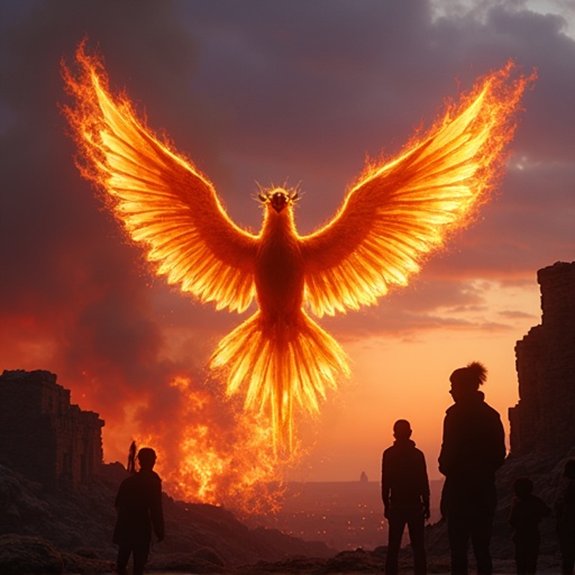
Throughout history, numerous accounts of phoenix sightings have captured people’s imagination, though most scholars attribute these to misidentified birds or deliberate fabrications. Medieval chroniclers recorded several alleged encounters, including a 1540 Swiss account describing a crimson bird emerging from flames near Basel. Chinese texts from the Tang Dynasty mention villagers witnessing a “fire bird” rising from Mount Hua’s ashes after a forest fire.
Modern reports haven’t ceased. In 1978, Arizona residents claimed they’d seen a massive bird with glowing feathers near the Superstition Mountains. Similar accounts emerged from Greece’s Mount Olympus region in 2003. While ornithologists explain these sightings as large raptors backlit by sunlight or rare bird species, believers maintain that phoenixes exist beyond scientific understanding, appearing only during moments of profound transformation.
Common Theories or Explanations
How did ancient cultures explain the phoenix phenomenon without modern scientific knowledge? They’ve interpreted the myth through various lenses throughout history. Some scholars believe the phoenix represents solar worship, with its death and rebirth mirroring the sun’s daily cycle. The bird’s connection to fire suggests ancient observations of flamingos or herons standing in shallow waters that reflected sunset colors.
Modern theorists propose the myth originated from rare bird sightings or misidentified species. Others argue it’s purely symbolic, representing humanity’s desire for renewal and immortality. Psychological interpretations view the phoenix as an archetype of transformation in the collective unconscious. Some historians link the legend to ancient Egyptian benu birds or Chinese fenghuang, suggesting cultural exchange shaped the myth’s evolution across civilizations.
Frequently Asked Questions
How Has the Phoenix Myth Influenced Modern Literature and Popular Culture?
The phoenix myth’s influenced countless modern works through rebirth themes. It’s shaped Harry Potter’s Fawkes, X-Men’s Jean Grey, and numerous fantasy novels. Authors’ve used phoenix symbolism to represent transformation, hope, and triumph over adversity. The cultural significance of the phoenix extends beyond literature; it also permeates art and music, inspiring visual representations that capture its fiery essence. This mythological creature has become a symbol of resilience in various cultural contexts, reminding individuals of their ability to rise from the ashes of their struggles. As societies evolve, the phoenix continues to be a potent emblem of renewal and the relentless pursuit of hope.
What Are the Symbolic Meanings of Phoenix Colors in Different Traditions?
Phoenix colors carry distinct meanings across traditions. Chinese culture’s red phoenix represents virtue and grace, while golden phoenixes symbolize imperial power. Persian traditions favor purple for royalty, and Egyptian bennu birds display blue-grey hues representing renewal.
How Do Various Religions Interpret the Phoenix Rebirth Cycle Differently?
Christianity sees the phoenix as Christ’s resurrection, Buddhism interprets it as cyclical reincarnation, while ancient Egyptians linked it to solar renewal. Hinduism connects it to cosmic cycles, and Zoroastrianism emphasizes purification through fire.
What Psychological Significance Does the Phoenix Archetype Hold in Human Consciousness?
The phoenix archetype represents humanity’s deep psychological need for renewal and transformation. It embodies hope during crisis, validates suffering as temporary, and reassures people they’ll overcome adversity. This symbol activates resilience mechanisms within human consciousness.
How Can Individuals Apply Phoenix Symbolism to Personal Transformation and Growth?
Individuals can apply phoenix symbolism by viewing failures as opportunities for renewal. They’ll embrace endings as beginnings, release outdated patterns, and trust that destruction precedes growth. This mindset transforms setbacks into catalysts for personal evolution.

The Wind God Across Cultures

The Legend of the Grail: Spiritual or Real?

The Sun & Moon Lovers Myths
About The Author
