Mythical Bridges Between Worlds
Throughout history, civilizations’ve crafted tales of mystical bridges spanning the gap between mortal and divine domains. These legendary structures don’t just connect physical spaces—they’re gateways to transformation itself. From rainbow paths to ethereal crossings, each culture’s version reveals deep truths about humanity’s relationship with the unknown. But what makes the Norse Bifrost stand apart from other mythical bridges? The answer lies in its unique role as both protector and destroyer.
Introduction
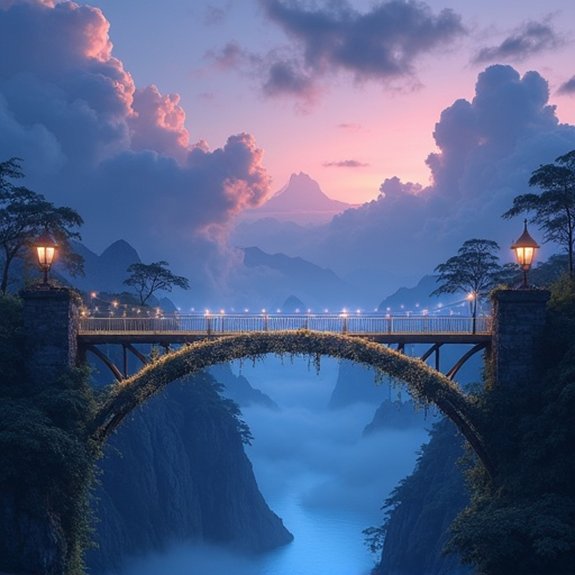
Although bridges typically serve as practical structures connecting two points across physical obstacles, mythical bridges transcend mere functionality to embody profound spiritual and cultural meanings across world mythology. These legendary passages don’t just span rivers or chasms—they’re cosmic highways linking mortal domains to divine territories, the living to the dead, and present existence to eternal afterlife.
From Norse mythology’s rainbow Bifrost to Islam’s hair-thin Sirat, these bridges appear in diverse cultures worldwide. They’re often depicted as treacherous crossings that test souls’ worthiness, determine eternal fates, or mark critical shifts in heroes’ journeys. Unlike their earthly counterparts, mythical bridges frequently possess consciousness, change form, or exist only when specific conditions align. They represent humanity’s universal desire to understand what lies beyond death and connect with forces greater than themselves.
Ancient Norse Bifrost Legends
When ancient Norse peoples gazed at the aurora borealis dancing across northern skies, they saw Bifrost—the burning rainbow bridge connecting Midgard, humanity’s domain, to Asgard, home of the gods. This celestial pathway wasn’t merely decorative; it served as the gods’ primary route for traveling between territories. Heimdall, the ever-vigilant guardian, stood watch at Bifrost’s edge, his keen eyes detecting threats from giants and other enemies who’d exploit this divine passage.
The bridge’s description varies across sources. The Prose Edda depicts it as having three colors, while poetic traditions emphasize its fiery nature. Norse mythology warns that during Ragnarök, the apocalyptic final battle, fire giants will storm across Bifrost, causing its collapse. This destruction symbolizes the severing of divine connection, marking the old world’s end.
Notable Cases or Sightings
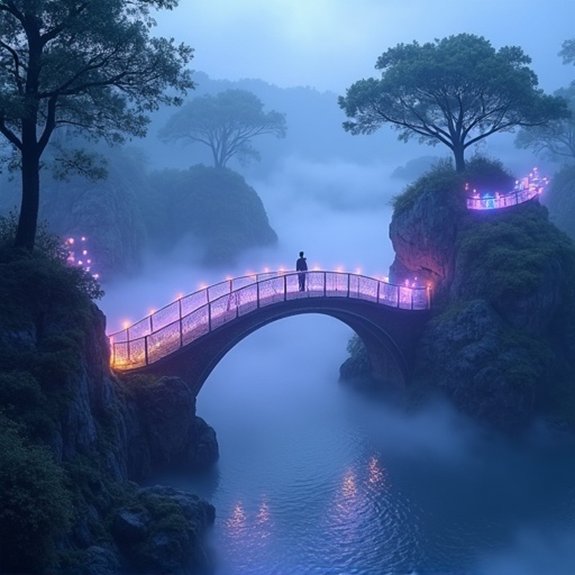
Three documented encounters with mystical bridges have captivated researchers and witnesses throughout history. In 1934, British explorer Theodore Whitmore reported seeing a shimmering golden pathway spanning the Himalayan peaks during a blizzard. He’d attempted to cross but couldn’t reach its surface before it vanished.
Iceland’s 1967 Aurora Bridge incident involved twelve fishermen who witnessed a translucent arch connecting their vessel to an unknown landmass. The structure lasted forty minutes while emitting harmonious tones.
Most recently, Peru’s 2018 Machu Picchu sighting drew international attention. Tourist Maria Santos captured footage of a rainbow-like bridge materializing above the ruins. Analysis revealed the structure’s geometric patterns matched ancient Incan descriptions of spirit pathways. These cases share common elements: temporary manifestation, inaccessibility, and correlation with local bridge mythology.
Common Theories or Explanations
Scientists and folklore experts have proposed several explanations for these mysterious bridge phenomena. Many researchers attribute sightings to optical illusions created by atmospheric conditions like temperature inversions and light refraction. These natural effects can distort distant landscapes, making ordinary structures appear otherworldly or creating mirages where none exist.
Psychological factors also play a significant role. Pattern recognition tendencies cause humans to perceive familiar shapes in random formations, while cultural conditioning influences what people expect to see. Sleep deprivation, stress, and altered states of consciousness can trigger vivid hallucinations of bridges that aren’t there.
Some theorists suggest electromagnetic anomalies at specific locations might affect brain chemistry, producing shared visions. Others point to geological features that naturally resemble bridges, which become mythologized through generations of storytelling.
Frequently Asked Questions
Can Ordinary People Cross Mythical Bridges or Only Gods and Heroes?
Most mythical bridges aren’t exclusive to gods and heroes. Ordinary people can cross many legendary spans like China’s Bridge of Magpies or Norse mythology’s Gjallarbrú, though they’ll often face trials or need special circumstances.
What Happens if Someone Falls off a Mythical Bridge?
When someone falls off a mythical bridge, they’re typically lost forever in the cosmic void between domains. Some myths describe eternal falling through nothingness, while others suggest the person’s soul dissolves into primordial chaos.
Are There Any Rituals Required Before Crossing These Bridges?
Yes, travelers often perform purification rites, leave offerings, or speak passwords before crossing. They’ll sometimes need a guide’s blessing, wear protective talismans, or wait for specific celestial alignments when the bridge becomes visible.
Do Mythical Bridges Appear at Specific Times or Celestial Events?
Yes, they’ll manifest during full moons, solstices, eclipses, and planetary alignments. Norse mythology’s Bifrost appears when gods summon it, while Celtic fairy bridges emerge at dawn, dusk, and Samhain when veils between worlds thin.
Can Mythical Bridges Be Destroyed or Are They Eternal?
Mythical bridges aren’t indestructible. Norse mythology’s Bifrost breaks during Ragnarok when Surtr’s forces cross it. Some bridges vanish at dawn, others crumble when mortals misuse them. Yet many regenerate, suggesting they’re resilient rather than eternal.



About The Author
