The Cailleach and Seasonal Myths
The Cailleach’s icy grip transforms landscapes across Celtic lands each winter, yet scholars can’t agree on her true nature. She’s appeared in countless forms throughout history—sometimes as a hag with one eye, other times as a mountain-shaping giantess. While some dismiss her as mere folklore, others point to unexplained phenomena that coincide with her legendary awakening. The evidence they’ve uncovered challenges everything modern society thinks it knows about seasonal change.
Introduction
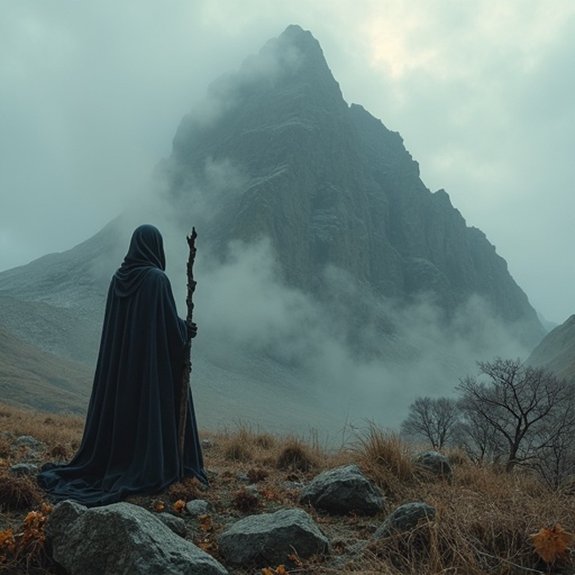
When winter’s harsh winds sweep across the Scottish Highlands and Ireland’s rugged coasts, ancient stories tell of the Cailleach—a powerful divine hag who shapes the land with her supernatural hammer and staff. She’s the embodiment of winter itself, controlling storms and determining the season’s length through her actions. Celtic mythology portrays her as both creator and destroyer, carving valleys, building mountains, and releasing wild animals across the countryside.
The Cailleach appears in countless regional variations throughout Scotland, Ireland, and the Isle of Man. She’s known by many names—Beira in Scotland, Caillí Bhearra in Ireland—yet her core identity remains consistent. As winter’s sovereign, she battles spring deities for seasonal control, making her central to understanding how ancient Celtic peoples explained nature’s cycles and the turning of the year.
Celtic Goddess of Winter
As darkness extends its reach across Celtic lands each autumn, the Cailleach awakens from her summer slumber to reclaim her throne as winter’s supreme deity. She’s known by many names—the Veiled One, the Hag of Beara, and Scotland’s Beira—each reflecting her ancient power over frost, storms, and death.
The Cailleach shapes mountains with her hammer, creates lochs from her footsteps, and carries stones in her apron to build the landscape. Her staff freezes the ground solid, while her washing creates blizzards that blanket the earth. She herds deer, protects wolves, and guards the boundary between life and death.
From Samhain to Beltane, she reigns unchallenged, determining winter’s severity through her moods. When spring approaches, she’ll either surrender gracefully or rage against the coming warmth, releasing final storms before retreating.
Notable Cases or Sightings
Three documented encounters with the Cailleach have shaped Highland folklore for generations. In 1803, shepherds near Ben Vair reported seeing a giant cloaked figure striking the mountainside with her staff, triggering an unseasonable blizzard that lasted three days. They’d fled when she turned toward them, her single eye gleaming like ice.
The second sighting occurred in 1857 when fishermen off Scotland’s west coast witnessed a towering woman walking across the water during a storm. She’d supposedly calmed the seas with a gesture before vanishing into mist.
Most recently, in 1952, climbers on Ben Nevis claimed they’d encountered an ancient woman who warned them of an approaching storm. Minutes after she disappeared, a whiteout engulfed the mountain, forcing their descent.
Common Theories or Explanations
While skeptics dismiss the Cailleach sightings as misidentified natural phenomena, folklorists propose several theories to explain these persistent accounts. Some scholars suggest she’s a cultural memory of ancient goddess worship, preserved through oral tradition when Christianity couldn’t fully erase pagan beliefs. Others view her as a personification of winter’s harsh realities, helping communities psychologically process seasonal hardships.
Carl Jung’s followers interpret the Cailleach as an archetypal crone figure representing change and death-rebirth cycles. Environmental historians argue she embodies ancestral knowledge about weather patterns and survival strategies. Modern pagans claim she’s an actual deity whose energy manifests during seasonal shifts. Anthropologists note similar winter hag figures across Celtic regions, suggesting shared Indo-European mythological roots that’ve adapted to local landscapes and climates.
Frequently Asked Questions
How Do Modern Pagans Honor the Cailleach in Their Seasonal Rituals?
Modern pagans honor the Cailleach through winter solstice ceremonies, leaving offerings of stones or grain at sacred sites, performing weather divination, and conducting rituals that acknowledge her role as winter’s guardian and the land’s ancient keeper.
What Offerings Were Traditionally Left for the Cailleach at Sacred Sites?
People traditionally left stones at her sacred sites, particularly at cairns and mountain shrines. They’d also offer water from sacred wells, barley, milk, and wool. Travelers sometimes left food offerings when crossing her mountain passes.
Are There Specific Festivals or Holy Days Dedicated to the Cailleach?
The Cailleach doesn’t have widely recognized festivals, but she’s honored at Samhain when winter begins. In Scotland, locals celebrate her arrival on November 1st, while some regions mark Beltane as when she retreats from power.
How Does the Cailleach Compare to Winter Deities in Other Cultures?
The Cailleach shares traits with Norse Skadi, Slavic Morana, and Greek Boreas as winter personifications. She’s unique in controlling seasonal shifts through battles with spring deities, while others typically embody winter’s harsh aspects without transformation narratives.
What Symbols or Animals Are Associated With the Cailleach in Folklore?
The Cailleach’s associated with deer, wolves, and wild boars in folklore. She carries a hammer or staff that creates frost, wields stones that form mountains, and she’s linked to holly trees, winter storms, and ancient megaliths.

The Forest Spirits: Kodama, Dryads

The Eternal Tree & Axis Myths

The Horned God: Pan Across Cultures
About The Author
