The Eternal Tree & Axis Myths
Throughout history, cultures’ve recognized sacred trees as cosmic bridges linking earth to divine domains. These axis mundi myths reveal humanity’s universal need to map spiritual geography through natural symbols. From Yggdrasil’s sprawling roots to Maya’s towering ceiba, these eternal trees anchor creation stories and shape ritual practices. But ancient Mesopotamia’s cosmic pillar predates them all, holding secrets that challenge modern understanding of how these myths spread across continents.
Introduction
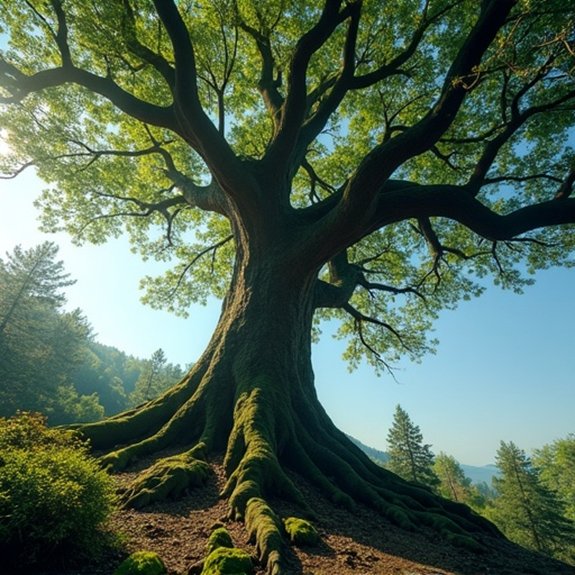
When ancient civilizations gazed at towering trees or mountain peaks stretching toward the heavens, they didn’t just see natural features—they saw cosmic bridges connecting Earth to divine domains. These axis mundi, or world axes, became central to mythologies across cultures. Norse peoples envisioned Yggdrasil, the mighty ash tree supporting nine spheres. Hindu and Buddhist traditions described Mount Meru as the universe’s spiritual center. The Maya believed in a cosmic ceiba tree linking underworld, earth, and sky.
These myths weren’t mere stories. They’ve shaped how societies understood their place in existence, establishing sacred geography and ritual practices. From Siberian shamans climbing world trees in visions to medieval Christians depicting paradise with the Tree of Life, axis myths have provided humanity with powerful symbols of connection between mortal and eternal spheres.
Ancient Mesopotamian Cosmic Pillar
Long before other civilizations developed their axis mundi myths, the ancient Mesopotamians carved images of cosmic pillars and sacred trees into their cylinder seals and temple walls. They believed a cosmic pillar connected the heavens, earth, and underworld, maintaining universal order. This pillar often appeared as the sacred kiskanu tree in Sumerian texts, growing in Eridu’s temple courtyard.
The Babylonians later adapted this concept, depicting it as a date palm with seven branches representing celestial spheres. Kings performed rituals near replica pillars to renew their divine mandate. The myth influenced their ziggurat architecture—these stepped pyramids weren’t just temples but physical manifestations of the cosmic axis. Through trade and conquest, Mesopotamia’s cosmic pillar concept spread throughout the ancient Near East, shaping religious thought for millennia.
Notable Cases or Sightings
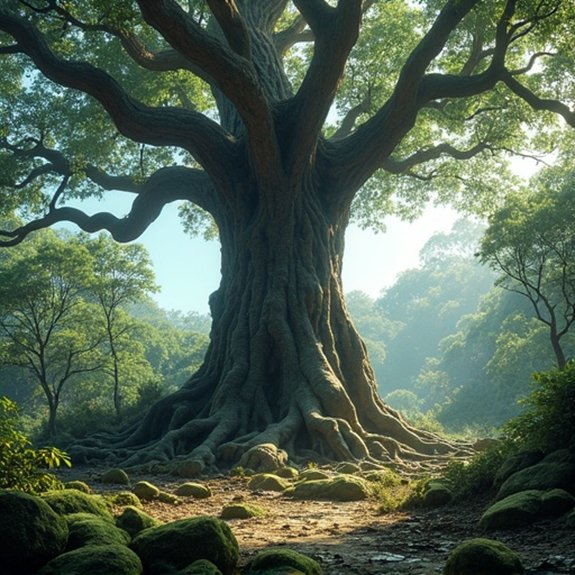
The cosmic pillar concept didn’t remain confined to ancient mythology—throughout history, explorers and mystics have claimed to discover physical manifestations of the world tree. Medieval texts describe monks encountering enormous trees that seemed to pierce heaven itself in remote forests. The 16th-century conquistador Francisco Orellana reported finding a colossal ceiba tree in the Amazon that local tribes worshipped as the universe’s center.
Modern accounts persist. In 1922, Russian explorer Nicholas Roerich documented Siberian shamans who’d allegedly located the actual world tree’s roots beneath frozen tundra. Tibet’s forbidden valleys supposedly hide ancient trees matching axis mundi descriptions. Even NASA’s deep space imagery has sparked theories about cosmic structures resembling mythological world trees, though scientists dismiss these interpretations as pareidolia.
Common Theories or Explanations
Several competing theories attempt to explain humanity’s universal fascination with axis mundi mythology. Psychologist Carl Jung proposed these symbols emerge from the collective unconscious, representing humanity’s innate need to connect earthly and divine domains. He argued the tree’s vertical structure naturally mirrors human aspirations toward transcendence.
Anthropologists suggest practical origins—ancient peoples observed how trees linked soil, surface, and sky, making them logical cosmic metaphors. Mircea Eliade’s religious studies framework interprets these myths as attempts to establish sacred centers that organize chaotic space into meaningful order.
Cognitive scientists now propose the human brain’s inherently hierarchical processing creates these vertical cosmologies. They’ve found cultures naturally conceptualize abstract concepts like morality and divinity as “above” while placing negative qualities “below,” explaining why axis symbols appear worldwide.
Frequently Asked Questions
How Do Modern Indigenous Communities Continue to Practice Axis Mundi Rituals Today?
Modern indigenous communities maintain axis mundi rituals through ceremonial gatherings at sacred sites, erecting ritual poles during festivals, conducting prayers around central trees, and preserving traditional dances that honor the connection between earth and sky domains.
What Psychological Effects Does Belief in Cosmic Trees Have on Individuals?
Belief in cosmic trees provides individuals with psychological anchoring, reducing existential anxiety while enhancing their sense of connectedness. It creates cognitive frameworks that organize reality, offering comfort through perceived cosmic order and one’s meaningful place within universal structures.
Are There Any Scientific Parallels to the Axis Mundi Concept?
Scientists find parallels in Earth’s magnetic axis, the solar system’s orbital plane, and galaxy rotation axes. Physics recognizes fundamental symmetry axes in crystals and molecules. DNA’s helical axis even mirrors the connecting principle of axis mundi.
How Do Artists and Writers Incorporate World Tree Symbolism in Contemporary Works?
Contemporary artists and writers weave world tree symbolism through fantasy literature’s magical forests, video games’ interconnected domains, environmental art installations, and graphic novels where trees serve as portals between dimensions, representing connection, growth, and cosmic unity.
What Role Did Axis Myths Play in Ancient Navigation and Cartography?
Ancient navigators used axis myths as celestial reference points, believing sacred mountains or trees connected earth to heaven. They’d orient maps around these cosmic centers, establishing directional systems that guided both physical journeys and spiritual cosmologies.
The Horned God: Pan Across Cultures

The Black Woman Myth Archetype

The Grootslang: Mixed Beasts in Myth
About The Author
