The Fisher King Legend in Different Cultures
The Fisher King legend isn’t confined to medieval romance—it’s emerged across cultures for millennia. Ancient rulers who’ve suffered mysterious wounds that mirror their kingdom’s decline appear in Celtic, Greek, and Eastern mythologies. These wounded sovereigns can’t heal until a chosen hero completes an impossible quest. But what drives this recurring pattern? The answer reveals something profound about humanity’s relationship with power, nature, and the price of redemption.
Introduction
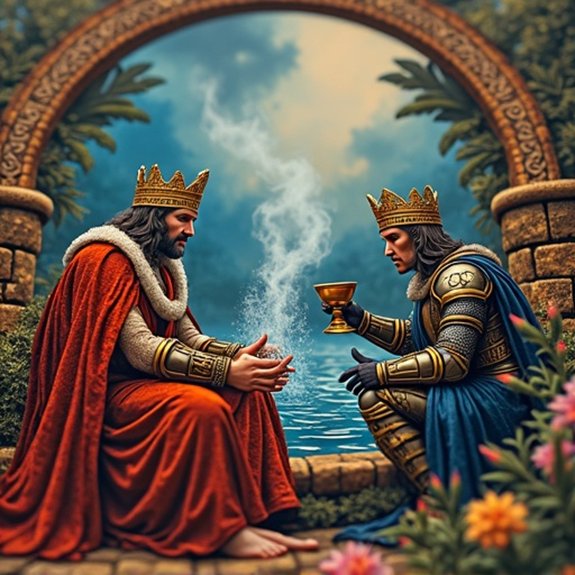
When medieval poets first chronicled the Fisher King’s tale, they couldn’t have predicted how this wounded monarch would captivate imaginations across centuries and continents. The legend depicts a king suffering from an unhealable wound that renders him impotent and his kingdom barren. Only a chosen knight’s correct question can restore both ruler and territory.
This archetype transcends its Arthurian origins. Celtic mythology’s Bran the Blessed shares the Fisher King’s wounded sovereignty. Hindu texts describe similar divine rulers whose physical afflictions mirror their lands’ fertility. Japanese folklore presents emperors whose spiritual health determines agricultural abundance.
The Fisher King represents humanity’s ancient belief that leaders embody their domains’ energy. His story explores themes of spiritual crisis, environmental decay, and redemption through compassion and wisdom.
Celtic Mythological Roots
The Fisher King‘s deepest roots stretch into Celtic mythology, where wounded sovereignty and mystical kingship shaped the spiritual landscape of pre-Christian Britain and Ireland. The Celtic tradition linked a king’s physical health directly to his land’s fertility. When rulers suffered injury or illness, crops failed and waters ran dry.
The Welsh Bran the Blessed exemplifies this archetype. After he’s wounded by a poisoned spear, his kingdom falls into chaos. Similar tales appear in Irish mythology with Nuada, who loses his kingship after losing his arm in battle. He can’t rule until he receives a silver replacement, restoring his wholeness.
These stories established the sacred bond between ruler and domain that’d later define the Fisher King. The Celts believed kings served as conduits between divine forces and earthly prosperity.
Notable Cases or Sightings

Medieval chroniclers and storytellers documented numerous encounters with Fisher King figures across Europe, transforming Celtic myths into witnessed phenomena. Geoffrey of Monmouth‘s 12th-century accounts describe a wounded king near Corbenic Castle who couldn’t stand but possessed supernatural fishing abilities. French troubadours reported sightings of a mysterious lord at Montségur, bearing an unhealable thigh wound and guarding sacred treasures.
Welsh manuscripts detail encounters with Bran the Blessed’s severed head, which spoke prophecies and protected Britain for eighty-seven years. German minnesingers claimed they’d met Anfortas, a king whose wound reopened during winter solstices. Pilgrims visiting Glastonbury Abbey between 1191 and 1278 swore they’d seen a limping figure fishing in the marshes at dawn, vanishing when approached.
Common Theories or Explanations
While scholars can’t agree on a single origin for the Fisher King legend, they’ve proposed several compelling theories that explain its widespread appeal and persistence. The psychological interpretation suggests the wounded king represents humanity’s disconnection from nature and spiritual wholeness. Carl Jung viewed the Fisher King as an archetype of the Self requiring integration and healing.
Historical theorists link the legend to ancient fertility rituals where kings embodied the land’s essential force. Some trace connections to Celtic mythology, particularly the god Bran, whose magical cauldron restored life. Christian scholars emphasize parallels with Christ’s suffering and the Eucharist symbolism.
Anthropologists note the legend’s function as a cautionary tale about leadership’s sacred responsibilities. The king’s wound reflects societal trauma, while his healing represents collective redemption and renewal.
Frequently Asked Questions
How Has the Fisher King Legend Influenced Modern Fantasy Literature and Films?
The Fisher King legend’s influenced modern fantasy through wounded ruler archetypes, quest narratives, and wasteland imagery. It’s shaped works like T.S. Eliot’s “The Waste Land,” Tolkien’s Middle-earth, and films including “Excalibur” and Terry Gilliam’s productions.
What Healing Rituals or Ceremonies Are Associated With the Fisher King Tradition?
The Fisher King’s healing traditionally requires a knight asking the right question about the Grail or the king’s wound. Medieval texts describe rituals involving sacred vessels, blessed water, and sometimes the Grail’s miraculous touch.
Are There Any Archaeological Sites Linked to Fisher King Mythology?
Several sites claim Fisher King connections, including Glastonbury Abbey in England, where monks linked Arthur’s grave to Grail legends. Corbenic Castle’s suggested locations include France’s Montségur and Spain’s Montserrat, though archaeologists haven’t confirmed these associations.
How Do Different Religions Interpret the Fisher King’s Spiritual Symbolism?
Christianity views the Fisher King as Christ’s suffering and redemption. Buddhism interprets him as karma’s consequences. Celtic paganism sees nature’s wounded sovereignty. Gnostics recognize divine sparks trapped in matter. Each tradition emphasizes healing through spiritual transformation.
What Role Does the Fisher King Play in Contemporary Neo-Pagan Practices?
Neo-pagans incorporate the Fisher King as a wounded divine masculine archetype representing nature’s cycles. They use his myth in seasonal rituals, particularly during autumn and winter ceremonies that focus on healing the land and restoring spiritual balance.

The Furies / Erinyes: Ancient Wrath Spirits

The Sun & Moon Lovers Myths

The Forest Spirits: Kodama, Dryads
About The Author
