The Legend of the First Woman
Throughout history, civilizations have crafted origin stories about the first woman, each revealing profound truths about their creators. These ancient narratives don’t just explain humanity’s beginnings—they’ve shaped entire belief systems and social structures for millennia. From sacred texts to oral traditions, the first woman appears as creator, destroyer, and everything between. But there’s something unsettling about how these legends mirror each other across isolated cultures that supposedly never interacted.
Introduction
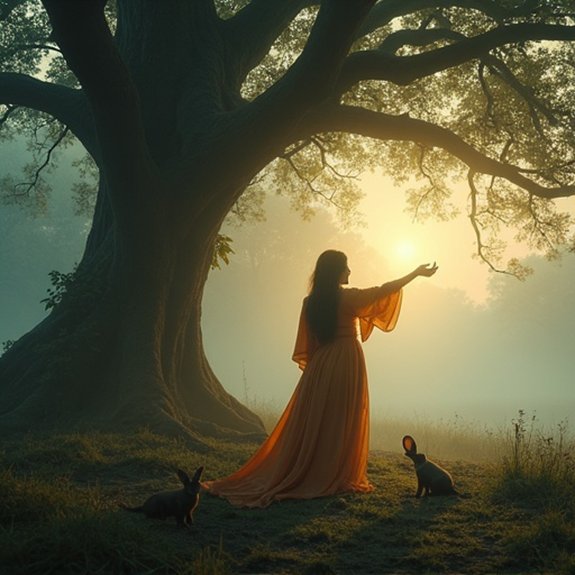
Throughout human history, countless cultures have woven tales about the first woman, each narrative reflecting the values, fears, and aspirations of its people. These origin stories don’t merely explain humanity’s beginnings—they’ve shaped societies’ views on gender, morality, and human nature itself. From Pandora’s infamous box in Greek mythology to Eve’s forbidden fruit in Judeo-Christian tradition, from Lilith’s defiant independence to the Japanese goddess Izanami’s creative powers, each legend carries profound cultural significance.
Scholars recognize these myths aren’t historical accounts but rather symbolic frameworks that ancient peoples used to understand their world. They’ve influenced art, literature, philosophy, and social structures for millennia. Modern anthropologists and mythologists continue studying these narratives, uncovering patterns that reveal humanity’s shared psychological landscape while highlighting each culture’s unique perspective on feminine power and responsibility.
Ancient Creation Myths Worldwide
While creation myths vary dramatically across cultures, they’ve consistently placed women at pivotal moments in humanity’s origin story. Greek mythology presents Pandora, fashioned by gods as the first mortal woman who’d release both suffering and hope upon mankind. The Judeo-Christian tradition tells of Eve, formed from Adam’s rib to become humanity’s mother and catalyst for knowledge. Hindu texts describe Shatarupa, Brahma’s female creation who’d become the progenitor of all humans. In Chinese mythology, Nüwa sculpted people from yellow clay and breathed life into them. Aboriginal Australian dreamtime stories feature ancestral women who shaped landscapes and birthed tribes. These diverse narratives don’t merely chronicle origins—they’ve encoded cultural values about femininity, creation, and humanity’s relationship with the divine across millennia.
Notable Cases or Sightings
Archaeological discoveries have sparked intense debates about humanity’s earliest female ancestors. In 1974, researchers unearthed “Lucy” in Ethiopia’s Afar region, a 3.2-million-year-old Australopithecus afarensis skeleton that revolutionized understanding of human evolution. Her forty percent complete remains revealed she’d walked upright, challenging previous theories about bipedalism’s development.
More recently, scientists’ve identified “Ardi,” a 4.4-million-year-old Ardipithecus ramidus female discovered in 1994. Her skeletal structure suggests an unexpected mix of primitive and advanced features. Meanwhile, genetic studies point to “Mitochondrial Eve,” a theoretical African woman who lived roughly 150,000 years ago. She’s considered the matrilineal ancestor of all living humans today. These findings don’t represent literal “first women” but rather significant evolutionary milestones that’ve shaped scientific comprehension of female ancestry and human origins.
Common Theories or Explanations
Since ancient civilizations first pondered human origins, competing theories’ve emerged to explain the appearance of the first woman. Religious scholars cite divine creation stories from various faiths—Eve from Adam’s rib, Pandora molded from clay, or Selu rising from corn. Anthropologists propose evolutionary models where early hominid females developed alongside males through natural selection over millions of years.
Some researchers’ve suggested the “mitochondrial Eve” hypothesis, tracing all humans to a single African woman who lived roughly 150,000 years ago. Others explore parallel evolution theories where multiple human populations developed independently. Mythologists interpret first woman legends as metaphors for humanity’s shift from hunter-gatherer societies to agricultural communities. These explanations aren’t mutually exclusive; many cultures blend scientific understanding with spiritual beliefs to comprehend this fundamental mystery.
Frequently Asked Questions
How Do Modern Feminist Movements Interpret First Woman Legends?
Modern feminist movements interpret first woman legends as patriarchal narratives that’ve historically justified women’s subordination. They reclaim these stories, highlighting female agency and power while critiquing misogynistic elements that blame women for humanity’s suffering.
What Archaeological Evidence Exists Supporting First Woman Narratives?
Archaeological evidence doesn’t directly support first woman narratives since they’re mythological. However, geneticists trace mitochondrial DNA to “Mitochondrial Eve,” a common female ancestor who lived in Africa roughly 150,000 years ago, though she wasn’t literally first.
How Are First Woman Stories Taught in Different Educational Systems?
Educational systems teach first woman stories differently across cultures. Indigenous schools incorporate oral traditions directly, Western curricula often present them as mythology, while religious institutions teach creation narratives as faith-based truth. Approaches vary greatly worldwide.
What Role Do First Woman Myths Play in Contemporary Religious Practices?
First woman myths shape contemporary worship through ritual reenactments, goddess veneration, and creation ceremonies. They’re invoked in women’s spiritual circles, fertility rites, and seasonal celebrations. Many practitioners blend ancient narratives with modern feminist theology.
How Have First Woman Legends Influenced Modern Literature and Media?
First woman legends’ve shaped countless modern narratives, from Margaret Atwood’s retellings to superhero origin stories. They’ve inspired feminist literature that reclaims Eve, Pandora, and Lilith as complex protagonists rather than cautionary tales about feminine curiosity.

The Role of Totems in Tribal Mythology

The Feminine Divine: Goddesses of Death

The Myth of the Sun Chariot
About The Author
