The Legend of the Red Thread of Fate
An invisible crimson thread connects two people who’re destined to meet, according to ancient Chinese mythology. The thread may stretch or tangle, but it’ll never break. This belief has shaped countless love stories across East Asia for centuries. Yet the legend’s origins remain surprisingly complex, with multiple versions appearing in historical texts. What’s most intriguing isn’t just the romantic promise—it’s how different cultures have interpreted this mystical connection.
Introduction
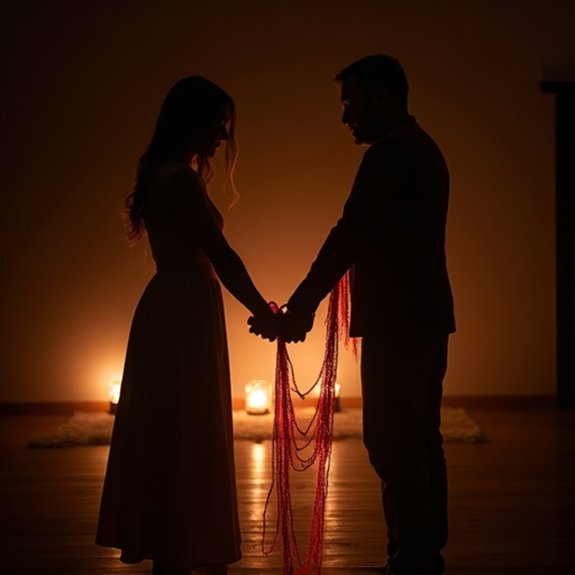
When someone finds their perfect match against all odds, they might unknowingly be experiencing what East Asian cultures have believed for centuries—the pull of the red thread of fate. This ancient legend suggests an invisible crimson thread connects two people who’re destined to meet, regardless of time, place, or circumstances. The thread may stretch or tangle but won’t ever break.
Originating in Chinese mythology, the belief spread throughout Japan, Korea, and other Asian nations, where it’s become deeply embedded in cultural consciousness. The concept appears in literature, art, and modern media, shaping how millions view romantic destiny. Today’s couples often reference the red thread when describing their unlikely meetings or instant connections, bridging ancient wisdom with contemporary love stories.
Ancient Chinese Mythology Texts
Although the red thread legend permeates East Asian culture today, its earliest written records appear in Tang dynasty texts from around 800 CE. The story first emerged in “Xu You Guai Lu” (續幽怪錄), a collection of supernatural tales by Li Fuyan. In this account, a young man named Wei Gu encounters Yue Lao, the matchmaking deity who reveals that an invisible red thread connects him to his future wife—a small child he’d never met.
Later texts expanded the mythology. The “Taiping Guangji” (太平廣記), a Song dynasty anthology, preserved multiple versions that emphasized the thread’s unbreakable nature. These writings established core elements: the thread connects ankles, it’s invisible to mortals, and no force can sever destined connections. Ming and Qing dynasty literature further popularized the concept through romantic novels and plays.
Notable Cases or Sightings

Despite the red thread’s mythical nature, countless individuals throughout history have claimed to witness or experience its power firsthand. In 1920s Shanghai, matchmaker Chen Wei documented over 300 couples who’d described seeing crimson threads during their first meetings. These accounts typically involved fleeting glimpses of red light connecting their hands or hearts to their future spouse’s.
Modern reports persist across Asia. Japanese forums feature thousands of testimonies from people who’ve felt invisible tugs toward strangers who later became their partners. South Korean television programs have investigated cases where childhood friends, separated for decades, reunited through seemingly impossible coincidences. They often describe an unexplainable pull that drew them back together. While skeptics dismiss these as confirmation bias, believers interpret such stories as proof the ancient legend endures.
Common Theories or Explanations
While believers embrace the red thread as supernatural truth, researchers have proposed various psychological and scientific frameworks to explain the phenomenon. Psychologists suggest the legend persists through confirmation bias—people remember coincidences that support the myth while forgetting contradictory experiences. They’ve identified pattern-seeking behavior as humans’ tendency to find meaningful connections in random events.
Sociologists argue the thread represents cultural bonding mechanisms that strengthen community ties across Asian societies. It’s functioned as social glue, encouraging patience in relationships and reducing anxiety about finding partners. Neuroscientists point to mirror neurons and unconscious attraction cues that draw compatible people together, creating seemingly mystical connections. Some anthropologists view the legend as an evolved narrative that promotes pair bonding and social stability, serving practical purposes despite its mythical origins.
Frequently Asked Questions
Can the Red Thread Be Cut or Broken by Human Actions?
According to the legend, the red thread can’t be broken by human actions. It may stretch, tangle, or become knotted through life’s challenges, but it’ll always connect those who’re destined to meet eventually.
How Do You Know if You’ve Met Your Red Thread Connection?
One can’t definitively know they’ve met their red thread connection. People often describe feeling inexplicable familiarity, intense magnetism, or profound recognition. The legend suggests destiny reveals itself through time, not immediate certainty or signs.
Does the Red Thread Connect Romantic Soulmates Only or Other Relationships Too?
The red thread doesn’t connect only romantic soulmates. While it’s primarily about destined lovers in Chinese mythology, some interpretations include profound platonic connections, family bonds, and friendships that transform one’s life path considerably.
Can One Person Have Multiple Red Threads Connecting to Different People?
Traditional interpretations say each person has one red thread connecting them to their destined romantic partner. However, modern versions sometimes imagine multiple threads linking someone to various soulmates they’ll encounter throughout life’s journey.
What Happens to the Red Thread After One Connected Person Dies?
When someone dies, their red thread doesn’t break or disappear. It transforms into a spiritual connection that transcends death, continuing to bind the souls together. The thread remains intact, waiting for their reunion in another lifetime.



About The Author
