The Legend of the Thunderbird & Whale
The eternal battle between sky and sea has shaped Pacific Northwest tribal consciousness for millennia. They’ve passed down accounts of the Thunderbird’s fierce clashes with the great Whale through generations of storytellers. These aren’t merely cautionary tales about nature’s power. Modern sightings and unexplained phenomena along the coast have reignited debates about what these ancient narratives might’ve actually documented. The truth behind these legends proves more complex than anyone expected.
Introduction
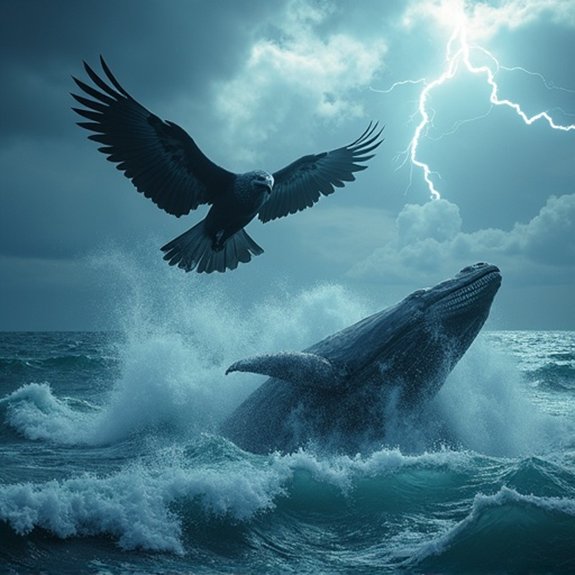
The ancient Pacific Northwest coastline echoes with stories of two mighty beings locked in eternal combat—the Thunderbird soaring through storm-darkened skies and the Whale ruling the depths below. Native American tribes from Alaska to Northern California have passed down this legend for countless generations, each adding their own cultural interpretations to the tale.
The Thunderbird represents the sky’s power, creating thunder with its wingbeats and lightning with its blinking eyes. It’s depicted as an enormous raptor capable of carrying whales in its talons. The Whale embodies the ocean’s strength, commanding the tides and depths with unmatched authority.
Their battle symbolizes the perpetual struggle between opposing forces—sky and sea, air and water, heights and depths. This myth explains natural phenomena while teaching profound lessons about balance, respect, and nature’s duality.
Pacific Northwest Tribal Oral Traditions
Among the Quileute, Makah, and Haida peoples, storytellers have preserved the Thunderbird and Whale legend through elaborate oral performances that blend spoken word with ceremonial dance and song. These tribes view the tale as both historical record and spiritual teaching, passing it from elders to children during winter gatherings.
Each tribe’s version reflects distinct cultural values. The Quileute emphasize the Thunderbird’s role as protector, while the Makah focus on the Whale’s connection to ocean hunting traditions. Haida renditions incorporate intricate carved masks and rattles during performances.
Storytellers don’t simply recite words—they embody the characters through dramatic gestures and voice modulation. This performative tradition guarantees the legend remains dynamic, allowing each generation to connect with ancestral wisdom while maintaining narrative authenticity.
Notable Cases or Sightings

Beyond ceremonial retellings, numerous eyewitness accounts have emerged from Pacific Northwest communities over the past two centuries. In 1925, fishermen near Neah Bay reported seeing an enormous bird-like creature diving into the ocean during a storm. The creature’s wingspan allegedly exceeded thirty feet, and witnesses claimed it lifted what appeared to be a whale calf from the water.
Similar sightings occurred throughout the 1960s along Vancouver Island‘s western shores. Local newspapers documented at least twelve separate incidents where observers described massive aerial shadows accompanied by thunderous sounds during calm weather. Most significantly, a 1967 photograph taken by forestry worker James McKenna allegedly captured a dark, winged silhouette above the treeline, though experts haven’t authenticated the image. These modern accounts consistently mirror traditional indigenous descriptions of the Thunderbird’s physical characteristics.
Common Theories or Explanations
While indigenous communities maintain the spiritual authenticity of the Thunderbird-Whale legend, researchers have proposed several scientific explanations for the phenomenon. Seismologists suggest the stories preserve cultural memories of massive earthquakes and tsunamis along the Pacific Northwest coast. The “battle” between sky and sea creatures could represent tectonic plate collisions that trigger these disasters.
Paleontologists point to prehistoric megafauna discoveries. Giant bird fossils like Teratornis and whale bones found inland might’ve inspired the legends when ancient peoples couldn’t explain their presence. Some anthropologists argue the tales served practical purposes—teaching coastal survival skills and encoding warnings about dangerous weather patterns. Meteorologists note that severe storms with thunder and lightning occurring during whale migrations could’ve created the perceived connection. These theories don’t diminish the legend’s cultural significance but offer parallel frameworks for understanding its origins.
Frequently Asked Questions
How Do Modern Indigenous Communities Use the Thunderbird and Whale Legend in Education Today?
Modern Indigenous communities incorporate the Thunderbird and Whale legend into cultural education programs, teaching children traditional values, environmental stewardship, and ancestral knowledge. They’re using storytelling sessions, art projects, and ceremonies to preserve this oral tradition.
Are There Similar Mythological Battles Between Sky and Sea Creatures in Other Cultures?
Yes, many cultures share similar myths. Japan’s thunder god Raijin battles sea dragons, Norse mythology features Thor fighting the Midgard Serpent, and Hindu texts describe Garuda’s conflicts with nagas. These stories often represent nature’s opposing forces.
What Specific Rituals or Ceremonies Honor the Thunderbird and Whale Spirits?
Pacific Northwest tribes perform potlatch ceremonies where dancers wear carved masks representing both spirits. They’ll conduct whale welcoming rituals in spring and thunderbird dances during storms, offering salmon and cedar to maintain cosmic balance.
How Has Popular Media Portrayed or Adapted This Legend in Recent Years?
Modern films, video games, and graphic novels’ve incorporated the Thunderbird-Whale legend through Indigenous-led productions, Pacific Northwest horror stories, and environmental documentaries. They’ve adapted these spirits as symbols of nature’s power and Indigenous cultural resilience.
What Archaeological Evidence Supports the Cultural Significance of These Mythological Beings?
Archaeologists’ve discovered thunderbird and whale petroglyphs throughout the Pacific Northwest, ceremonial masks depicting both creatures, and carved totem poles. They’ve found whale bone tools at indigenous sites and thunderbird imagery on ancient copper plates across North America.

The Raven in Mythology Around the World

The Moirai / Norns: Fate Weavers

The Womb of Gaia: Birth Myths
About The Author
