The Nine Muses: Modern Inspirations
The Nine Muses haven’t vanished from human consciousness—they’ve simply changed their methods. While ancient Greeks attributed creative sparks to divine intervention, today’s innovators channel similar forces through unexpected mediums. Digital platforms, AI collaborations, and cross-cultural exchanges serve as modern-day Mount Helicon. But something strange occurs when creators acknowledge these contemporary muses. Their work transforms in ways that ancient texts predicted, yet scholars can’t fully explain.
Introduction
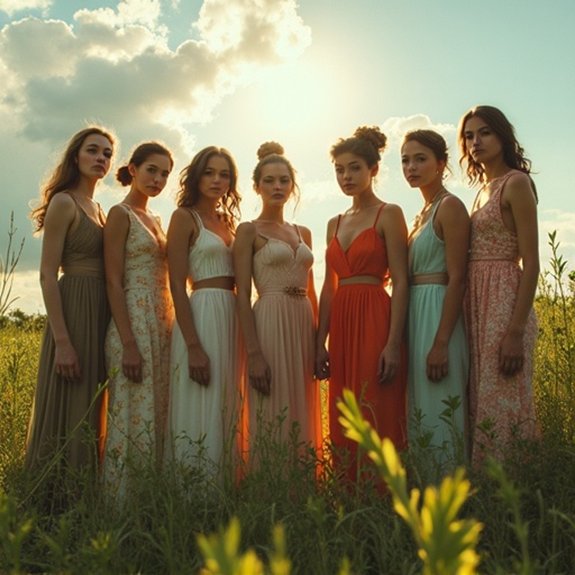
Innovation drives humanity forward, shaping how people live, work, and connect with one another in the twenty-first century. Just as ancient Greeks looked to the nine Muses for creative inspiration, today’s world finds its spark in diverse sources that transcend traditional boundaries. Modern muses don’t sit on Mount Olympus; they emerge from technology labs, artist studios, scientific breakthroughs, and social movements that challenge conventional thinking.
These contemporary forces of inspiration manifest through digital platforms, environmental activism, space exploration, and cultural fusion. They’ve transformed how creators approach their craft, entrepreneurs build businesses, and communities solve problems. Each modern muse represents a unique pathway to innovation, whether through artificial intelligence’s computational power, nature’s biomimicry lessons, or humanity’s collective wisdom shared across global networks. Understanding these nine modern inspirations reveals how creativity evolves in an interconnected world.
Ancient Greek Genealogical Texts
While modern society draws inspiration from technology and social movements, ancient Greek genealogical texts reveal how the original Muses shaped creative expression through divine lineage and mythological authority. Hesiod’s Theogony establishes the nine Muses as daughters of Zeus and Mnemosyne, positioning them within the Olympic hierarchy. This text doesn’t merely list names; it assigns each Muse specific creative domains—Calliope governs epic poetry, Clio oversees history, and Terpsichore rules dance.
Homer’s invocations demonstrate their practical influence on ancient artists who’d call upon specific Muses before performances. The Orphic Hymns further codified their genealogical connections, linking them to Apollo’s artistic patronage. These texts weren’t academic exercises but functional guides that structured how Greeks understood creativity’s divine origins and organized their cultural productions accordingly.
Notable Cases or Sightings
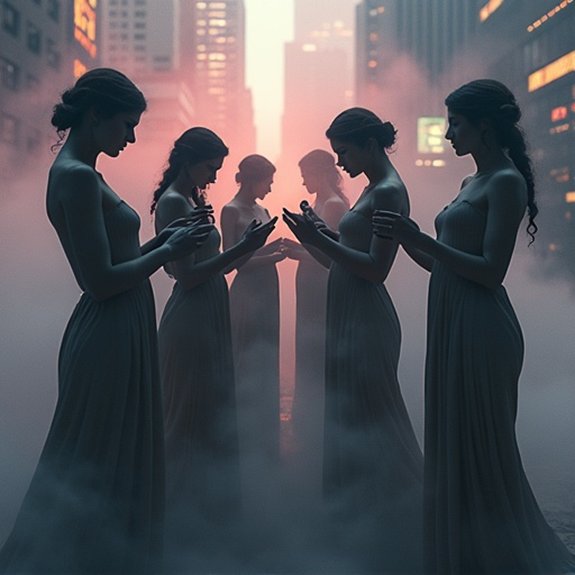
How do contemporary artists describe their encounters with the Muses in practical terms? Musicians often report sudden melodic fragments arriving during mundane activities—Paul McCartney famously heard “Yesterday” in a dream. Visual artists describe moments when compositions suddenly “click” after weeks of struggle. Writer Elizabeth Gilbert speaks of ideas as conscious entities seeking the right collaborator, while poet Ruth Stone described poems rushing toward her across fields like thunderstorms.
These experiences aren’t limited to professionals. Amateur creators report similar phenomena: solutions appearing during walks, melodies emerging in showers, or plot twists revealing themselves at 3 AM. Neuroscientists link these “eureka moments” to the brain’s default mode network, which activates during rest. Whether divine intervention or neural processes, artists consistently describe inspiration as something that arrives rather than something they manufacture.
Common Theories or Explanations
Although ancient Greeks attributed inspiration to divine Muses, modern psychology offers several competing explanations for creative breakthroughs. The unconscious processing theory suggests the brain continues working on problems during rest, producing “eureka” moments when solutions suddenly emerge. Neuroscientists point to the default mode network, which activates during relaxation and connects disparate brain regions, fostering novel associations.
The flow state theory describes peak creativity occurring when skill level perfectly matches task difficulty, creating deep focus and effortless productivity. Some researchers emphasize environmental triggers—certain locations, times, or rituals that prime the creative mindset. Others argue inspiration’s simply pattern recognition: the brain detecting connections between stored memories and current stimuli. While these theories don’t invoke divine intervention, they’ve yet to fully explain why inspiration strikes unpredictably.
Frequently Asked Questions
How Can Artists Invoke or Connect With a Specific Muse Today?
Artists can’t literally summon ancient muses, but they’ll connect through studying their domains—reading poetry for Calliope, watching dance for Terpsichore. They’re creating rituals, visiting museums, meditating on specific arts, and embracing each muse’s creative energy.
What Modern Artistic Disciplines Would Each Muse Oversee if Updated?
Calliope’d oversee blogging and podcasting, Clio’d manage documentaries, Euterpe’d guide electronic music, Thalia’d inspire comedy streaming, Melpomene’d influence true crime, Terpsichore’d lead viral dance, Erato’d spark dating apps, Polyhymnia’d oversee meditation apps, and Urania’d guide space exploration media.
Are There Contemporary Artworks Directly Inspired by the Nine Muses?
Yes, artists’ve created numerous contemporary works inspired by the nine muses. Cy Twombly painted “Nine Discourses on Commodus,” Rachel Whiteread sculpted muse-themed pieces, and choreographer Twyla Tharp created “Nine Sinatra Songs” referencing classical inspiration.
Do Other Cultures Have Similar Divine Inspiration Figures?
Yes, many cultures have divine inspiration figures. Hindu tradition features Saraswati, goddess of knowledge and arts. Norse mythology includes Bragi for poetry. Chinese culture reveres the Eight Immortals who inspire various artistic and scholarly pursuits.
Which Muse-Inspired Symbols Appear in Modern Logos or Branding?
The lyre appears in music company logos, theater masks represent drama organizations, and Pegasus symbolizes creative enterprises. Publishing houses often incorporate quills or scrolls, while dance companies use flowing figures that echo Terpsichore’s graceful movements.



About The Author
