The Nine Worlds of Norse Myth
The ancient Norse cosmos isn’t what most people imagine. Nine distinct worlds spiral around Yggdrasil’s massive trunk, each domain teeming with beings that shaped Viking culture for centuries. Modern scholars still debate the exact nature of these worlds, as medieval manuscripts offer conflicting descriptions. What they’ve uncovered challenges everything previously assumed about Norse cosmology—and the truth behind these domains proves far stranger than the myths themselves suggest.
Introduction
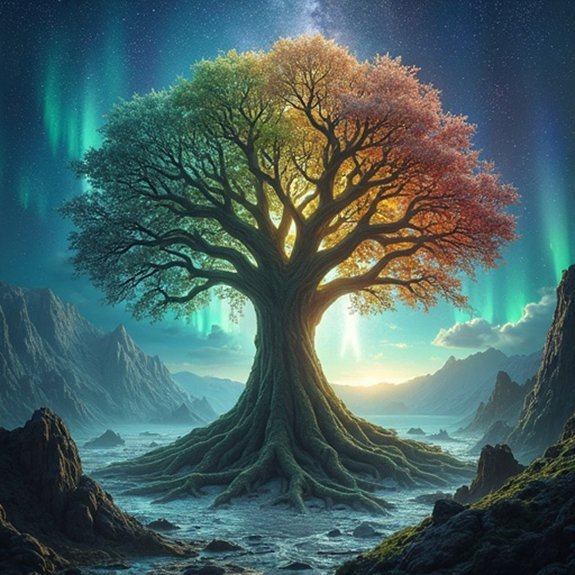
While modern audiences might recognize Asgard and Midgard from popular culture, Norse mythology actually describes a complex universe of nine interconnected worlds. These domains exist within a cosmological framework centered around Yggdrasil, the immense ash tree that serves as the universe’s axis. Each world houses distinct beings—gods, humans, giants, elves, and the dead—maintaining the cosmic balance through their interactions and conflicts.
The nine worlds aren’t merely separate locations but form an intricate system where events in one domain affect others. Ancient Norse peoples used this multiverse concept to explain natural phenomena, human fate, and divine intervention. Understanding these worlds reveals how Vikings perceived reality’s structure, from creation through Ragnarök, the prophesied end times when most worlds face destruction and subsequent rebirth.
Eddic Sources and Manuscripts
Although the nine worlds appear throughout Norse literature, scholars primarily reconstruct this cosmology from two medieval Icelandic manuscripts: the Prose Edda and the Poetic Edda. The Prose Edda, written by Snorri Sturluson around 1220 CE, systematically describes Norse mythology for aspiring poets. Snorri’s work preserves vital details about Yggdrasil and the worlds it connects, though he doesn’t explicitly list all nine domains.
The Poetic Edda, compiled in the 13th century from older oral traditions, contains mythological poems that reference various worlds. The poem Völuspá mentions “nine worlds” directly, while Vafþrúðnismál and Grímnismál describe specific domains and their inhabitants. These texts survived in manuscripts like the Codex Regius, discovered in 1643. Together, these sources provide fragmentary but essential evidence for understanding how medieval Icelanders conceptualized the Norse cosmos.
Notable Cases or Sightings
Since Norse mythology‘s nine worlds exist within religious and mythological frameworks rather than physical reality, there aren’t documented “sightings” in the conventional sense. However, medieval Icelandic sagas contain accounts where characters claim encounters with these domains through dreams, visions, or supernatural experiences. The saga of Erik the Red describes Thorstein’s deathbed vision of Valhalla’s gleaming halls. In Gísla saga, the protagonist reportedly glimpses two afterlife destinations in prophetic dreams.
Archaeological discoveries’ve sparked modern interpretations linking physical locations to mythological worlds. Uppsala’s temple site in Sweden’s been associated with connections to Asgard, while Iceland’s volcanic landscapes’ve inspired comparisons to Muspelheim. Contemporary practitioners of Norse paganism report spiritual experiences they interpret as contact with these domains through meditation and ritual work, though these remain matters of personal belief rather than empirical observation.
Common Theories or Explanations
When scholars examine the nine worlds of Norse mythology, they’ve developed several frameworks to explain their structure and significance. The most accepted theory places Yggdrasil, the world tree, as the cosmic axis connecting all domains. Midgard sits at the center, with Asgard above and Helheim below, creating a vertical cosmology that reflects ancient Germanic social hierarchies.
Some researchers interpret the nine worlds as psychological states rather than physical locations. They argue Niflheim represents primal chaos while Muspelheim embodies creative destruction. This approach views Norse cosmology as a map of human consciousness.
Another theory suggests the worlds mirror seasonal cycles and natural phenomena observable in Scandinavia. Jotunheim’s giants personify winter’s harsh forces, while Alfheim’s elves represent summer’s fertility and light.
Frequently Asked Questions
How Do I Travel Between the Nine Worlds in Modern Norse Pagan Practice?
Modern Norse pagans travel between the Nine Worlds through meditation, shamanic journeying, and visualization techniques. They’ll often use drumming, chanting, or guided pathwork to achieve trance states that facilitate spiritual travel along Yggdrasil’s branches.
Which Norse Gods Rule Over Each of the Nine Worlds?
Norse mythology doesn’t assign single rulers to each world. Odin governs Asgard, Hel rules Helheim, and Surtr dominates Muspelheim. The Vanir control Vanaheim, while Midgard, Alfheim, Svartalfheim, Jotunheim, and Niflheim don’t have specific divine rulers.
What Creatures or Beings Inhabit Each of the Nine Worlds?
Each world’s inhabited by distinct beings: Asgard houses gods, Vanaheim holds Vanir deities, Alfheim contains light elves, Midgard supports humans, Jotunheim shelters giants, Svartalfheim harbors dwarves, Helheim keeps the dead, Muspelheim breeds fire giants, Niflheim spawns primordial creatures.
How Are the Nine Worlds Connected by Yggdrasil the World Tree?
Yggdrasil’s massive roots and branches physically connect all nine worlds, with three main roots extending to different domains. Its trunk serves as a cosmic highway that gods, humans, and creatures traverse between the worlds.
What Happens to the Nine Worlds During Ragnarok?
During Ragnarök, fire consumes most of the Nine Worlds as Surtr’s flames engulf creation. The Bifrost bridge collapses, Midgard floods, and Yggdrasil shakes violently. After destruction, the worlds’re reborn with surviving gods rebuilding existence.
The Legend of the Grail: Spiritual or Real?

The Golden Apples in Myths
The Underworld Journeys in World Mythology
About The Author
